
The practice of architecture is nearly as old as human history itself. Admittedly, the first humans probably didn’t bother themselves with building complex houses with proper indoor plumbing. Still, at least they had nests, huts, or some other kind of dwellings to stay warm and protected from other carnivores. Humans then learned how to use and craft tools, which enabled them to build more complex structures like semi-sedentary dwellings and wooden houses later on.
Fast-forward a couple of thousand years, and they figured out that building a proper home required planning, and that’s when architectural drawings came into existence. It turned out the drawings were found to be useful, and that modern civilizations all around the world still use the same practice now. Of course, ancient architectural drawings from the bygone millennia were nothing in comparison to construction plans created in today’s digital age in terms of clarity or complexity. What started as relatively simple illustrations and hand-drawn blueprints has now become sophisticated data-rich visualizations generated on computers.
We now rely on CAD software to ensure precision, perfect geometry, and error-free structural engineering calculations. And more recently, the advent of 3D architectural visualization services has introduced a massive improvement in how we plan, perceive, and execute construction projects. Instead of seeing a project plan as a complex two-dimensional image, 3D hyper-realistic rendering allows you to visualize just about every single detail of the construction process (especially with BIM) and how the final building should look and feel, even before the actual construction happens.
RELATED: Architectural Illustrations vs. Architectural Visualization Services
Creating two-dimensional construction drafts is one thing, but transforming the plans into a realistic imagery of the structure is another matter. In fact, 3D architectural visualization has become a trade of its own. You need skilled professionals with the right tools to generate realistic imagery that accurately represents architectural designs. But renderings can be expensive.
One of the best places to look for those experts is the AEC-focused freelancing platform, Cad Crowd. Populated by hundreds if not thousands of experienced 3D render artists from every corner of the world, Cad Crowd is your one-stop shop to discover and connect with some of the most talented freelancers specializing in architectural renders, whether for residential, commercial, industrial, or civil projects – at affordable rates.
How accurate visualizations enrich the design process
Having realistic 3D architectural visualizations can improve the construction workflow and design process by leaps and bounds. Not just on the technical level, but the benefits touch on the communication process and collaboration, too.
All-around better clarity
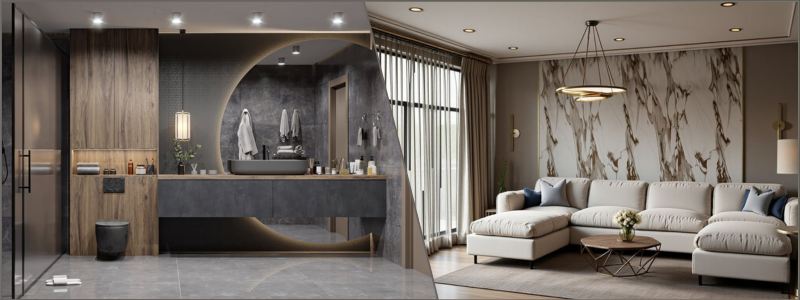
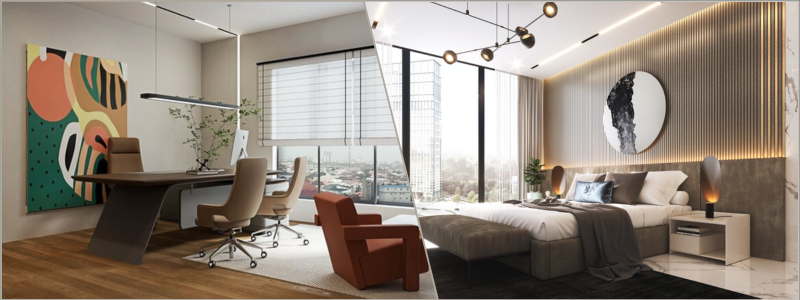
In principle, 3D renderings transform construction drafts and two-dimensional design illustrations into photorealistic imagery of the finished structure. All the lines and shapes you see in a conventional 2D drawing are no longer there, and instead, you get an image that looks as if somebody has captured a photograph of the structure when construction hasn’t started at all. To some extent, the client gets to see how the project should materialize early on in the design process. If the rendering also includes 3D interior visualization services, taking a look at the imagery can feel like having a quick walkthrough inside a building that still only exists as a design plan.
RELATED: Camera Angles in the 3D Architectural Visualization Realm for Your Projects
Conventional 2D architectural drawings are tricky to understand. The walls, doors, windows, appliances, and furniture pieces are outlined together on a two-dimensional plane visible only from a bird’s eye perspective. Unless you pay close attention to the symbols and annotations, it can be difficult to tell a table from a tub, because both are observed from a top-down view. There is no sense of height from the walls, and the drawing for the roof is probably on an entirely different sheet. In short, it takes some serious mental translation to have a good grasp of the design.
Architects, engineers, designers, and contractors are trained to build structures from 2D drawings, so they have no problem understanding all the details and visualizing the design at a glance. For the non-technical people, on the other hand, making a correct interpretation can be a monumental challenge. Photorealistic 3D architectural visualizations make such a cognitive barrier disappear in an instant. You can clearly see where the walls stand, the placement of furniture, the positions of doors and windows, and how every room is connected to the others. A 3D exterior rendering also clearly visualizes the roof, the facade, the wall paint, and even the landscape and the surrounding environment.
Architectural visualizations come in several different forms, including floor plans, aerial views, interior design, and more. Each of them provides an immersive view of design, allowing you to gain a clear understanding of the structure’s spatial relationships from a human-friendly, comfortable viewing angle. High-end visualizations even render the lighting, shadows, material textures, and surface patterns. Everything appears crisp, detailed, and yet completely natural to the point where you might think that you’re looking at a photograph. Advanced rendering software can simulate the position of the sun and artificial light sources along with light intensity and direction adjustment for contextual accuracy as well.
RELATED: Techniques for 3D Architectural Visualizations and Tips for Your Services Firm
Rapid design iterations
Render firms use 3D models (as opposed to photographs of physical artifacts) as objects in the final render. This allows architects and designers to experiment with practically limitless combinations. The configuration and specification of load-bearing components might not be as flexible, but everything else can be modified without altering the structural integrity. Suppose the design of a house features a sizable living room with a large glass window on the east-facing wall; because the homeowner isn’t fond of the idea of a single massive glass panel for sunlight, the architect decides to use two smaller windows instead.
Making this kind of change in a digital environment is easy (in the hands of professionals, of course), quick, and definitely inexpensive. 3D rendering for architectural projects cannot happen without 3D architectural modeling services first. In the best-case scenario, the rendering process happens only when the 3D models of the design have been finalized and approved by the clients. Unfortunately, this isn’t always the case because without the photorealistic render, there’s no hint at how the lighting works or if the furniture pieces blend well with the overall color accents. But even with the back-and-forth of reviews and revisions, making changes to the rendering is still much cheaper and quicker than altering an already constructed design.
This kind of rapid design iteration puts 3D visualization way ahead of traditional 2D drawings. Clarity has everything to do with this advantage. When clients can see and understand how the proposed design will materialize in the end, they feel eager to provide feedback and propose modifications if necessary. The architectural designer can also provide multiple design options to begin with, allowing the client to explore variations in interior layout, facade treatments, material options, rooflines, and more. But then again, everything can be modified to cater to every client’s specific requirements on a computer screen for design process efficiency.
RELATED: Architectural Visualization Services: A Complete Comprehensive Guide to Mood and Atmosphere
Keep in mind that expensive redesign and rework can happen because the client only understands the design concept after the structure, or at least parts of it, have been constructed. When things don’t look exactly like what the client imagines in the first place, modifications are likely expensive. Photorealistic rendering moves this hassle (if any) to the design process, where corrections remain within the confines of digital space and are cheap.
Engineering and design coordination
There might be multiple instances of disagreement between the engineers and designers in the project. However, this is exactly what you should expect in a carefully put-together team of professionals, where all the members perform their roles to the best of their ability. For example, a designer may propose an intricate room layout for the interior or complex geometry for the roof and facade. While all of those ideas are far from impossible, they might be an engineering nightmare due to resource limitations. 3D rendering isn’t all about aesthetics, but it’s also a tool for objective technical review where an interdisciplinary team can coordinate and make educated design decisions.
Let’s say the windows in the living room are supposed to be made of stained-glass because the client requires a unique lighting effect when the morning sunlight shines through. There are many different types of stained-glass (opalescent, streaky, flashed, iridescent, etc.), and the client gives the freedom to the architecture designer to determine what’s best. Instead of physically testing every type of glass, it is much easier and cheaper to simulate the lighting effect using the PBR (physically based rendering) feature in the software. The architect can then show the client how each type produces its own lighting effects in the room in broad daylight.
Simulation isn’t limited to lighting effects only. Engineering software with an FEA (Finite Element Analysis) tool can simulate how materials behave under real-world conditions, including mechanical and environmental stresses. FEA isn’t actually a rendering tool, but a construction project can take advantage of the analysis to accurately predict how the physical characteristics of specific materials change over time. It can tell you whether the structural strength will degrade or remain intact after long-term exposure to real-world conditions.
RELATED: Top 6 Architectural Visualization and 3D Rendering Trends for Your Company to Follow
Furthermore, the combination of 3D rendering and BIM (building information modeling) facilitates early clash detection in construction design. BIM is essentially an accurate visualization loaded with detailed specifications of every element that forms the structure, including mechanical, electrical, and plumbing. The software can handle even the most complex structures and the interactions among the various systems in the building. Clashes may include improper placement of structural elements, the lack of geometric tolerance, construction scheduling conflicts, and more.
Permit approval
In most, if not all, countries around the world, the process of acquiring construction and building permits still requires the use of conventional 2D architectural drawing services. That being said, it doesn’t mean that 3D visualizations have no place in the procedure. Quite the contrary, photorealistic rendering can be a significant factor in the approval decision. Most large-scale projects require approval from local authorities like the planning commission, the city council, or community boards. Each of those bodies needs to scrutinize certain aspects of the architectural drawings to determine if they warrant a permit. Much of the approval process relies on the information provided by the 2D drafts, but 3D renderings might serve as invaluable additions.
One of the best things about photorealism is the lack of ambiguity in the image it represents. It tells the reviewing parties how the new structure will look after completion, where the external lights illuminate the property boundaries at night, and if the new building integrates well (doesn’t break any zoning law, for example) with the existing neighborhood. Imagine a scenario where a brand-new house is being built in a city or area that imposes strict requirements focused on eco-friendliness and sustainability. It’s either a green building or none at all. Photorealistic visualization designers have what it takes to showcase important features like natural ventilation, solar panels, and rainwater harvesting systems.
Not only does the visualization highlight the “green” features, but it also illustrates how everything works with pleasing visuals. For example, the ventilation design displays arrows and other symbols to show the direction of airflow in and out of the building, the drainage diagram shows where wastewater goes, and the solar panels include a diagram specifying their average efficiency year-round. Regulatory approval isn’t exactly an integral part of the design process, unless disapproval calls for design modification, in which case the building must be redesigned, remodeled, and re-rendered.
RELATED: Turning Concepts Into Stunning 3D Renderings with Architectural Visualization at Your Services Firm
Digital fabrication
As mentioned earlier, 3D modeling is the underlying process that makes photorealistic rendering possible. In fact, you can say that 3D modeling designers provide the most important building block of modern construction planning because it also opens the door for parametric and generative designs. Visual design tools such as Dynamo and Grasshopper enable architects to explore and experiment with complex geometries and see the results through rendering. The method is usually intended for the design and construction of customized elements.
Both the visual programming and rendering tools allow verification that the addition of any unique element or design will not affect the structural integrity of the building. No matter how you put it, there’s no way you can do this with conventional 2D drafting, unless you’re willing to risk an expensive rework. 3D architectural modeling services are also useful for the off-site manufacturing of prefabricated components. Although most fabricators still use traditional shop drawings as standard documentation, rendering helps visualize how the final product should look and perform.
Things like custom millwork, sheet metal, and curtain wall systems are likely fabricated off-site. And the fabricators rely on shop drawings to build the elements as specified. Even if the realistic renderings have little technical information, they can at least provide visual hints to the aesthetic details of the finished products. Many large-scale projects use BIM software not only to render structural elements but also to digitally capture and preserve material technical specifications, such as reinforcement bar detailing.
RELATED: 13 Mistakes When Employing 3D Architectural Visualization Specialists for Companies
Takeaway
3D rendering isn’t just a trend in the architectural sector. Given the benefits of accurate visualization for the architectural design process, it appears the AEC industry at large is ready to adopt the technology as the next big change from conventional 2D-based construction drafts. A large chunk of the industry still cannot make the transformation right away; 2D construction drafts, including as-built and shop drawings, remain the standard used for construction permit applications, component prefabrication, and archiving, among others. But the future is bright for 3D visualization companies, partly thanks to the rapid development of computer technologies as well as the growing number of professionals specializing in the field.
Architects, engineers, and designers can also benefit from the faster iteration cycles and clear communication with clients. Accurate visualization improves the chances of the final structure being more closely aligned with the initial design plans, while reducing the risk of construction mistakes along the way. Cost-efficiency is also a big part of the equation here. Architects have the freedom to experiment with the design in a digital environment, meaning there’s no need for a physical model at all.
In architectural projects, especially the complex and expensive ones, there might be a big time gap between ideation and execution. From the moment the initial design idea comes up, it can take quite a while before the actual construction begins. It is within that gap that the design is scrutinized for possible flaws and errors, analyzed for cost estimation and completion timeline, and reviewed for approval by the project owners. Also taking place during the gap is a series of feedback loops to bring about design improvements.
RELATED: From Concept to Client: The Power of Architectural Visualization Software for 3D Services
Proper integration of 3D architectural visualizations by expert 3D visualization designers both simplifies and accelerates progress significantly, without sacrificing accuracy. Realistic visualization ensures that clients and architects are on the same page throughout the design process. There’s practically no more language barrier; the client isn’t bewildered by the complexities of conventional 2D drafts, and the architects can explain every design decision without resorting to jargon. That being said, you don’t want the 3D renderings to be nothing but pretty pictures to impress clients.
How Cad Crowd can help
Renderings must serve a practical purpose of illustrating a structural design as accurately as possible. It has to be an effective tool that allows everyone involved in the project to accelerate the design process and make informed decisions. Precision is of the utmost importance, and Cad Crowd is loaded with just the right professionals to help you achieve that very objective. Get a free quote today!