

Golf course design has traditionally been a highly calculated process involving a lot of planning, aesthetic vision, and a deep understanding of the game itself, but innovation in technology has started using 3D modeling and rendering into the fray as a revolutionary tool to produce detailed, high-fidelity visualizations of golf courses before a single blade of grass is ever planted.
Freelancers and design service companies are now using advanced tools to develop golf course models. Among the advantages of these models is the ability to bring ideas to life for designers, developers, and investors, offering quite a wide range of benefits.
Cad Crowd is the leading agency that can help you connect with 3D modeling and 3D rendering experts, providing services to your firm. Consisting of over 94,000 freelancers, we pride ourselves on our ability to give reasonable service rates while still exceeding your highest standards. Whether you’re looking for innovative solutions, new concept design, strategic insights, or top-tier execution, CAD Crowd has the expertise and the talent to bring your vision to life.
In today’s article, we will discuss the top eight benefits of 3D golf course modeling and rendering, and how freelance 3D rendering services and specialized design companies are revolutionizing the view on the visualization, design, and construction of golf courses.
🚀 Table of contents
RELATED: 10 awesome vehicle designs from the Cad Crowd gallery
Understanding 3D golf course modeling and rendering
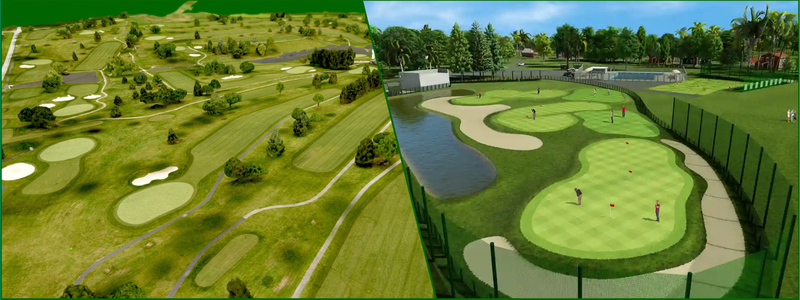
3D golf course modeling and rendering is a particular type of computer-aided design process that can be achieved through 3D landscape rendering services, which produce ultra-high resolution, photorealistic images of golf courses. It allows designers, developers, and facility managers to visualize the details of the layout, terrain, and environmental features of the golf course during pre-planning or before any renovation work.
From 3D modeling, every part of the course is well thought out by the designers, including the fairways, bunkers, water hazards, and surrounding landscapes. Then, the rendering process incorporates realistic textures, lighting, and perspectives to mimic how the course would appear and represent the actual environment. This allows stakeholders to make rational decisions regarding design changes, landscaping, and even marketing presentations.
The union of 3D modeling and rendering boosts the mutual understanding of architects with clients on possible views concerning the course of action and elevates the process in planning and development to ensure that all the minutest details coalesce into the overall vision. Take a look at the benefits that 3D golf course modeling and rendering have to offer:

RELATED: How engineering & 3D design contests give companies a competitive edge
Enhanced visualization and design accuracy
Probably the most significant advantage of 3D golf course modeling is its ability to deliver precise, realistic visuals through detailed renderings from 3D architectural visualization services. Two-dimensional blueprints cannot communicate depth, slope, and scale as effectively as 3D renderings. A freelance designer with expertise in CAD modeling and architectural visualization can produce photorealistic representations of how the course will appear, accurately showcasing every contour, hazard, and green.
Once accurate topographic information is in place, 3D models look just like the real terrain in every detail. As such, designers and clients should be able to walk through the virtual course and feel the elevation changes in their design. This will enable them to determine the flow of holes into one another. It is that level of immersion that results in a visual look that is absolutely stunning and will play as they want.
The challenge of redesigning a golf course arises simply because one has to iterate on the basis of architects’, developers’, or even prospective investors’ feedback. It can be pretty long and costly to correct the physical model or 2D drawings.
3D modeling is more flexible
Particular components of the course may be easily altered by freelance CAD designers and companies specializing in 3D CAD design services. Changes in the fairway layout or adjustments to bunker depth can be quickly tweaked without an overhaul. With 3D CAD models, revisions are efficient and cost-effective, enabling several design iterations before finalizing the ideal version.
Natural integration
A golf course is not a set of holes but rather an experience in nature. The 3D modeling and rendering can be applied to integrate the course into the environment, thus ensuring it blends with nature. This integration will ensure sustainability while making the course visually more appealing to the people.
Using very high-resolution environmental data, land survey drawing experts can simulate how a golf course will interface seamlessly with natural elements, such as forests, rivers, or hills. Leveraging these specialized services allows for detailed environmental analysis, predicting how design choices affect ecosystems and surroundings. This culminates in an effortless merging of the artificial with the natural—each hole is not merely a design feature but an integrated part of the broader environment. In this sense, 3D modeling and environmental engineering help designers create sustainable golf courses that minimize ecological disruption while enhancing the golfer’s experience.
Improved stakeholder communication
In the process of developing golf courses, most of the time, several investors, architects, developers, and the local government are involved. In this case, communicating sophisticated design ideas using traditional media forms such as 2D plans or technical documents often risks that the concept will not be achieved or will fail to communicate adequately. 3D modeling and rendering offer a much clearer and more compelling means of communicating design intent.
A 3D model gives freelance designers the opportunity to share a real-to-life and immersive representation of the course with the stakeholders. This will make it easier to conceptualize the design and even give feedback. It will certainly ensure everyone is on the same page, thereby making delays minimal and timelines toward project approvals lighter. Be it pitching to investors or having your permits from your local authorities, it may be that only a well-crafted 3D render utilizing 3D rendering services will seal the deal.
Pre-construction marketing and investor confidence
RELATED: Featured freelance CAD designer portfolio on Cad Crowd
Often, developers will seek to secure investors, or simply future members of the golf course, to fund the project before it is even commenced. A 3D rendering could be very valuable in marketing efforts for building such a project. Detailed 3D models will let potential investors see accurately what the finished course will look like, including realistic textures, lighting, and environmental features. This will help build confidence in the project by giving a very tangible vision of the end product.
Freelance design companies develop high-quality visualizations and virtual tours that developers can present to potential investors or to promote their golf course projects. The ability to show a course before setting foot will attract investors and excite prospective members, hence increasing the chances of raising funds for the venture.
Customization and personalization of golf course
Each golf course is unique, and 3D modeling will allow for a great deal of personalization. Whether the developer desires to incorporate specific natural features or emphasizes a certain architectural style, 3D modeling will allow for detailing all aspects of the course design to fit the client’s vision. Lastly, freelance CAD designers are also adept at designing some weird custom elements within a 3D environment. A signature hole with a panoramic water hazard or a dramatic elevation shift can also be done quickly. This level of personalization helps developers in designing unique courses in a very competitive golf course design market. This level of detailing is often provided by CAD design experts.
Proper planning and construction feasibility
Golf course design requires one crucial factor, which is that the course must be aesthetic yet feasible to construct. 3D modeling can pick up some of the issues that may come up with the actual design process, such as problems with drainage, grading complexities, or infringement of existing land features.
Using 3D models, freelance designers and special design companies study the topography and design the course in minute detail. For example, 3D models can model water flow across the course during the rainy season; thus, the designers have proper designs for rainfall drainage systems. Thus, by being proactive about such issues, developers can avoid expensive delays during the construction period. This proactive approach often involves hiring freelance design services.
RELATED: 3D modeling software or CAD programs: What should my designer use?
Virtual reality andinteractive experiences
One of the most exciting advancements in 3D golf course modeling is incorporating it into virtual reality (VR) technology. Freelance designers are becoming more and more leery of putting such VR experiences in design presentations to allow clients and other stakeholders to walk “the course” before it actually exists. Using a headset, users can actually walk through or even “golf” the course in real time, feeling every detail of the design from a player’s perspective.
With this interactive experience, stakeholders can move beyond the static 3D model of the course. Not only will they have an immersive first-person view of the course under development but also see at a level of interactivity that supports the overall presentation and, in some way, offers some critical insights into the details of how the course will be played, giving them scope to adjust as players, developers, and course architects respond. This level of interactive presentation is often a service offered by freelance 3D modeling.
With golf courses, freelance services illustrate this to a great extent, comprising enhanced visualization and integration with the environment while offering cheap design revisions as well as interactive VR scenarios. Freelance designers and specialized design firms offer exactly the necessary experience in producing individual designs with beautiful layouts that can meet the highest standards in the appearance and functionality of each golf course.
RELATED: How does product prototyping with 3D modeling help grow sales and save R&D money?
How Cad Crowd can help
Whether it’s a wannabe developer looking to pitch to interested investors or a golf course architect working hard to be perfect in his design, just like Tiger Woods is in his game, 3D modeling is starting to revolutionize the face of golf course design once and for all. Combine it with talented freelancers or specialized firms to bring your vision to life, creating courses that are as gorgeous to behold as they are beautiful in play.
3D golf course modeling and rendering offer numerous benefits, especially when entrusted to and carried out by reliable freelance services and design companies. Here at Cad Crowd, we will make sure that you get in touch with top talents who can come up with mind-blowing golf course designs. Get a free quote today.



