

An architectural visualization, more specifically, a rendering based on a BIM file, isn’t just a pretty picture to please the eyes. In the context of a large-scale industrial project, such as the construction of a brand-new production facility or a major renovation of an old factory, a visualization is supposed to be an accurate depiction of the structure and a precise representation of all the manufacturing and utility systems in the building. The visualization also serves as the foundation for crucial decisions, such as stakeholder approvals and budget allocations.
3D rendering services and data-rich BIM files walk hand-in-hand to give a better understanding of the factory layout along with all its equipment and machinery, offering a level of insight that no conventional 2D blueprint can deliver. The ability to get a clear grasp of the spatial relationship of the entire building and an automated clash detection prior to construction improves the chances of efficient design, including for future-proofing purposes.
🚀 Table of contents
Why production facility visualization matters
High-fidelity visualization requires familiarity with the works of architectural design and a strong knack for artistic touches. Similarly, a comprehensive BIM file needs 3D modeling proficiency and industry knowledge. All those might seem hard to come by in this day and age, but not in Cad Crowd. As a freelancing platform specializing in the AEC industry, Cad Crowd acts like a massive hub that connects clients of all backgrounds with the most capable industrial project visualization services. And when the rendering and BIM file are left in the hands of the platform’s best-qualified professionals, expect nothing less than the following 10 advantages.
Early detection of errors
Let’s start with the most obvious, an advantage that photorealistic rendering services can give to architectural projects of any kind: pre-construction error detection. Construction work, whether a brand-new building or a renovation, is often an expensive undertaking, and even more so if you’re talking about such a complex structure as a factory. A manufacturing facility isn’t supposed to be luxurious or fancy, but designed to be as efficient as possible and conducive to productivity. And the truth of the matter is that ensuring efficiency often requires a pretty substantial upfront investment. Every mistake, no matter how small it may seem, can swell the budget to an unfriendly extent.
Factories are most likely dense environments. In addition to all the structural support steel, chances are you’ll also find heavy machinery, complex utility grids, overhead cranes, various office spaces, and sometimes a massive warehouse under the same roof. Everything has to coexist and fit in a relatively limited space. A traditional 2D blueprint can probably represent the entire factory, along with all the equipment and structural elements, on one big page. It’s practical, but the visualization format makes it easy to overlook a “clash,” for example, a load-bearing beam that obstructs a stretch of fire sprinkler pipe. Because you can’t clearly see the mistake on a two-dimensional blueprint, the error is only discovered during the construction phase. The next thing you know, the project is put on hold until you find a workable solution.
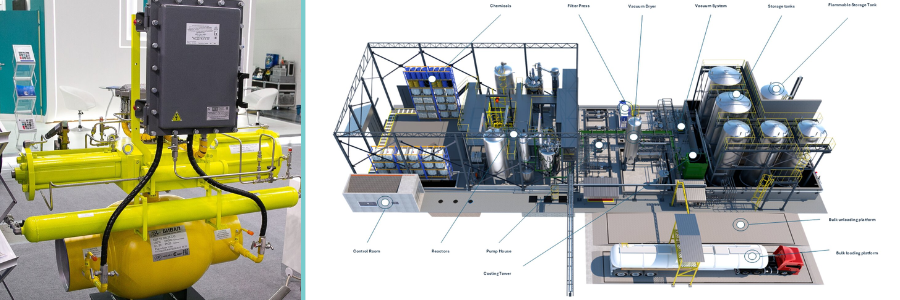
An architectural rendering, especially when integrated with BIM (Building Information Modeling), allows you to run an automated clash detection before construction begins. A clash can be many things, from a simple mismatch between logistics and construction schedules to poor clearances and object interference.
In a complete render, all the components of the factory are properly visualized as interconnected 3D objects to give a clear view of how they interact with each other. The result is little to no risk of a stop-work order. Any spatial conflict in the construction plan is identifiable in the BIM file when the project is still in the digital phase, and corrections are nowhere as resource-demanding as onsite modifications. Since most construction projects suffer from budget overrun due to change orders, architectural visualization services make things cost-efficient. Also, it’s possible to “virtually” install any equipment on the factory floor in the rendering, allowing you to verify that everything has enough clearance for operation and maintenance.
RELATED: 12 important hiring tips for 3D rendering freelancers & 3D modeling service companies
MEP integration
Still on the subject of clash detection, a high-quality factory rendering allows for a comprehensive planning of the facility as a whole rather than as separate systems combined into one. Other than that, you’ll see not only a flat image as if you’re looking at a floor plan, but the spatial relationships among all the objects. And this is particularly important in the case of MEP (Mechanical, Electrical, and Plumbing) systems.
A manufacturing facility is, in essence, one big machine housed in an extensive structure. And like every machine, they need a proper electrical system, water inlets and outlets configuration, chemical piping, specialized HVAC components installation, and compressed air circulation, among other things. Just about everything is substantially more complex than what you typically find in residential buildings. Designing all these systems in isolation increases the likelihood of clashes. You don’t want to find that the ventilation duct is planned to be installed exactly at the same coordinate as a crane rail or structural steel support, leading to an untimely delay that costs thousands of dollars. The problem is that you can’t just move the parts to another spot because it may cause another series of clashes. Chances are, you have to dismantle a lot of interconnected parts and redo the process.
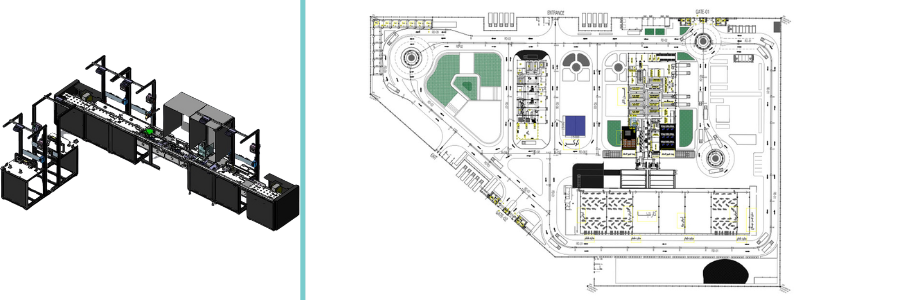
One of the best ways to ensure construction efficiency is zero conflict. Once again, architectural BIM services emerge as a reliable savior, providing a sort of “X-ray” view of the factory plan. BIM may not produce a photography-like visualization, but it can give you a clear outline of the building’s internal systems, which in turn allows for an overview of how the ducts, wiring, and piping integrate with the facility itself.
Stakeholders’ investment approval
Constructing a factory is an industrial project, and that’s capital-intensive. It may take tens, if not hundreds of millions of dollars, to build a new manufacturing facility capable of high-volume mass production. Like the vast majority of big industrial projects, it takes funding and approval by multiple stakeholders, which may include individual venture capitalists, the company’s boards of directors, or perhaps government agencies.
One of the biggest challenges in securing the approvals of investors isn’t the technicalities of the construction itself, but the presentation. Not every stakeholder is trained to read a blueprint in the same way that an architect or engineer is. As a matter of fact, most people struggle to visualize a fairly simple 2D floor plan, let alone the construction plan of a gargantuan factory from a flat drawing.
You probably won’t need a sophisticated BIM file for this, as a photorealistic rendering would suffice to communicate a design for the less-technical audience. Throw in an animated walkthrough for the immersion effect, and you have a complete package of high-quality visualization to transform an otherwise complex architectural plan into an easily understandable view of a design. Add complex details when necessary, such as a showcase of the warehouse workflow or production line, for an extra touch of realism.
Investors are more likely to approve a big project when they’re confident in the design. Photorealistic rendering affords them the opportunity to take a glance at the foreseeable future when the construction reaches its final stage, and the factory building finally stands with all its industrial prowess. Visual clarity reduces the sense of risk and, therefore, speeds up the approval cycle for manufacturing design companies.
Safety compliance simulation
A factory is designed for productivity and efficiency, without sacrificing the health and safety of all the people populating the facility. Health and safety aren’t just moral obligations, but mandatory (as in, they’re required by law) and often have everything to do with financial concerns because non-compliance is a big liability. The problem is that most safety-related equipment and designs are built based on various “what if” scenarios, such as in the cases of fire, potential workplace injuries, occupational burnout, machinery-induced noise pollution, and more.
Static two-dimensional images cannot reliably visualize the hypothetical scenarios in which accidents happen. Photorealistic rendering, on the other hand, can make use of animation to showcase “imagined” incidents where individuals’ health and safety are at risk in work environments. A 3D rendering expert may frame the animation in such a way that the audience can see from the perspective of an employee or a worker on the factory floor to understand the situation better. The simulation should be helpful for sightline analysis, emergency response training, and ergonomic optimization.
Efficient logistics
Forming the foundation of productivity in a manufacturing facility is a well-planned workflow, which can only happen when backed by efficient logistics. Think of it this way: if a forklift has to travel just one meter longer than necessary for every journey back and forth, the factory loses money in fuel, tires, maintenance, and time. A crane that takes a few seconds longer to carry raw material from the warehouse to the production line may cause a chain reaction of delay across the factory floor, leading to poor productivity and a loss of potential profit.
There’s no easy way to perceive the idea of congestion with static two-dimensional blueprints, such as when movements (whether of humans or machines) are hindered by some obstacles. Blueprints can’t visualize the possibility of crowding in heavy-traffic lanes during busy hours on the factory floor.
Animated rendering removes all the guesswork. By formatting the visualization as a spaghetti model (often used to explain the flow path of storms during hurricane season), you should be able to see with clarity how all the forklifts, cranes, trucks, materials, finished products, and people move about inside the facility. This is how you identify potential “traffic jams” or bottlenecks on the factory floor and plan for buffer spaces wherever necessary.
RELATED: Freelancing vs. in-house 3D visualization services: The best choice for companies
Accelerate construction
Just about every construction project appears to always happen in a rush. Heavy construction vehicles carry raw materials to the next processing station, while workers stay busy installing all the parts and assemblies in a seemingly random fashion. They’re all over the site, working on rebars with the help of rebar design services, steel structural supports, concrete, wooden beams, nuts and bolts, roofing components, and utility systems. But what looks like chaos really is a managed project, where everyone has a well-defined job description and carries out their duties as expected.
Another thing to mention is that long before the construction happens, there is usually a long process for design proposals, reviews, verifications, bidding, and approvals. The old way of doing architectural projects is linear and often slow. In the event of misunderstanding between the architect, engineer, or contractor, the construction schedule gets pushed back, and this adds to the project completion timeline. There’s also the problem with creating pages of 2D drafts just to plan for one specific location on the site. Each draft must be properly evaluated and approved by the stakeholders before the project can move forward. So if they have to do the same process dozens of times throughout the entire project, it can take months, if not years, to get the job done.
This is not to suggest that the old way is bad in any way. After all, people have been building production facilities for centuries before the proliferation of CAD or 3D rendering. That said, modern technologies, including photorealistic visualization and BIM, can improve efficiency a great deal. In the case of BIM, for example, the entire project plan is contained within a single file stored in a centralized database accessible by all stakeholders. Architects, engineers, and designers can update the plan simultaneously, and every modification is visible to everyone who has access to the file. Design reviews and approvals have become streamlined processes that happen in real-time.
A BIM file contains not only an imagery of a structure, but detailed specifications of the materials, dimensions, geometries, tolerances, installation instructions, and manufacturer information of every component. The contractors understand the assignments well, component fabricators know exactly what to build, and the investors enjoy the comfort of knowing where the money goes. It even has scheduling information with automated clash detection to avoid conflicts with the construction timeline. Thanks to BIM, the entire project becomes predictable, more manageable, and highly efficient to expedite construction. And the sooner you get the facility up and running, the quicker you get to kick off production.
Thermal and lighting analysis
Every manufacturing facility should be well-lit in all areas. Great visibility is even more important in the actual production line. But it shouldn’t be all about installing the brightest lamps every few meters throughout the factory because they also generate heat. LEDs produce much less heat than the conventional incandescent type, so they’re a preferable choice for manufacturing design experts. If you have to use hundreds of LEDs, however, the increase in temperature would still be pretty noticeable. Let’s not forget that machinery, whether internal combustion or electric, also generates heat.
A lot of manufacturing facilities suffer from either hot zones or dark spots (sometimes both) due to poor air circulation, inefficient positioning of skylights, or improper placement of heat-generating equipment. This might not have been an issue in the old days when no better option existed, but now that architects and engineers are armed with modern rendering engines, an uncomfortable work environment and poor machine longevity because of excessive heat should be problems of the past. Advanced rendering engines offer many useful features for this purpose, such as Radiosity (which is an application of Finite Element Analysis) and Ray Tracing, to predict with great accuracy how light behaves in an environment to minimize dark spots. ThermoAnalytics can also visualize thermal data in high-fidelity graphics to help you get rid of hot zones. l
It’s worth mentioning that both Ray Tracing and Radiosity are capable of simulating natural lights as well. The visualization showcases the areas inside the facility that might be penetrated by natural light during daytime, so the engineers can then use the data to reduce/optimize the use of LEDs for energy efficiency. At the same time, the data gathered from thermal analysis reveals a clear view of how heat rises and accumulates in different spots, which offers an insight into how the HVAC system may mitigate the issue.
Environmental impact study
Anybody who’s been in the construction business, especially on industrial projects, is perhaps perfectly aware of the whole “NIMBYism” movement. It’s actually a pretty common phenomenon where residents oppose a new development in their local area, mostly out of fear that the new industrial infrastructure and industrial design services will negatively affect the surrounding environment. Sometimes, they also express concern for the possibility of noise pollution, an increase in traffic jams, or a decrease in their property value.
It can be difficult to dismiss the opposition unless you can provide an easy-to-understand visualization to inform the protesters that none of those concerns are actually true. Photorealistic renderings, both static and animated, give a clear explanation about how the factory handles its byproduct (if any), treats wastewater, implements a government-approved energy efficiency system, and manages noise. An aerial rendering of the facility should showcase the presence of green buffer zones, too. An accurate depiction of the facility and how it affects the environment fosters trust from the nearby community and helps de-escalate tensions in times of protest.
People might not be entirely interested in the actual environmental study conducted on the facility and what the data can tell them. However, you can produce some renderings based on that data to try to convince the community that everything is safe and runs in accordance with the regulations.
RELATED: 5 reasons freelancing studios are the future of 3D visualization services
Brownfield project management
A good number of industrial constructions aren’t actually greenfield projects (facilities built from scratch), but brownfield (renovations, retrofitting, or expansions). When old buildings are supposed to integrate with modern equipment and utilities, many things can go wrong, from incompatibility issues that lead to performance inefficiency or even weakened structural strength. The existing pillars, low ceilings, waste treatment systems, old electrical wiring, and even the roof structure can be engineering nightmares.
Photorealistic 3D visualization services can help, for example, by converting the old blueprint into a 3D model or BIM file. However, an old building might have undergone multiple changes over the years, so the original construction documents are no longer accurate. Let’s not forget that many of the structural components suffer from degradation as well. Another option is LiDAR, which basically scans the old facility as it stands today and transforms the data into a 3D model. All of these require manual inspection, but modern visualizations are still better than relying on outdated blueprints.
Once you have the 3D models ready, planning for a brownfield project is no longer as complex as it used to be. Don’t get this wrong: Brownfield is almost always more difficult than greenfield, but at least the visualization helps you draft the project in a virtual environment, allowing for greater efficiency and accuracy. At the very least, the digital models afford the architects an opportunity to experiment with different factory floor layouts that facilitate efficient placements and installations of new production tools, heavy machinery, electrical wiring, lighting, HVAC components, and even routing for AGVs. The idea is to create a perfect fit, with zero interference, no compatibility issues, and enough spatial tolerances.
Scalable factory
Perhaps the greatest advantage of all is that photorealistic rendering opens the door to value engineering in preparation for growth. Manufacturing facilities may start with a single production line or hands-on assembly process, but they’re constantly looking to welcome emerging technologies, such as full automation and robotics. And with the current pace of development and competition, companies have no choice but to consider such growth an impending necessity, perhaps in the next 5 or 10 years.
From the perspective of infrastructure, it only makes sense to pour some additional resources upfront to make the building more scalable, or futureproof, if you please. In other words, a manufacturing facility built today must be able to adapt to the forthcoming industrial landscapes of the foreseeable future. If you build the factory by emphasizing only its usability for the current manufacturing systems and technologies, every major upgrade to the equipment and utility systems is likely cost-prohibitive.
Accurate visualization of the current structure enables the architectural design experts and engineers to plan for a flexible infrastructure designed to undergo changes and improvements without sacrificing the present-day functionality. For instance, the visualization may show a time-lapse animation that showcases how a new production line is added while keeping the current systems intact; the installation of solar panels on top of the roof structure without disrupting workflow; the integration of automated driverless robots with the crane equipment in the warehouse to achieve lean logistics, and so forth.
RELATED: How to hire freelance CAD design talent for your project: Tips for design companies and firms
Takeaway
The advantages of visualization services for manufacturing facilities go beyond pre-construction planning and budgeting, but reach far into scalability and futureproofing the infrastructure itself. You can even say that photorealistic rendering pushes the boundary of what’s possible with architectural drafting to allow stakeholders to have a sneak peek at the future. This will then enable them to develop a comprehensive measure and devise strategies to be prepared for every new technological development in the manufacturing sector. Although it’s actually impossible to make a perfectly accurate prediction of what the future may hold, visualization services can at least give you educated assumptions and informed estimates so that what you build today helps you gain competitive advantages in the future.
Not every factory rendering is created equal, however. As much as advanced software plays a factor in determining accuracy and overall quality, the professionals tinkering with object geometry, composition, lighting, shadows, textures, patterns, and post-processing details are the real defining factors. It takes skills, experience, and artistic touches to produce a high-quality rendering of a small-scale building, let alone a gigantic production facility.
That being said, BIM professionals and render artists capable of translating the file into photorealistic imagery remain scarce at this point. Cad Crowd is your best bet to find and connect with the right talent to get the job done. The platform places heavy emphasis on the AEC industry and is largely populated by experienced professionals of related trades, including BIM and architectural visualizations. Request a quote today.



