

Today we share how the future of 3D rendering services in architecture is influenced by mobile technology. It seems like it was just yesterday that architects were lugging around enormous spools of paper clutched under their arms, some sort of gallant medieval scriveners who had wandered into the wrong century. But these same architects today stroll into meetings with hardly anything at all but a smartphone, and this attitude of bemused confidence that all the sketches and illustrations they might possibly want access to are right there with them.
The future is here, and it apparently brought with it a convenient surprise: a plug. It should be a virtual certainty that mobile technologies have entered architectural visualization, given that they seem to have their hands in all but every area of life. What would be mind-blowing is realizing exactly how scale changes have been introduced in 3D architectural visualization. A task that would have taken an entire week on a serious workstation would now be done on something that weighs less than a sandwich.
RELATED: 5 Reasons Your Architectural Firm Should Use 3D Rendering Outsourcing
Computer tablets and smartphones: suddenly causing giants to shake
It wouldn’t have been very long ago that you raised an eyebrow at someone who suggested they wanted an architectural renderer on a phone. It would have been laughable. And yet we are caught up within a world that regards smartphone processors as if they were guys who pump iron at night while the rest of us are still asleep. Apart from these highly efficient chipsets, it should be noted that most capabilities offered in software and running on mid-range laptops would be processed on smartphones and tablets.
It would have been known that graphics processing units have emerged as highly efficient because it would have been heard that these portable devices are capable of real-time graphics processing. Its efficiency establishes a platform for the next generation, for which 3D visualization services will be carried out in line with its capabilities. Where architects can at last open an actual 3D file on a tablet and, with a flick of their fingers, turn it, and then concentrate on kitchen island designs and say, “And would you like marble or stone?”-all from sitting at a coffee shop.
A 3D file based on no heavy machinery and no towering computers on the desk, but on sleek plastic or aluminum and an excellent Wi-Fi signal. Despite appearances suggesting there will never be an end to the power a mobile device consumes, there will be an ever-decreasing gap compared with desktop rendering. Soon, aside from the desktop being slightly heavier, there will be no difference at all.
RELATED: How Emotional Design in Architecture Enhances Mood for 3D Modeling & Architectural Services Firms
Real time rendering on-the-go
Also, it was a scene that would have been a challenge even for large data centers at that period. Again, at present and on a tablet, ‘real-time shadows, reflections, and textures would be no more complex an operation than checking the weather. Architectural designers would be able to project their designs in AR, full-scale and almost life-size, with designs previously unimaginable. They would not have to stand there watching a static picture, then try to imagine what it would be like with the sun streaming into the lobby at noon.
Architects would be able to walk them through a virtual living room with actions intuitive to them. Collaboration on architectures implies a paradigm shift driven by mobility. It enables dynamic communications and fun. When your client asks, “Can we move that wall three feet to the left?” and you turn your building model with your hands and then with your finger, it becomes a magical scene.
Augmented reality and the pocket-size visualization era
There are very few technologies that have entered the world of architectural practice with as much flash as augmented reality. Whether you have ever thought about dropping an entire 3D structure onto the very land you are standing on, trust and believe it will be your BFF. The architect and customer might walk about with a phone open, some sort of window into the world that they absolutely need. Unveil some structure seamlessly integrated into the world. The whole thing might be contained within some grassy knoll. Interior designers might create interiors of business offices within these raw concrete boxes.
RELATED: The Power of Architectural CAD Services
Your tablet would be your gateway and promise of the world before anything begins. The convenience factor alone is literally out of this world. A user can create designs on the spot and achieve an exact look and feel in an actual space. Going back and forth to an office or finding an office within an office on a desktop would soon be but a distant memory.
The world of architecture would literally fit inside a screen. But AR is more than just a cool party trick-impossibly more- and perhaps the most useful tool working within the world of visual design to solve problems quicker, get ideas cheaper, and achieve an interest from a client that no traditional drawing ever could.

Cloud rendering: the unseen partner for success with smartphones
It cannot be a shortage of their capability, because all they need is a helping hand as they embark on a journey that has involved some heavy lifting, and that is what Cloud Rendering and its superhero cape are all about. It will be cloud rendering if heavy 3D processing work is done at a distant location on groups of processing centers. The device that goes into an architect’s toolkit isn’t exactly muscle but a portal. A low-end tablet will be able to display detailed images as soon as it connects to the cloud.
Through this, mobile phones will be capable of operating at very high speeds, just like an architect who would request rendering to the cloud and then have a chance to have a cup of coffee. By then, he would be able to see the result on his phone. By this, cloud rendering will finally allow architects to work on designs at any given time and from any location imaginable – on an airplane, on a train, in a waiting room with people all around, and on a balcony with a questionable railing – as soon as internet connectivity is available, architects can choose cloud.
RELATED: Top 37 Commercial Architectural Design and 3D Rendering Companies for Architectural Firms
And all these put together – mobile technologies with cloud rendering – enable a world without constraints based on location and device, and all these alternatives encourage architects to redesign and make designs that have never been conceptualized before.
Collaboration methods are more agile
Among the greatest pleasures of the current architectural work made possible by mobile technologies: no more uncomfortable scheduling. Those days are gone when one had to wait for everyone to return to their desks or workstations before collaborating. Collaboration on mobile applications is therefore immediate. Perhaps someone is working on textures as a rendering artist from the comfort of his couch. Perhaps someone is looking at models as a project manager on his daily commute.
Perhaps someone is pointing out changes waiting in a supermarket line as an architect, all while perhaps resisting the temptation to compare said supermarket produce layout with said poorly optimized hallway layout. It is here that they begin using collaboration tools, working with feedback, making several graphical changes, and watching things occur. It becomes so efficient that it picks up speed beyond surprise. The clients are more involved, thereby more confident.
RELATED: How Architectural Design Services are Creating Sustainable Architecture
Prioritize database integrity over faster data extraction
It would not be remarkable without mobile visualization that several clients walked into a consultation confused about plans and diagrams. It would not be easy for everyone to abstract the structure. It would be much easier with mobile visualization, and architectural drafting experts could intuitively lead them through the designs, with the possibility to fly into a room and even view alternative solutions. The participative method accompanying the above activity fosters a sense of empowerment among the clients. It impacts their trust in the design process.
Misconceptions among them start getting removed. It adds a degree of fun amid highly technical discussions. Perhaps the greatest compliment an architect receives from his clients is something like ‘I finally know what you mean!’ as they have tried to make them understand something, and it all makes sense in the client’s mind. Once he understands exactly what he is talking about, he becomes even more confident in making decisions that will carry the projects forward without any hurdles. Moreover, given that it speaks so eloquently to the freedom in design, there would also be an implication for extending that freedom.
Ironically, creativity will occur at random times around the week, maybe at dinner or while drifting off to sleep thinking about closing the gate. With mobile rendering, architectural drafting professionals not only have access but also an opportunity to put these ideas on paper at the source. It would be feasible to begin conceptualizing on a tablet and then, at a later stage, develop it on a render application with changes before running out of ideas. Use concepts involving shapes, colors, and arrangements that could be experimented with.
RELATED: Architectural Visualizations vs. Architectural Renderings: A Comparative Guide for Services
The world is gradually abandoning this notion of creative exploration and adopting fixed creative exploration. Many tools exist on mobile devices that help architects with exploration at any time and at any location whenever they get inspiration, and this helps the architect develop new ideas and designs and construct new buildings.
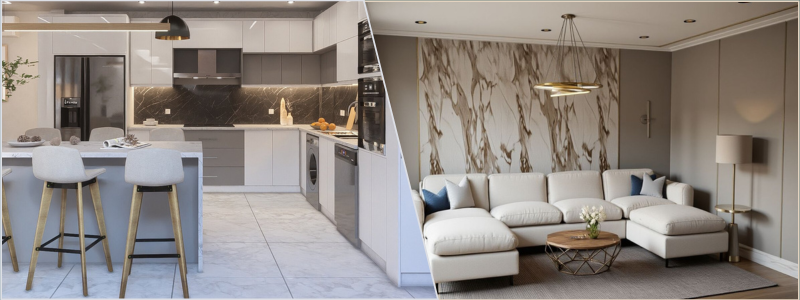
The future: working with an architect in one hand and a smartphone in the other
But it’s barely even begun with mobile communications and architectural rendering tools. The breakthroughs will come with rapid acceleration in computers, then with augmented reality, and finally with cloud computing. Cooperation will be made possible. And with one hand on the smartphone and with the other on the vision, architects will be on the threshold of a completely new era, one that will be much more rapid, more efficient, and will astound their clients with awe-inspiring graphics that literally would come to life before their very eyes.
RELATED: Best 50 Sites to Hire Freelance Architects and Architectural Designers for Remote Services Experts
How Cad Crowd can help
With companies like Cad Crowd, which hires freelance rendering professionals, every architect will be able to build a team of their own dedicated professionals who can actualize an idea. The subject matters pertaining to the future have been covered. It’s high time that ways and means were explored that might be applicable with regard tothe utilization of mobile communications in the purview of architectural designs.
And perhaps there might be some need with regard to someone who needs freelance 3D architectural rendering professionals who are highly proficient at what they do. It would be a very good practice for someone to check out Cad Crowd. Contact us for a free quote.
