
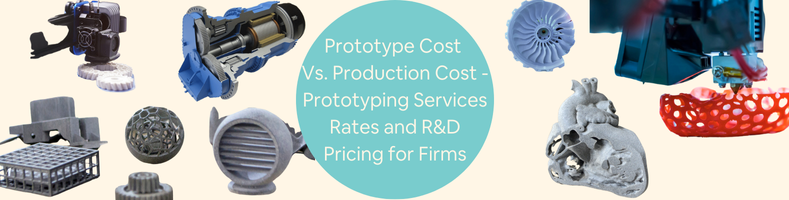
First things first, the cost of a prototype is never an indicator of the manufacturing of the same product, thanks to economies of scale. For example, if a single pencil costs you $1, it does not always mean that a box of 10 pencils is worth $10. In fact, you can probably get the entire box for only $5. There is nothing wrong with the pricing model because selling ten pencils at one transaction is much more remunerative to the manufacturer than selling one at a time. The same rule applies to prototyping and mass production.
Careful budgeting for prototyping is of the utmost importance because it inevitably affects the overall cost of product development. For certain products, such as complex electronic devices, the prototyping phase may take at least 50% of the total development budget. Avoid overspending by considering the quantity of prototypes and how the design team plans to use each of them. Also, remember that prototyping is often an iterative process, so you will probably need another run of small batch production later; be very cautious about spending too much on this process alone.
In many cases, a seemingly non-essential feature of a product (presumably an electronic type) can increase the development cost to a large extent. For example, the location of a small reset button on a hard-to-reach corner of a toy might require an extra thousand dollars of investment when purchasing injection molds or availing of injection molding and casting services for enclosure manufacturing. With platforms like Cad Crowd, you can connect with experts to help optimize your design and keep costs down. It is always best to reduce the design complexity as much as possible, especially if the budget is a concern.
🚀 Table of contents
- Prototype cost
- 3D printed prototype – $30 to $500 per unit of product
- 3D-printed simple electronics or basic mechanical prototype – $1,500 to $20,000 per unit
- Complex electronics prototype- $10,000 to $50,000 per unit of product
- High-tech Device Prototype – at least $100,000 per unit of product
- Software or App Prototype – $5,000 to $50,000 per app
- Production cost
- Mass production and rapid prototyping
- How Cad Crowd can help
Prototype cost
Once again, complexity plays a major role in determining how much you should pay for a single product prototype unit. The following guide must be taken as a general estimate only.
3D printed prototype – $30 to $500 per unit of product
A straightforward prototype produced by additive manufacturing experts, using a 3D printing machine, costs between $30 and $500. In addition to complexity, the size and post-processing tasks involved also affect the price. At the price range, the product typically has no moving part, let alone a printed circuit board. Common examples include an electronic product enclosure (only), an action figure, or a container. The product must be made of plastic material and should not exceed 12 inches long. Furthermore, using specialized materials like Acrylic or Delrin and larger dimensions will substantially increase the cost.
RELATED: How to design the best prototype for your new product
3D-printed simple electronics or basic mechanical prototype – $1,500 to $20,000 per unit
A prototype of an electronic device with a few advanced features and functions can be three times more expensive than an enclosure-only unit. Even a simple mechanical item with several moving parts also falls under the same price range of between $1,500 and $20,000. Parts and labor are the biggest contributors to the increased price. Moreover, creating a functional electronic product requires firmware testing and configuration. Even if you have the firmware tested earlier, the prototype maker still has to calibrate to ensure everything is safe to use and the product works as expected.
Building a mechanical product requires good attention to detail and may take more than a few trials and errors. If the product is made of metal and features intricate details, the prototype maker uses CNC machines instead of a 3D printer.
To ensure your project stays on track, consider leveraging CAD design experts who specialize in precision design and prototyping services.
Complex electronics prototype- $10,000 to $50,000 per unit of product
An electronic product prototype that requires software programming and integration may cost anywhere from $10,000 to $50,000. A high-end product with multiple connectivity features often comes with an even higher price tag, reaching hundreds of dollars.
Several factors that affect the price:
- Custom PCB fabrication
- The complexity of the PCB layout
- Type of software to be developed (computer or mobile/smartphone app)
- Enclosure design
Common examples include Bluetooth-enabled wristwatches, video doorbells, and wearable fitness trackers.
RELATED: Complete guide to prototyping methods used in product development services for companies and firms
High-tech Device Prototype – at least $100,000 per unit of product
The prototyping process is done in stages if the product in question is audio equipment, a high-end smart thermostat, or a similarly sophisticated device. Some of the materials for the fabrication might not be easily available, and the complexity of the design calls for specialized tooling or equipment. Sometimes, the prototype maker will do a trial run by making a pre-production prototype as a proof of concept. Producing the electronics alone is likely a time-intensive process. Most prototype makers can offer a custom set of mechanical engineering design services for every high-end electronic product. The price is likely more than $100,000.
Software or App Prototype – $5,000 to $50,000 per app
The process usually involves building a mockup UI and creating a functional prototype. For the mockup version, the prototype maker uses 3D modeling design tools and supplemental services to build an interface that at least resembles the functional one. Depending on design quality and layout complexity, it may cost between $2,000 and $12,000. The functional prototype requires high-level programming and understanding of both computer hardware and software configuration. On average, an app development costs up to $50,000. If you need an app for both Android and iOS, you have to pay for two prototypes. A fully developed software prototype with enhanced security measures and smart/automated features can be much more expensive. Working with 3D modeling design professionals can help streamline the process and ensure your prototype is created efficiently.
Production cost
All the difficult technical tasks are already completed at this stage of the product development process. The prototype is basically ready for mass production, and only a few adjustments are needed.
RELATED: 10 steps for product design services: Designing a prototype
Molds
The plastic enclosure of an electronic product is possibly manufactured using 3D printing. However, the production cost per unit is unreasonably expensive if you plan for high-volume manufacturing. Injection molding is still the most efficient technique for mass-producing multiple plastic parts. Before you can do that, you must design and build custom molds. Most products require two molds: one for the top side and another for the bottom.
A simple aluminum mold costs at least $1,500; a single plastic part requires its own mold. An enclosure made of four different plastic parts will need four molds for $6,000. Aluminum is good, but the material can only withstand a moderate production volume. While it is more than sufficient for the first production run, you must consider switching to heavy-duty steel molds that can withstand high-volume manufacturing of millions of individual plastic parts. The price of a multi-cavity steel mold starts at $10,000 to $50,000.
In addition to the setup cost, there is the actual injection molding manufacturing process. At a low-volume production run (100 or fewer), the price “per part” is around $4 – $5. Increasing the production to at least 50,000 units will decrease the price to just around $1.7 per part, making manufacturing design services essential to optimize production efficiency.
RELATED: 10 Tips when hiring a prototype design firm for new product design
PCB manufacturing
As a starting point, PCBs with 2 to 4 layers and medium complexity cost between $200 and $500 for a low-volume production of no more than ten pieces. A simpler design is less expensive, but anything with a complex 6-layer layout is only available for at least $800. The price covers both component assembly and fabrication. A large production volume (5,000 units or more) of the same simple 2 to 4-layer PCB can cut the price per unit to only $5 per board.
Mass production and rapid prototyping
There have been plenty of refinements, improvements, and inventions in the rapid prototyping industry. Industrial 3D printers can now produce intricately designed objects with specialized materials like metal, glass fiber, and high-speed PLA. Printing speed has increased while the cost keeps decreasing for the masses. That said, there is still a big, bold line between rapid prototyping and mass production.
Rapid prototyping is a reliable, quick, accessible method for building something at a low-volume production run, about 50 objects or fewer. Traditional mass production with injection molding remains the best and most efficient method for producing a large quantity—up to millions—of plastic parts. Price is also an issue; the initial injection molding setup is expensive, but the manufacturing cost per unit is remarkably lower than that of the additive manufacturing method.
Although a 3D printer is capable of creating complex objects and intricate plastic parts, you cannot really refer to the process as mass production. It is typical prototyping work done at a rapid completion time. If you have to build $50,000 of those same plastic parts, the production cost per unit will sound like a ridiculous exaggeration compared to injection molding.
The same thing applies to metal parts. Rapid prototyping used to be an excellent option only for plastic parts, but now, some industrial-grade 3D printers can build moderately complex objects using metal filaments as well. Unfortunately, the inability to handle high-volume production is a big obstacle. There is no way – at least currently – for additive manufacturing to match the production speed of traditional assembly drawing services in factories.
In short, additive manufacturing methods like 3D printing are remarkable technologies that allow you to build product prototypes, especially mechanical products or plastic enclosures, quickly and with a high degree of accuracy. When it comes to mass manufacturing, however, traditional injection molding and metal fabrication methods are still superior in terms of production speed and cost efficiency by a large margin.
RELATED: Different kinds of prototypes and how to use them for your design project
How Cad Crowd can help
Prototyping is an essential part of product development, but it can get pricey. The costs vary based on complexity, manufacturing methods, and quantities, so it’s important to keep track and plan carefully. If you’re working on a product, make sure you consider the different stages and how they affect the budget, especially when it comes to high-tech or intricate designs. If you need help, platforms like CadCrowd let you connect with experienced professionals who can refine your prototype. Get a free quote and ensure your project stays on track and within budget.



