
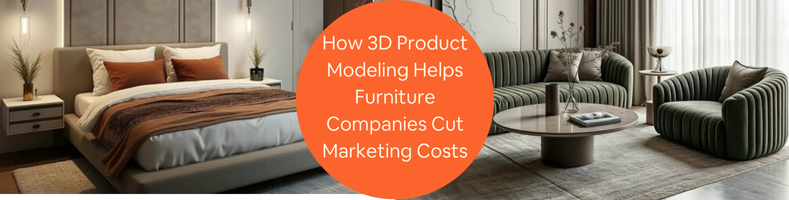
In the furniture business, effective advertising is the key driver of sales and brand exposure. Comprehensive photo shoots, hardcopy catalogs, and physical models are some of the traditional methods that can be expensive. However, with the invention of 3D product modeling services, the way furniture companies collaborate with design firms has changed to make marketing economical while reducing expenditures significantly.
As a leading agency with over 94,00 experts, Cad Crowd is the best choice for furniture companies in finding the best design teams that excel at 3D product modeling. Whether you’re looking for innovative solutions, strategic insights, or top-tier execution, CAD Crowd has the expertise and the talent to bring your vision to life. In today’s blog post, we’ll dive into how 3D product modeling helps furniture companies save on marketing expenses effectively.
RELATED: Mastering 3D product modeling: company techniques and tips for stunning visuals
The essential elements which make a 3D render truly realistic
An excellent 3D render from a professional 3D rendering firm is not just merely representing objects but instead creating them with attention to detail and realism. The trick is acquiring mastery over certain key elements that mix together to produce an image nearly indistinguishable from an actual photo. Lighting is the foundation of realism. Whether working with natural light or artificial, the placement and intensity of the light will drastically change the reality of a scene. Bad lighting will flatten objects, but well-placed lights provide depth and texture.
Flat, smooth surfaces may cause objects to feel artificial. The addition of shadows grounds the scene firmly and makes it more believable. Complex, rich textures—such as the subtle wood grain, permeability of stone, or the metallic sheen forms definition and depth in a way that invites a touch response, bringing objects into being and tangible. Scale makes every object fit into its environment naturally. A margin call can shatter the illusion, as when a coffee cup will look like a vase.
To have measurements precisely accurate helps to keep the proportions to which the eye comes subliminally accustomed and provides overall realism. Camera Angles are equally important with 3D furniture rendering services as it is in conventional photography. The correct angle can make a render much more attractive, highlighting design features effectively. 3D software applications usually have preset angles, which assist artists in discovering the most engaging views. Lastly, Image Quality in High-definition (HD) or 4K resolutions enhances details, but they also expose imperfections.
RELATED: How to use 3D product modeling and 3D product photography for company advertising
All aspects—lighting to textures—need to be perfected to hold up to such magnification. In simpler terms, a good example of 3D render has all these factors that make it so realistic. Since now we are aware of the essential elements needed for 3D Rendering. Take a look at how it helps furniture companies cut marketing costs.
1. Enabling the elimination of costly photoshoots
Among the expenses in marketing for furniture businesses, professional photoshoots have the highest percentage. Hiring photographers, leasing studio spaces, moving bulky furniture, arranging light equipment, and editing during post-production are all part of planning a photoshoot. Furthermore, every design change or product alteration necessitates new photoshoots, further adding cost.
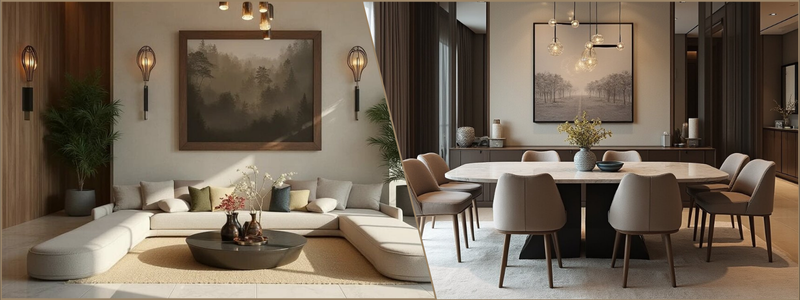
3D product modeling does away with the need for conventional photography. High-quality 3D images from photorealistic rendering designers can be used for furniture products with photorealistic accuracy, capturing texture, color, and fine detail without the logistical inconvenience of physical shoots. Businesses can build a library of reusable 3D models that can be edited instantly and easily, conserving time and money.
RELATED: Important reasons to add 3D modeling to company product design, manufacturing, and development
2. Minimizing prototype development expenses
Creating physical prototypes of marketing materials or client presentations is another costly process. Each prototype involves materials, production, and labor expenses, especially when repeated design iterations are needed. With custom or small-run furniture, these expenses add up rapidly.
With 3D product modeling, businesses are able to create virtual prototypes with the same functionality as the actual models. It is simple to change the virtual prototypes merely on the basis of customer feedback without the need to design several versions of them physically. These results not only reduce material consumption but also accelerate time-to-market.
3. Scaling up product customization without increasing the cost
Due to high demands for customization, today’s consumers typically order custom furniture that aligns with their distinct tastes and décor schemes. Previously, presenting several options for customization meant making numerous prototype copies or huge photo books, which are costly and time-consuming. 3D product rendering designers enable furniture businesses to display unlimited versions of one product without the added expense. Design companies can modify color, fabric, finish, and layout readily within the computer model which provides a unique experience to customers.
RELATED: 3D Modeling and design: how companies can utilize it for better product development
4. Ease of producing marketing content
Advertising campaigns through various styles such as ads, social media posts, catalogs, and web graphics have become easier due to digitization. Creating quality content through conventional means is very costly in terms of photography, graphics, and printing.
3D models offers content that is flexible and reusable across various platforms for use. It can also be used to create images, animation, interactive 360-degree panoramas, and even virtual reality. Marketing agencies can deliver great visuals in various formats appropriate for across marketing mediums without the repeated costs of creating original content.
5. Enabling faster time-to-market
Given the competitive furniture business, being the first one to introduce new styles into the marketplace can be advantageous. Conventional marketing procedures takes a long time due to the result of the trial-and-error practice of prototype-making, photography, and copywriting. 3D product modeling speeds up the whole process because it can be readily modified for use on different marketing materials.
Design houses can be modified real time, so furniture product design companies can bring new products to market faster. This is less expensive and shortens marketing lead times, thereby enabling companies to take advantage of market trends in time.
RELATED: How to design a 3D product visualization that converts company leads into clients
6. Reducing Errors and Lowering the Cost of Rework
Marketing materials with wrong colors, dimensions, or features are too expensive to correct through revision. In typical systems, revelation and elimination of such errors take re-producing the products, constructing graphics, or re-copying catalogs. With 3D product modeling, errors are detected and corrected early in the design stage as these models can be easily revised with much less rework and expense. The accuracy of digital models prevents inaccurate representation of products, reducing the chances of waste products.
7. Facilitating sustainable marketing practices
Sustainability is required in today’s business practice. Conventional marketing practices such as physical models, printing, and extensive photo shoots generate waste in the environment. 3D product modeling facilitates more environmental-friendly marketing practices. Reduction of the requirement for physical samples and printed catalogues save businesses on environmental cost. Global supply of digital media eliminates transportation and logistics-related carbon cost. Green practices are not only cheaper but also improve the environmentally friendly consumer reputation of the business.
8. Building global access without additional cost
International expansion used to demand big capital expenditures on region-specific content marketing, shipping prototypes, and local shoots. Geographical constraints are broken by 3D models. Furniture businesses can bring their products to a global marketplace through virtual showrooms, interactive websites, and online catalogs. Design businesses can render digital content in multiple languages and cultural affinities without physical marketing costs. This worldwide accessibility expands market access for the same marketing budgets.
RELATED: How are concept design services used to innovate during product development?
9. Facilitating interactive and immersive experiences
Customers increasingly demand interactive and immersive experiences when they shop for products online. Static images and printed brochures, which are conventional marketing methods, do not fulfill these expectations. 3D product modeling allows interactive elements like 360-degree views, augmented reality (AR) applications, and virtual reality (VR) environments to be developed. Such experiences more effectively engage customers, leading to higher conversion rates. 3D design firms can produce these advanced marketing tools without the recurring costs of physical displays or in-store arrangements.
10. Cost-effective A/B testing for marketing strategies
A/B testing is a very useful method of maximizing marketing campaigns by comparing variant forms of content and determining what best performs. Running A/B tests on typical marketing materials takes a lot of time and money. 3D models present a cost-effective A/B testing solution. Design firms are able to quickly create multiple versions of product images, designs, and presentations. Furniture companies are able to test different marketing approaches at little expense, fine-tuning their strategies based on real-time feedback and customer data.
11. Simplifying collaboration with design firms
Effective marketing campaigns depend on effective cooperation between design companies and furniture firms. Conventional processes typically consist of multiple revisions, physical prototypes, and long meetings. 3D product modeling makes it easier to work together by giving all the people involved an online forum to see, comment, and make actual-time changes. Cloud-based sharing platforms enable effortless exchange without physical product handing-over and face-to-face meetings, saving time and project management expenses.
RELATED: 5 Reasons to hire a CAD design specialist to bring your company’s concept to market
12. Long-term cost savings through asset reusability
In contrast to customary marketing materials rendered obsolete by-product revisions, 3D models are one-time assets that are reusable and reversible. 3D Modeling design houses can revise models in place in order to insert new features, colors, or configurations without undergoing the whole cycle again. This reusability provides huge long-term cost benefits. Furniture businesses can have a new digital catalog without the ongoing cost of new photoshoots or printed copies. The capacity to tweak and prolong the life of marketing materials maximizes ROI in the long run.
In summary
3D product modeling has been a lifesaver for furniture businesses looking to make the most out of their advertising budgets. Removing expensive photoshoots, cutting prototype expenses, and optimizing content creation can be a budget-friendly option relative to conventional forms of advertising. Its adaptability, eco-friendliness, and capacity for creating engaging experiences make it an even greater asset.
Cad Crowd is here to help
By teaming up with CAD crowd, we can help you connect with experts that specialize in 3D modeling. In that way furniture manufacturers like you can remain competitive, nimble, and lean in their advertising efforts. With the industry adapting and changing each day, going with 3D product modeling is not simply a cost-reduction strategy—It’s a strategic move into future-proofed advertising strategies. Get in touch with Cad Crowd today to have a quote sent your way for our 3D product modeling services.



