
Today’s post covers how 3D artists convey emotions with beautiful architectural rendering and visualization services. Architectural visualization has taken a huge leap forward with the proliferation of 3D rendering software capable of generating lifelike imagery of a building before even the first brick is put in place. However, an effective visualization shouldn’t just be a mere illustration of a structure. It needs to convey a story, deliver a message, and form a cohesive narrative that may evoke emotions from the audience. In the same way that a photograph can elicit memories, imaginations, and perhaps inspirations from the viewers, an architectural visualization has the power to grow a strong emotional connection between the project and the client.
For the visualization to trigger a positive impact on the viewer’s perception, a render artist has to explore all the multifaceted aspects of a CGI (computer-generated imagery), including but not limited to composition, perspective, artistry, and lighting. Strategic use of colors and such photography principles as the rule of thirds, negative spaces, and leading lines also matter a lot to influence the viewer’s impression of the imagery. All those elements must work together in harmony to produce an emotionally resonant visualization without undermining design clarity.
RELATED: The Benefits of 3D Architectural Rendering for Companies in Real Estate
Take, for example, using 3D interior rendering services for a home office – just because you want to highlight the presence of a massive desk right in the middle of the room, it doesn’t necessarily mean you have to direct all the lights toward the center and leave the corners unnaturally dark. It might work well as far as artistic expression is concerned, but the lack of balance in lighting makes the imagery ineffective for architectural visualization purposes. The article discusses the numerous factors that determine the efficacy of an architectural visualization, and the way a render artist can utilize them to foster or enhance communication among stakeholders.
Considering how the demand for photorealistic renderings has soared in the last few years, an in-depth understanding of those factors and a strong technical 3D CAD know-how are crucial skills in the trade. And for an unmatched expertise in architectural visualization, Cad Crowd is the one-stop shop where you can connect with the world’s most talented and experienced architectural render artists. The AEC-focused freelancing platform offers robust screening and a secure payment process to ensure that you receive nothing but the best for your money.
Storytelling with architectural visualization
Technology has changed the way stakeholders and clients communicate in the architectural industry. The old methods of using physical scale models and two-dimensional illustrations are still around, but they’re slowly going away, partly thanks to the rapid development and adoption of 3D renderings. The market is getting more saturated by the day, with more CAD companies and CAD design professionals offering architectural services at sensible prices. Potential clients, including homebuyers and real estate developers, are always in search of comprehensive information about houses and building designs, whether for immediate purchase, renovation projects, or even brand-new constructions.
RELATED: The Impact of AI on 3D Architectural Rendering Services for Companies and Firms
With hundreds, if not thousands, of design agencies, firms, and freelancers competing in the market, one of the keys to establishing a place among the best 3D architectural rendering firms is to incorporate storytelling in the visualization. And of course, good storytelling is an effective way to elicit emotions. An architectural visualization isn’t just about showcasing the looks of a structure. It should convey a series of messages about design intent and purpose, be it efficiency, luxury, comfort, eco-friendliness, affordability, elegance, simplicity, and so forth. The narrative expressed by the imagery is expected to bridge a form of communication that surpasses conventional engagement and instead triggers positive emotional connections.
Storytelling can happen in a lot of ways. Apart from the conventional spoken and written forms, you can convey a meaningful narrative through signs, symbols, motions, expressions, fashion, or, in the case of architectural designs, lifelike visualizations. Using an immersive form of imagery where every visual element adds to important details, you can elevate an otherwise typical design presentation into an effective narrative tool that describes concepts, speaks values, and triggers emotional responses. The visualization from an expert visualization designer can then become a medium to bring about constructive communication among clients and stakeholders alike. Every single object and visual element visible in the imagery must serve as a building block to craft a compelling story.
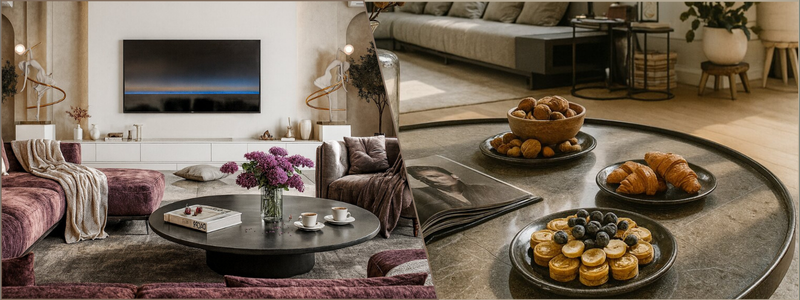
When put together properly, you’ll be presenting not just a visualization, but a whole package of a virtual world in which the audience can immerse themselves, and potentially entertain the idea of living inside that world. In many cases, it all comes down to the atmosphere depicted in the 3D visualization, whether it is minimalistic, industrial, luxurious, practical, high-tech, or tranquil. And the visual elements have to become integral parts of the intended atmosphere. An architectural visualization has the potential to be both a technical exploration of ideas and a powerful narrative art, meaning it can deliver emotional resonance while still being an accurate depiction of the design. You want the audience to have the full imaginative experience of the building just by looking at the imagery, and you can do that by strategic use of the following elements.
RELATED: 3D Architectural Rendering Projects for Your Business with a Winter Theme
Perspective and composition
Just like in photography, the world of 3D architectural visualization services has everything to do with composition. The arrangement and placement of objects within the frame create a specific look and feel that may guide the viewers’ eyes as they observe the visualization. Composition is intertwined with perspective; principles like the rule of thirds and depth of field are powerful tools to help the audience interpret the unspoken message the image tries to tell. How the objects relate to each other, where you put the focal point, what atmosphere is created by the color scheme, and the viewing angles play important roles in influencing individual interpretation, which ultimately leads to emotional responses.
The “rule of thirds” has been a prominent guiding principle in visual art for centuries, because it’s an effective method to keep the audience engaged. In general, you want the viewers to observe the image for quite a few moments so they can construct their opinions about it. Since the rule of thirds breaks down monotonous lines and symmetry in the frame, there’s an additional yet effortless tension to generate interest among the viewers. You don’t have to place the main object right in the center of the image, and instead let the viewers explore the asymmetrical composition to look for more details. Furthermore, you can enhance the impact by experimenting with perspectives such as linear, vanishing point, diminishing scale, or aerial views.
Every perspective offers a different kind of perception of the relationship between the objects in the image. With some exterior renderings, the exterior design expert uses an eye-level point of view for clarity. By putting the camera at a human’s eye level, the viewers can see the main object and everything else around it in a natural fashion. It offers a clear idea of the scale of things and is generally regarded as a comfortable perspective. Others use aerial views to showcase the dominance or the grandeur of a structure. The good thing about an aerial view is how it reveals details not normally visible from eye-level perspectives. An aerial view architectural rendering speaks not only about the structure itself, but also where it stands in the broader landscape.
RELATED: Progression of 3D Architectural Rendering Technology for Firms in the Business World
Let’s also not forget about “close-up” shots of objects. When you move the camera closer to a particular object or area, you may have to sacrifice (basically remove) quite a lot of useful elements from the scene. This is why close-up is most often used by interior rendering designers, where panoramic atmosphere isn’t a major concern. The good thing about close-up is that it allows you to focus on elements typically obscured in a wide shot, such as details on patterns and textures on fabrics, material finishes, furniture designs, functional ornaments, or any other intricate elements.
Details like the unique aesthetic of the granite kitchen countertop or the elaborate craftsmanship of the stained-glass window might be overlooked without close-up views to enhance the immersive visual experience. Regardless of the perspective in use, it’s crucial to incorporate guiding lines to lead the viewers’ attention back to the focal point. Guiding lines bind the composition and perspective together into unity to create the flow of a visual narrative, naturally taking the viewers to always circle back to the main object in the scene.
For design process
As mentioned earlier, architectural renderings can be an excellent medium for design exploration. In addition to showcasing the aesthetics and functionality of a structure, detailed visualization allows the architects, engineering designers, and designers to test various concepts on screen. It helps them identify design issues and implement changes early on in the design process. Changes might be as simple as wall paint and flooring materials or complex structural-related matters like window placement, solar panel installation, etc.
Clear graphics certainly help understand the design intent, especially for non-technical stakeholders (which may include homeowners and investors) in the project. Detailed visualization makes sure that everyone involved shares a common understanding and contributes to every design decision.
Artistic input
An architectural rendering is a technical representation of a project as much as it is a visual art. It should convey the technical portion as well as the artistic expression of the design. If the rendering is only intended as a technical illustration, the visualization may come across only as a construction document that has little regard for emotional connections. At the same time, an architectural rendering that leans too heavily toward evocative purpose might not give technical accuracy enough consideration.
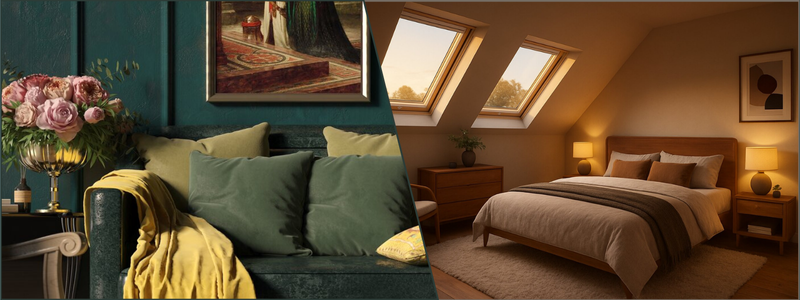
The 3D architectural designer must take both aspects into account, not just for the sake of balance, but also to make sure that whatever emotional responses are triggered by the imagery are authentic and have practical value. In other words, inaccurate architectural visualization may give a false impression. The good thing is that you can still incorporate some artistic inputs without compromising accuracy. It’s not impossible to introduce some touches of uniqueness that can actually improve (rather than diminish) the design visualization. Here are just a few examples.
Motion Blur
In animated media like video games from the bygone decades, motion blur exists to hide imperfections by giving the perception of smooth frame-to-frame motion. When used (strategically) in static architectural rendering, it brings about a sense of subtle movement in an otherwise motionless image. For example, an interior rendering of a living room that features a large window, a motion blur on leaves or trees in the backyard can effectively introduce the idea of a relaxing space alongside nature. An exterior rendering of a commercial building may also feature motion blur for the traffic in the street to suggest a bustling activity in a place full of life. In general, motion blur can bring a touch of realism to a lot of different objects, such as doors, water, clouds, cars, toys, window blinds, paper, and more.
RELATED: Techniques for 3D Architectural Visualizations and Tips for Your Services Firm
Imperfections
The idea of a photograph is to capture an image or a moment and present an exact representation of how we saw and experienced it. Because the moment is captured within seconds (sometimes a fraction of a second), every single imperfection in the scene is also well-preserved. Imperfections come in all kinds of shapes and forms; clutter on the table, scattered pillows on the bed, dirty shoes, stains on porcelain tile, and so forth. Imperfections don’t make the photograph bad. On the contrary, they’re evidence of life and effective agents of storytelling. Photorealistic rendering services isn’t that much different from photography. The presence of a forgotten toy in the children’s room, droplets of water on the kitchen counter, leaves in a swimming pool, or scribbles on the desktop can be an excellent narrative tool.
Viewing angles
Finding the right point of view in architectural rendering is akin to choosing the right camera placement in photography. It determines what the viewers can see and therefore affects their emotional response. Ideally, you set the viewing angle in such a way that highlights the interplay between lights and shadows, the juxtaposition of patterns or textures, depth of field, motion blur, and imperfections. All those elements must be presented as naturally as possible, so the viewers aren’t overwhelmed by the bombardment of details.
Keep in mind that every element carries information that contributes to the narrative. For example, if there are people in the scene, the types of clothing they wear and activities they do may suggest whether they’re in a relaxing home environment or in an office setting; the objects visible from windows can indicate if the building is located in an urban neighborhood or the outskirts of a town; a cup of hot coffee with visible plume of steam implies that someone is in the room, even when the person isn’t in the scene. All these visuals work together to build a context, and as an architectural modeling expert you can experiment with them to craft a coherent story revolving around the design, the location, or even the lifestyle associated with the structure. This “association” will, in turn, create an impression and invite emotional responses.
RELATED: 3D Architectural Visualization Services – How Project Deadlines Influence Rendering Quality
Context with colors
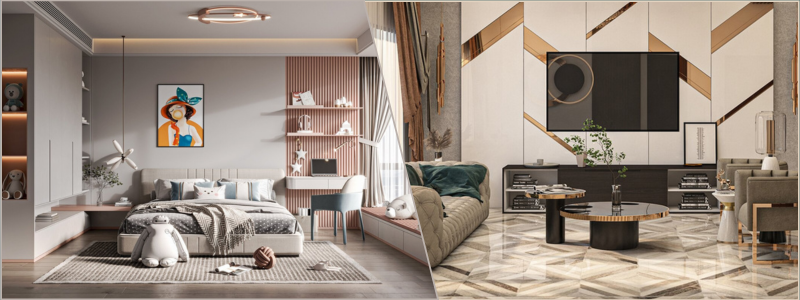
The notion of the psychological impacts of color shades may seem trivial, but it is important nonetheless. In its most basic form, warm hues like oranges and red evoke vibrancy or vigor, whereas cool tones such as green and purple imply serenity or calmness. Every good render artist needs to have a good grasp of the application of hue and understand how each color tone is associated with specific emotions. Many people think of colors as nothing more than a superficial aesthetic aspect of an object, even in real life. For example, a red balloon is no different in functionality and purpose from the green, black, or orange ones.
While this is true to some extent, especially when you see a color as an individual element, a mixture of two or more colors within the same scene may offer hints to the intended context of the image. Suppose you have two renderings of the same room with identical layout, composition, and viewing angle. They even have the same objects positioned at the same spots. The objects in one room have dark hues, whereas you see bright colors in the other. When you’re presented with such a direct comparison, what immediately comes to mind is that the room with bright colors is more playful and lively compared to its darker counterpart.
Pretty much the same practice applies to exterior rendering services, where a serene landscape is best pictured with muted soft hues to depict a sense of peace and quiet, while busy urban streets should use bold shades to illustrate exuberance. In short, a clever use of colors in architectural visualization helps create context that communicates the nature and story of the structure.
Sometimes, the best way to achieve the correct color combination is by experimentation. Try using different shades of colors for the same visualization and see which version works better for the purpose. There’s no scientific formula to give you the right combination and ratio of colors, which means there’s no single best solution for every image. It all depends on how you want the viewers to emotionally connect with the visualization.
RELATED: How to Find the Right Architectural 3D Visualization Expert for Your Company or Firm?
Weather and lighting
The most powerful narrative tool in visual art is lighting. Just about every other element in an architectural visualization is heavily influenced by the lighting effects you use. They contribute the most to the atmosphere of the scene and the expression of mood. Whether the cool glow of moonlight, the warmth of sunset, or the brightness of high noon, the lighting effects are of the utmost importance to set the stage for emotional resonance. Imagine an aerial rendering of an urban market square. In many instances, render artists opt for daytime visualization to showcase the liveliness of the structure populated by busy sellers and buyers.
The green trees around the main building, the white clouds, and the blue sky add to the narrative. Some may say that daytime rendering is preferable because of its clarity and inviting mood. But it doesn’t mean nighttime rendering can’t achieve similar results, or perhaps surpass the daytime ones. While the trees should at least partially appear dark and the sky isn’t going to contribute much to the narrative, nighttime rendering affords you the opportunity to experiment with artificial light sources. You can use various shades of light, be playful with neon signs, try different placements for the lamps and lanterns, etc.
Like lighting effects, weather conditions can dramatically change the whole atmosphere of an architectural visualization. Imagine an exterior rendering of a log cabin set during broad daylight in the summer. The front doors and windows are open to let the cool breeze flow through the structure, and natural light is reflected by the shiny floor. Trees look crisp against the backdrop of empty blue sky. Now, in another version of the same visualization, the weather is set to depict the height of winter during a snowy day.
RELATED: 5 Uses of 3D Architectural Animation for Marketing Your New Development Project
The open doors and windows don’t seem to be welcoming, and instead, they make the cabin look deserted. Each image evokes a different emotion. When the 3D architectural animation firm includes lighting and weather effects, it play major storytelling functions in the scene. You can even say that they lead the direction of the narrative and can somehow dictate the viewer’s perception.
Takeaway
Every architectural visualization wants to tell a story, but whether or not the audience can capture and understand the concept is a different matter entirely. A great number of exterior and interior renderings out there are aesthetically pleasing and technically sophisticated, but the lack of artistic touch and ineffective use of perspectives diminishes their storytelling power. And when the audience fails to experience a connection of any sort with the visualization, they express no emotional connection and quickly move on to the next image without a second thought. People want to see architectural renderings that awaken their imaginative mind, create a strong impression, and drive them to an envisioned life in or around the structure.
How Cad Crowd can help
An effective architectural visualization can connect with the audience on an emotional level. It takes a render artist skillful enough in optimizing the intersection between the various visual elements to produce a visualization that conveys a clear narrative and resonates with viewers. Cad Crowd is the place where you can discover and collaborate with the world’s most talented render artists experienced in residential, commercial, and industrial projects. Whether you need a rendering of a simple, straightforward exterior or a highly complex interior visualization with unmatched details, there’s always a professional on the platform ready to meet and exceed your expectations.