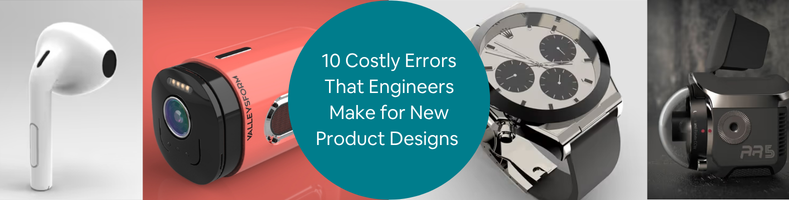
An new product design project typically involves a number of engineers with different specializations, such as industrial, mechanical, and electrical/electronics. They work as a team alongside designers, marketers, researchers, and a project manager. Depending on their field of expertise and specific roles within the team, they might be responsible for building and testing prototypes, ensuring compliance with standards and regulations, and applying the DFM approach to the project. In general, they act as a bridge linking conceptual design to an optimized product ready for mass production.
So long as you have one or two engineers on your team, creating a new product is going to be easy, right? Wrong. Even for a big development firm that employs dozens of engineers, a New Product Development (NPD) project isn’t always a smooth-sailing process. Lots of product concepts never saw the light of day, and many others tasted failure because they couldn’t live up to consumers’ expectations. Adding more engineers or bringing in a qualified project manager to the project will reinforce the teamwork and at least reduce everybody’s workload to some extent.
But instead of going through the traditional hiring process and causing delays to the project, you definitely want to turn to Cad Crowd, a US-based freelancing platform with a heavy emphasis on design, engineering, and NPD at large. Cad Crowd connects you with some of the most qualified and experienced NPD professionals (of various specializations) in the business to help minimize the chances of mistakes and errors in your project.
RELATED: Product Development Considerations that Can Make or Break New Product Ideas Before Launch
Costly engineering errors
We’re not saying that all product development engineers are prone to making these mistakes. The more experienced the engineers are, the less likely they are to struggle with errors of any kind. But then again, every mistake listed below is worth mentioning because of how costly it can be for your company to rectify.
Aesthetic vs. performance disproportion
Every good product from an experienced product designer is designed to strike a nice balance among performance, aesthetics, and cost. An excellent performance is a must, but if the product as a whole looks aesthetically unappealing, buyers might not be interested in even trying it in the first place. This applies to just about every product, but even more so if the product is meant to be plainly visible when in use. For example, a pair of socks can look ugly from all sides, but you don’t mind as long as they work as intended. Also, very few people get to see the socks anyway, so aesthetics don’t really matter. In fact, your ugliest socks in the drawer might be the most comfortable to wear. But you can’t say the same about, let’s say, shoes. Chances are you don’t want to be seen wearing a pair of fish-shaped shoes.
They might be aerodynamic, ergonomic, and all that, but are you sure that’s the aesthetic you want to go for? The worst offender, however, is an aesthetically pleasing product that never seems to work as advertised. Say you’re making a robot vacuum in the shape of R2-D2. It does look great, but the machine gets clogged easily and has to recharge itself every 10 minutes or so. Within even a week has passed, the buyer no longer sees it as a functional appliance but as a novelty item sitting beside the TV. Such a product only shows you care so much about appearance while neglecting functions. It’s form over function, and this rarely goes well unless you’re a jewelry designer or designing other purely decorative products.
You need a good balance between aesthetic and performance. A product that’s aesthetically beautiful but underperforming in any other way isn’t going to win customers. Value for money is still the number one factor people consider when buying a product. At the same time, useful but ugly products won’t attract buyers to begin with. Either way, this balancing-act error can quickly send the product down the path to commercial failure, despite the time and money spent developing it.
Unmanaged expectations
An NPD project is full of great expectations. For now, we’ll focus on just two points: development timeline and test results. Setting a proper timeline is tricky. Every single aspect of the product, from the smallest design details to the internal engineering mechanisms, can change over the course of development. When the 3D designers propose changes, the engineers may have to modify some components to make it work. Or it can happen the other way around, as in the engineers’ decision to use different components requires design revisions. It’s all interconnected, and even minor adjustments can add weeks, if not months, to the finalization process.
RELATED: How to Take Hardware Product from Concept to Commercialization: A Complete Guide
Setting a strict development deadline is likely to cause more trouble than it’s worth. For instance, you’ve agreed with the contract manufacturer (CM) to start the first production run on a certain date. And then the inevitable happens. The engineers need more time to assemble some components to fit a new design, or the suppliers can’t send the parts on schedule because of bad weather. Depending on the terms of the agreement, you might be subjected to fines because you can’t fulfill your end of the bargain. Ideally, you agree with a CM once your product has reached a final production version. No engineer should get ahead of themselves and move forward based on nothing but unmanaged expectations around deadlines.
As for the test results, our second point is that unmanaged expectations usually occur when engineers fail to specify the correct metrics for the test. It can be an honest mistake, such as an input error, or they may unknowingly use lower quality standards. What they then get is a set of misleading data in which a bad product appears good on paper. For example, the product material is supposed to withstand heat up to 80°C, but the test metric is set to 60°C. This error goes unnoticed, and the engineers don’t bother to try another material. They proceed to build a prototype and only realize the mistake during the next test run.
It’s a rookie mistake, alright, and completely avoidable indeed, but that doesn’t mean it can’t happen. Keep in mind that the smallest mistakes are the most likely to slip through the cracks because no one cares enough to take a second look at a supposedly trivial matter. Everyone assumes somebody must have done it right, only to realize how wrong they were when the damage is already done.
Pushing it
The NPD project is a race against time and the competitors. Market trends change just as easily as buyers’ preferences. The research you completed last week will be irrelevant next month. Other companies launch new products and flood the market with options more quickly than ever to stay ahead of the race. While you’re still in a workshop prototyping a design, some other companies are probably preparing to release half a dozen similar products. A sense of urgency is always welcome in an NPD project, but don’t fall into the trap of finishing a design just for the sake of it. Quality over quantity is what wins customers in the end.
It takes time to develop a proper product, wherever it might be. You can’t create a robust electronic device in a few months or a pair of shoes in just several weeks. There needs to be detailed market research, experiments with materials, design considerations, iterative prototyping, engineering testing, problem-solving, optimization for manufacturing, and so forth. The problem is that every single one of those steps can fail, meaning you probably won’t always get things right on the first try. As a rule of thumb, the more complex and sophisticated the product, the longer the development time.
RELATED: CNC Machining vs. 3D Printing Costs for Precision Prototype Development Insights
Despite feeling like you’re in a race, you shouldn’t simply make a foolish leap, for example, jumping from the ideation phase directly to rapid prototyping, skipping the entire design validation work in the process. There’s nothing wrong with getting overwhelmed with the excitement of a new project. Being overly confident in an idea is what you should take issue with. Some ideas are outright terrible, so you shove them all the way to the bottom drawer, never to be seen again. Good ideas, however, are somewhat trickier. When an idea sounds feasible, it always looks great on paper, and that’s where the impulse to rush the project comes in. There are times when getting things done quickly isn’t the best path to move forward, especially if it involves skipping important development steps.
A design idea must be validated to assess its technical feasibility and its manufacturability at scale. It also offers an insight into DFM (Design for manufacturing services) approaches, which reduces the risk of major revisions during the final stages. Before you get to build the prototype, you will at least need a Proof of Concept, detailed technical drawings using CAD, analysis of usable materials, a review of possible patent issues, regulatory/compliance research, and the lot. Rushing into the prototyping phase usually comes with a muddle-headed “It’s only the first prototype” attitude. It does hold some truth, as the first prototype will most likely need many revisions to improve it. But this “We’ll fix it later” mentality will eventually catch the engineers off guard.
No one expects the prototype to be even remotely perfect in every way, but the right thing to do is to build it based on the data from the design validation phase. While this is a prototype, every good engineer strives to create the best possible iteration using the latest available data. Professional engineers don’t just brute their way into making a prototype. It’s an absurd exercise that leads to nothing but wasted time and materials. And by the time they figure out the prototype is all wrong, they have to do it all over again. So why bother with rushing it in the first place?
Making design changes at a later stage is almost always more expensive than refining in the earlier design phase, when development still mainly revolves around the CAD file rather than a physical prototype. It’s not like reviewing an idea or concept is a particularly challenging phase, either. Of course, you need a cross-functional product concept design team, consisting of people from different disciplines, to offer their takes on the idea. The good thing about a multidisciplinary group is that each member focuses on specific design aspects and likely has a unique viewpoint on why something will and won’t work as a product. Say your new product idea is a fitness tracker.
RELATED: How to Quickly Cut Prototype Design Costs in 2026 for Product Design & Engineering Firms
The designers have drawn raw sketches of the product, in colors for clarity, and everything looks excellent on paper. The mechanical engineers take a glance and rush to the workshop floor to build a quick prototype using readily available materials, including an off-the-shelf PCB. A few weeks after the prototype is ready, the marketers come back to say that the diameter needs to be smaller to attract more buyers, and that the strap should be made of stainless steel rather than plastic, so it’s more durable. Not to mention that a smaller diameter requires a custom PCB with reduced functionality to improve battery life. So what happens to the prototype now? It’s discarded at a moment’s notice. Rushing to prototype isn’t exactly the way to cut development time. If anything, it will send you back to the drawing board after wasting a good portion of the budget on a failed prototype.
Overlooking IP issues
Among the most ridiculous errors design engineers can make in a new product development is when they can’t be bothered with checking the patent database. It might be a direct result of rushing the project as discussed in the previous point, or a downright screw-up on the engineers’ part. Not many new product designs are completely brand-new. Most are at least partly based on previous inventions or on already patented technologies or mechanisms. If you develop a product while being completely oblivious of the matter, there’s a good chance that you’re actually copying someone else’s solution.
Let’s say you’ve finalized the new product after a lot of laborious effort in a workshop. You then set up the first production run for several thousand units and launch it to market. All of these were happening without anyone telling you that one or two technologies in the product are actually registered Intellectual Properties. The patent holder files a complaint, demanding that you either pay a hefty royalty for every sale or recall the product from the market entirely. It’s a costly error that’s otherwise easily avoidable if you’re just willing to do some preliminary IP research.
RELATED: Ultimate Guide to Engineering CAD Drafting Services: Benefits, Applications & Costs
Consumer research not done well
Let’s be blunt about it. As a 3D product designer, you don’t know your customers that well to think that whatever product you’re building will get them to line up at the door. A lot of people want different things from the same product. They can’t even agree on what the best-looking color for a smartwatch strap is, and they rightfully shouldn’t, because aesthetics is subjective. That’s why you make multiple versions of a product. You might even want to make sure there are different materials available to give customers options. And we’re not talking about the features yet. Some people want a colorful screen, others prefer a monochrome display.
A good percentage of the target market wants a full touchscreen, but the rest expect physical buttons. On the other hand, from a business perspective, it doesn’t seem like you can afford to develop two different products at once. Even with extensive customer research, you’ll still have a difficult time generalizing on what the vast majority of the customers really need. Imagine doing it with minimum data. Engineers are indeed supposed to be making the new product for customers, but it would be a mistake not to experience the product before launch. Have you actually spent some time using the product and making sure everything works as intended?
Does the product do what it promises to do? Is it an effective solution to the problem you’re trying to solve? Have you tried the product in different use cases? Engineering design experts have to experience the product as if they’re users who spend their hard-earned money on it. Think of the process as stress testing for performance, reliability, durability, repairability, and all that. If you find flaws, your customers will too.
Product that just works
Finalizing a design that “just works” sure sounds like a brilliant idea. After all, everything you’ve done so far is aimed at making something that works. So by that logic, you can call your product “ready” just as soon as it is in working order, right? Wrong. Remember that you have competitors and are in a race to be the first to launch a product to the market. Your company probably isn’t the only one with a new product development project. If every company only aims to make a product that works, how would they set themselves apart from each other?
Also, there won’t be real product choices for people to buy because everything is basically the same. Nothing is really better or worse. No matter what they buy, the product just works, and that’s good, right? Wrong again. “A product that works” should be the bare minimum of anything you’re trying to accomplish. And you don’t want to launch a product that only barely meets the requirements. You need to make refinements wherever possible in both functionality and aesthetics through iterative prototyping, giving the product a better chance of outselling competitors. Customers appreciate value-added features.
RELATED: Benefits of Prototyping for Electronics Engineering Design for Improving New PCB Hardware
Ignoring the manufacturability factor
With 3D printing services and CNC machines, it’s easy to get carried away with the prototyping process and think that every single thing is as manufacturable as the next. Well, no one is going to blame you for saying that advanced additive manufacturing methods can fabricate even the most complex design imaginable. It’s true, but at the moment, the technologies haven’t reached a point where they’re effective for mass production. People think additive manufacturing is affordable only because they use it for very low production volumes, sometimes no more than two or three units at a time.
If the product is to be mass-produced at scale, engineers have to put manufacturability into account right from the beginning of the development. The idea is to make a product or a design that requires minimal tooling investment for a high-volume production run. You want to manufacture the products efficiently and consistently while keeping production costs low. Take our word for it: DFM is easier said than done. Engineers, designers, and the factory partner must work together to determine the most effective way to optimize the product for mass production. Sometimes it involves breaking the product down into multiple parts and assemblies, using custom materials, simplifying the mechanism, and so on.
Reinventing the wheel
One of the most common bottlenecks in an NPD project is the obsession with being innovative in everything. While product engineers naturally are creative people and want to be appreciated for what they do, there’s just no need to try to reinvent the wheel in every project. Companies and engineers can work to their full potential by simply playing to their strengths, rather than focusing on areas where they’re inefficient. They just have to do what they do best, in the best way possible. Never let yourself get bogged down in tasks beyond your field of expertise.
Take, for example, the DFM approach. Mechanical engineers are probably aware of the practice and understand pretty well what it takes to build a product that’s easy to manufacture. That being said, the real experts here are manufacturers, people with years of first-hand experience in mass-production matters. As professional engineers, you’re indeed required to strive to devise creative measures to solve complex problems and make things work, but this isn’t the same as trying to figure everything out, knowing full well that your attempts to reinvent DFM services are going to be unproven at best.
RELATED: How the Engineering Design Process Helps You Craft New Products for Consumer Goods Firms
Thinking you can do it all yourself
Even if you’re not trying to reinvent the wheel, thinking that you can handle every little detail of the NPD project by yourself is a recipe for disaster. An NPD project is a multifaceted undertaking. It involves not only engineering expertise but also an in-depth understanding of design and detailed consumer research. From a business standpoint, achieving commercial success (whether in the form of profits or greater market share) is the primary driver, which means the project needs a marketer, too. A multifaceted undertaking may also mean you need more than one type of engineer to get the job done. Some engineers specialize in electronics design projects, while others specialize in industrial processes, mechanical systems, chemicals, and more.
Depending on how your product is supposed to work and what your specialization is, you may need other engineers to strengthen the team. As mentioned earlier, a partnership with a contract manufacturer also plays a significant role in NPD. You might think that doing it all yourself can save a sizable amount of money and resources, but often the opposite happens. Instead of lowering development cost, all the mistakes and blunders you make because you don’t have the right team on your side cost you a lot of money.
Running an overall inefficient operation
Just about every NPD project (specifically for physical products) follows more or less the same progression. It starts with research or ideation, followed by concept development, design validation, prototyping design, evaluation, refinement, and finally production. But that’s on paper. In the real world, all the steps are interdependent and can create a jumbled workflow, like an entangled string. You’re doing a lot of reviews that cause delays and engineering refinements that send you straight back to square one. What about a fully-functional prototype that turns out to be a manufacturing nightmare? Do you know how complex it can get when the development budget runs thin, and you have to secure more funding?
You might think it won’t happen to you, but there is always a chance something will go wrong during development, and it takes a restart to fix it. Engineers are supposed to be the smartest, most creative, and most practical people on the team. Don’t be the bottleneck because you can’t keep things in order. Make the effort to detail and document your process, update the workflow with every completed milestone, and avoid making any uninformed decisions. More importantly, never jump the gun and skip to phases the project isn’t ready for, even if it looks like you can make it. By being simply procedural, you can prevent the project from going sideways.
RELATED: 38 Top Tips for Outsourcing Physical Product Development with US Product Design Firms
Closing thoughts
For every engineer, the prospect of bringing mere ideas of a product to life is almost like an instant rush of dopamine. It brings excitement, pleasure, and that oddly satisfying sense of welcoming a good challenge. You live for it, and having the opportunity to prove your innovative and inventive nature is a chance you just can’t miss. But at the same time, an NPD is riddled with likely missteps. Most of the errors listed above probably won’t happen to experienced engineers, although you can’t be too careful with everything you do when it comes to product development. There’s just too much money and time involved in the process to let some otherwise rookie mistakes ruin the whole project.
How Cad Crowd can help
Tap into Cad Crowd to minimize the risk of errors and bolster your team with experienced engineers and NPD professionals. The US-based freelancing platform helps you connect with some of the best-qualified product development specialists from all around the world at affordable rates. Call us today for your free quote!