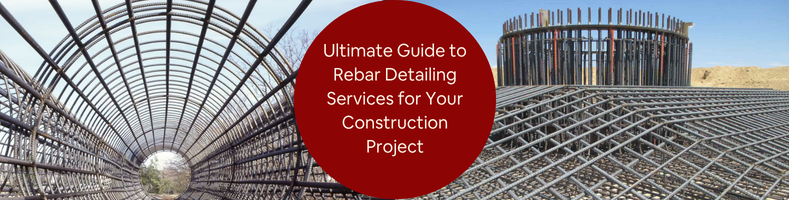
If you’re building custom furniture, you need millwork drawing services as documentation, reference, and instruction for the millworker to construct and install the product. A rebar (reinforcement bar) shop drawing is somewhat like a millwork drawing, but for the construction of rebar in a concrete structure. The process of creating the rebar shop drawing is often referred to as rebar detailing.
A reinforcement bar is a mandatory ingredient of concrete, as it can significantly enhance the durability and load-bearing capacity of the structure. Concrete is created by mixing cement, sand, gravel, and water in a specific ratio; while the resulting mixture itself is exceedingly complex and dense, it’s relatively brittle and prone to fail under heavy stress. When used for load-bearing components of a building (such as beams, walls, slabs, trusses, arches, etc.), the concrete is susceptible to rapid cracking. The low tensile strength may even lead to sudden structural collapse. Reinforced concrete solves all those issues.
That said, not every AEC has an in-house professional for the task, which means they must hire one from an external source each time a project necessitates a detailed rebar shop drawing. Some companies outsource the job to the smaller construction firms, while others prefer to hire freelancers. The latter option is often more affordable, but there is the inherent risk of the drawings turning out to be underwhelming, or perhaps worse than the expectation due to poor communication or blatant incompetence. If you have to hire a freelance rebar detailer, at least choose a professional from a reputable platform.
And when it comes to rebar detailing services, a specialized platform like Cad Crowd should be the first choice. Cad Crowd specializes in the AEC industry, with a strict freelancer-screening policy, to make sure that you always get to hire a qualified rebar steel detailer on demand at an affordable rate.
🚀 Table of contents
Why you need rebar detailing
Design (including size, shape, and materials) and structural integrity are the two most significant contributing factors to the overall rigidity of a construction. As mentioned earlier, rebar increases the tensile strength of a building’s load-bearing components. While an amateur handyperson can probably install reinforcement bars when building a few simple beams in a tiny-scale project, it’s a whole different story if you want to make an entire structure from scratch. The bigger the structure, the more complex the installation. Rebar detailing is a job best left to a trained professional with in-depth knowledge of construction methods and structural design.
It is possible to simply use the biggest rebar from the building material suppliers, cut or bend the rods to shape, pour wet concrete over them, wait until dry, and consider it a job done. But this is an amateurish practice at best and grossly inefficient at worst. More than just inserting steel rods into a wet concrete mixture, the installation takes precise calculation of the rebar dimension and shape, depending on the size of the load-bearing component itself and the expected weight capacity. Rebar comes in a variety of sizes, shapes, and grades for different design requirements.
One of the primary purposes of rebar detailing is to use the most efficient type and volume of steel rods to achieve greater efficiency without sacrificing structural integrity. Not only do the steel rods have to be in the correct sizes and shapes, but they must be installed and configured in the correct order. Accuracy is of the utmost importance because the rebar shop drawing will also be used as a reference for cost estimation by architectural design firms.
RELATED: Structural steel detailing services for companies: Steel detailer costs and rates complete breakdown
What’s a rebar shop drawing?
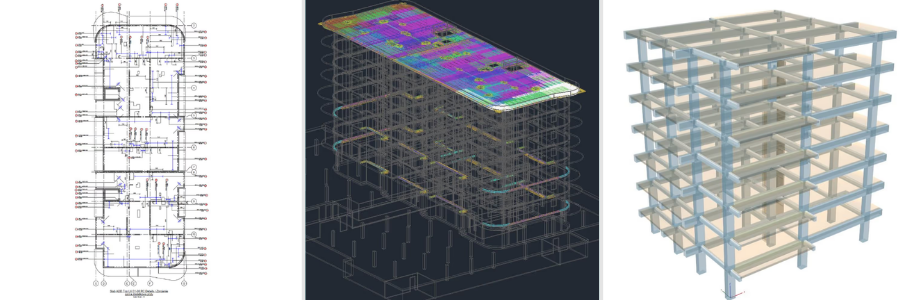
Every project comes with a set of construction documents. A rebar shop drawing is a blueprint created as a detailed visualization for reinforced components. It specifies and configures rebars to be placed in the concrete mix of various load-bearing components in a structure.
A rebar detailer creates a shop drawing based on the engineer’s latest design/construction plan. The problem is that in most projects, there’s barely any direct contact between the detailer and the engineer; any communication between them is typically bridged by the general contractor (GC). In case of unclear or missing information in the design plan, the detailer must submit an RFI (Request for Information) to the engineer through the GC. And the standard response time is around two weeks.
Professional rebar detailers are not mere “image editors” who receive a design plan and add rebar visualization to the drawings. They’re problem-solvers to figure out the most effective rebar configuration for the construction. The shop drawings are sent back to the engineers, and if approved, will eventually reach the hands of rebar fabricators and installers. A proper rebar shop drawing must contain at least the following information:
- Rebar schedule: a comprehensive list of rebars required for the construction project. The list should mention the shapes, sizes, grades, and quantities of reinforcement steel rods. This is to make sure that all the materials are prepared and ready for fabrication.
- Material specifications: additional information to reiterate the specifications of rebar, concrete elements, and other materials required for the installation. It provides insights into the overall strength, performance, durability, and cost factors of the structure.
- Rebar details: visualization for the rebar assembly process. The main idea is to provide visual guides to the types and spacing of the rebars. Architectural visualization services may include representation of bends, hooks, and other fixtures. Keep in mind that the visualization is more than a mere image, but a data-driven drawing based on the intended design and strength of the structure.
- Bar bending schedules: a complete list of rebars to be bent and cut during fabrication. If the bars are already cut and bent to specifications, the construction workers can be expected to finish the assembly and installation processes quickly. Every single bar should fit well in the designated spot without further modification on-site.
- Clear cover: a visual representation to depict the space between the outer surface of the concrete and the nearest-positioned rebar unit. A safe distance keeps the rebar from corrosion and rust, so the reinforcement remains effective over an extended period of time.
- Development and lap lengths: an estimation to show how the rebars should be spliced and lapped for a more seamless continuity and to optimize structural strength.
- Anchorage details: information about the pattern and length of the rebar that must be anchored into the concrete. This is especially important if the anchorage has to be aligned with other structural elements by structural design services.
- Spacing and location: construction drawings to represent the complete details of rebar placement inside the concrete. Every single rebar (with all the specifications) must be accounted for.
- Structural notes: a set of instructions for the rebar installers/contractors. It’s filled with specific information such as construction methods and the required structural strength.
During the process of creating a rebar shop drawing, the detailer works closely with the general contractor, the structural engineer, and the fabricator to achieve high accuracy. Well-coordinated teamwork is expected to deliver error-free drawings that simplify both the fabrication and construction tasks.
RELATED: How to detail sheet metal shop drawings for increased fabrication accuracy for companies
Common Challenges in Rebar Detailing
Even a seasoned detailer doesn’t always produce accurate rebar shop drawings on the first attempt. Among the most common challenges are listed below:
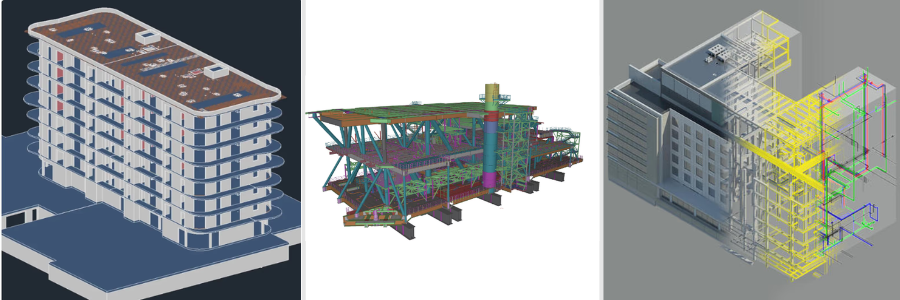
- Reinforcing steel clashes: using multiple drawings for separate structural elements makes the configuration susceptible to clashes, for example, rebars interfering with each other or sticking out of the concrete because the drawings aren’t correctly aligned. The good thing is that a unified, data-rich, realistic 3D model can provide a better visualization to help solve the issue for architectural design experts.
- Intricate design: while there’s nothing wrong with complex designs, inexperienced detailers may find it challenging to interpret the engineer’s construction plan. A thorough analysis of load distribution is crucial to prepare the shop drawing because incorrect interpretation may lead to structural collapse if left unaddressed. It might be necessary to use an in-depth 3D model and structural analysis software to prevent mistakes.
- Design modification and specification change: In the event that the architect or the engineer makes an alteration, especially concerning the construction plan of any of the structural elements, the rebar shop drawing must be redone. An alteration requires a systematic reassessment to identify potential effects on the rebar specifications, placement, schedule, and budget. It is wise not to commission rebar shop drawings until the design is finalized.
Most AEC companies and rebar detailers still use the conventional 2D imagery for shop drawings, which may not illustrate the placement and configuration of reinforcing steel with precision. 2D drawings are also difficult to interpret, further adding unnecessary challenges to an already intricate rebar detailing task. But the conventional way is slowly growing out of trend in favor of 3D modeling design services and BIM-based shop drawings. A data-rich model delivers a realistic visualization of the rebar with automatic cost estimation and a real-time update feature.
RELATED: Casework vs. millwork design: A detailed breakdown for freelancers and architectural firms
Takeaway
Meticulous planning and accurate cost estimation play significant roles in the success of every facet of a construction project. Among the most crucial aspects of a construction are well-built structural elements, such as foundations, beams, columns, slabs, trusses, and walls. Because all those load-bearing components form the backbone of durable structures, it only makes good sense to be fastidious about how you build them.
In designing load-bearing components, rebar detailing is a pivotal point that will determine the overall structural strength of the building. The rebar shop drawing serves as a blueprint for the configuration and placement of the reinforcing steel within the concrete. It makes sure that the rebar is fabricated to the correct specification and installed in accordance with the specific design requirements of the structure.
How Cad Crowd can help
Considering the importance of rebar shop drawings, it takes an unparalleled expertise in rebar detailing to produce precise shop drawings that guarantee not only the structural integrity of the building but also cost efficiency. Cad Crowd, the AEC-focused freelancing platform, is home to rebar detailing professionals committed to providing quality services at affordable rates. Request a quote today.