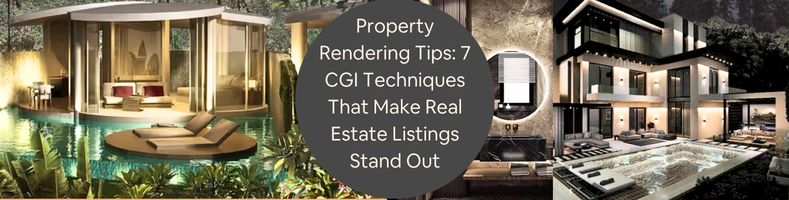
A good real estate developer seeks to sell properties as quickly as possible, sometimes before they’re built. They would (and should) have a go at showing potential buyers an empty parcel of land and describing a gleaming story of future homes, offices, streetlights, retail centers, and all the rest of it to try and make an early sale. It’s been a pretty common practice everywhere, but then again, not every pitch ends with a deal. You can’t just expect clients to drop a hefty amount of money based on a mere “description” of what the property will look like in the future when it’s eventually built.
Some people excel at creating precise visualizations of real estate plans, while others lean more toward artistic touches. In times when you need both, look no further than Cad Crowd, an architectural freelancing platform loaded with the most talented and experienced CGI professionals from all around the world. It’s a massive online hub for real estate developers to collaborate only with the best 3D CAD modelers and render artists in the industry for projects big and small.
If you don’t always make a convincing sales pitch using a blueprint, imagine doing it with nothing but a story. While a blueprint is accurate and detailed, it’s also very technical, so the typical client won’t have the faintest idea about what it represents. Most of these typical clients aren’t the construction-savvy sort trained to read and understand architectural drawings. They’re also not mind-readers who effortlessly get a good grasp of abstract architectural ideas and concepts. These clients need brochures for a clear visualization rather than blueprints and shop drawings.
RELATED: Marketing Real Estate: Top Real Estate 3D Rendering Trends for Companies and Firms
It is always difficult for a real estate developer to sell a house that hasn’t been constructed yet, but CGI (computer-generated imagery) can make the job a whole lot easier. CGI combines the art of digital modeling and 3D rendering to create a photorealistic depiction of what a house can be, including the exterior and interior, as well as the overall architectural style. And it’s not just a single house or a building. The imagery can cover an entire area, including roads, amenities, surrounding views, and the lot. You create demands by offering a glimpse of what they can have.
CGI transforms an otherwise empty plot of land into finished real estate, at least on paper. While the visualization is hypothetical, a real estate rendering (or any other architectural visualization for that matter) is supposed to be as accurate as possible. It must represent what’s technically feasible, sometimes with exaggerated elements here and there, without taking away much of the photorealism. An effective CGI needs a proper blend of technical skills and digital artistry. What you want is a balanced visualization that looks both professional and emotional. You’re trying to convince people to spend a fortune, and often you can’t do that by being entirely clinical.
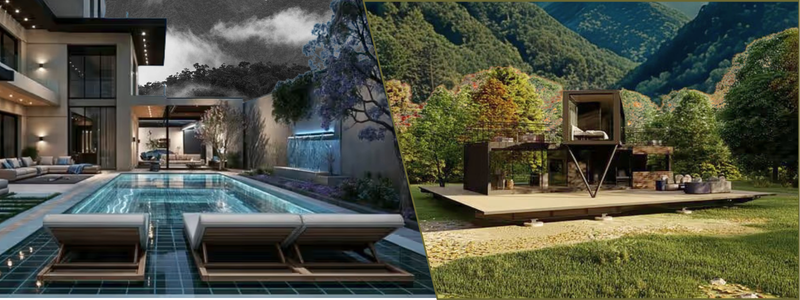
Don’t take our words for it. Show the clients a complete blueprint layout and a hyper-realistic 3D rendering of the same house side by side, and see for yourself which image lights them up more. CGI has been the new standard in real estate marketing these days, thanks to the sheer number of refreshing advantages it offers developers and clients alike.
RELATED: Creating Lavish Real Estate Listings with 3D Services and 3D Real Estate Rendering
🚀 Table of contents
Get a feel of the neighborhood
People buy a house so they have a place they can call their own. It’s going to be a shelter, a refuge, a home. But in many cases, they actually buy more than just the actual building with four walls and a roof. People also want a home in a safe, accommodating neighborhood. This is why the “neighborhood” is among the most important things buyers consider before making a purchase. How far away is the neighborhood from the main road? Is it close to their workplace or school? Is the house near a public park, coffee shop, beaches, a police station, a hospital, or other amenities? People don’t just buy a house; they decide where to live and how it affects their everyday lives.
A couple of photographs of the house’s facade and backyard simply won’t cut it. Your client wants to know if the house in question is conveniently located.
In the old days, the only way to create this overview was by using a physical scale model. Not only was it expensive, but also time-consuming. Now you can use 3D CAD modeling and high-resolution rendering to build (virtually, of course) a complete visualization that covers the entire area in crisp detail. It’s going to be like looking at Google Maps, but with 3D architectural overlays that mark the area’s boundaries, streets, landmarks, and just about every label you need in a single bird’s-eye perspective. This offers a clear spatial awareness of where the house is positioned in the area, allowing the (potential) buyers to picture themselves already having their day-to-day activities there.
RELATED: Types of Architectural Renderings: A Complete Guide to Choosing the Right Visuals
Make the case for fixer-upper potential
Not every real estate listing has to be a brand-new building with all the latest fixtures and furniture already in place. Quite a lot of buyers are looking for older dwellings at bargain prices, so they can spend a good portion of their budget on renovations later. The problem is that many clients might not know exactly what they’re looking for or where to start with home improvement unless you make it crystal clear for them. And selling a fixer-upper, and actually making a profit from it, can be a real tough uphill battle.
Say you’re listing an outdated single-family detached home built in the 1960s. It remains structurally sound, but both the exterior and interior will need a major overhaul before it’s ready for occupancy. Your first big challenge is to convince clients to see past the house’s ugly aesthetics, because it looks hideous from every angle, but you know it has fixer-upper potential. So how do you elaborate on this potential without the client getting overwhelmed by thoughts of a chaotic renovation?
Well, you don’t. Renovation is for sure messy and often overwhelming. The best you can do is to visualize the finished product using a simple before-and-after comparison, which is where 3D rendering comes in. On the left, the image shows the house as it is today with its cracked walls, overgrown yard, broken windows, stained carpets, holes in the floors, leaky pipes, hanging wires, and the lot. You don’t even need 3D models for the images; some photographs will do. And on the right, you have a photorealistic visualization that shows what the house “could” look like after renovation. The walls have been repainted, the kitchen renewed, the bathrooms upgraded, the furniture replaced, and the broken things repaired.
RELATED: How Property Developers Use 3D House Rendering Services to Help Reduce Costs & Boost Sales
It’s not like you have a choice, either. You have to use CGI rendering for this. The house is yet to be renovated, and everything you see in the visualization is, well, computer-generated based on the actual property. But depending on the scope of the renovation, the interior layout can also be modified, such as by removing or adding walls.
Now, be very clear with clients that you’re not selling the renovated house and that you use 3D rendering only to highlight its fixer-upper potential. Of course, the renovation doesn’t have to match what’s shown in the visualization. The main point is to use CGI to help the clients see more clearly the extent of possible transformation. It’s just a way to let them realize how big a makeover a proper renovation can give to the house. If a picture is indeed worth a thousand words, this is the right moment for that.
Bad weather no more
Real estate developers who rely solely on conventional photography for any listing are a dying breed. We won’t go so far as to say photos won’t work in today’s competitive market; it’s just that CGI design has become the mainstream choice for many good reasons. Chief among these is the fact that you’re no longer at the mercy of the weather. Imagine having to stage an exterior photoshoot, only for the day to suddenly turn overcast, or for the sun to be in the wrong position to catch those rays of light through the clouds for a dramatic shot.
RELATED: 3D Rendering Techniques in Architecture: CGI Conundrum for Architectural Companies
Although post-processing might help, it can only do so much to minimize the effects of bad weather (and therefore poor natural lighting) in the final photograph. Sure, many photographers are skillful enough to get an excellent shot despite terrible weather, but what if you can just remove the weather from the equation entirely? Don’t you think your listings will look great no matter the weather or season? CGI is the answer. Not even the sky is the limit with CGI. Every single detail of the visualization, from the shortest strand of grass in the yard to the majestic view of the horizon in the backdrop, is created on a computer. And everything can be calibrated exactly to your liking. You determine where the sun is positioned in the sky, what season it is, how dark the shadows are, the camera angle and distance, everything.

It doesn’t really matter if the house in question is already built or still a mere concept; those CGI artists at Cad Crowd cater to your every need to make sure that the visualization is identical to the actual design. Thanks to their accurate modeling, meticulous lighting, and artistic touches in the visualization, real estate developers anywhere can produce a flawless listing every time. When it comes to architectural imagery, Cad Crowd knows a thing or two about making nature work perpetually in your favor.
Home staging on screen
Interior photographs are more easily done because you’re using artificial lighting for the most part. You don’t have to deal with the weather, the direction the sunlight comes from, rain, snow, clouds, and all that. Still, it doesn’t mean CGI offers no advantage to interior visualization. Quite the contrary, you get probably the biggest advantage of 3D rendering when you use it for the interior view of a real estate listing, more specifically, the staging process.
Physical home staging is among the most cumbersome, impractical, and expensive work in real estate listings. This is how it usually goes: you hire a staging company (which costs a fortune), watch them move absolute loads of equipment and furniture into the house, and finally “stage” the interior to give it a welcoming look. Even if the decorations and furniture (which are all rented from the staging company) are only there for a couple of days, as in a photoshoot, it’s still going to cost at least $1,000. Physical home staging is a money pit, and a massive one at that.
RELATED: How Virtual Staging is Shaping the Future of 3D Interior Design for Home Builders
CGI eliminates the hassles and does it all on a computer screen. If the purpose of your “staging” is to make the house look “ready to buy” in a real estate listing, hiring a digital artist from Cad Crowd makes a whole lot more sense, in terms of both cost-efficiency and speed. A capable artist can create any object imaginable and make it as realistic as possible to complement the interior. Think of furniture pieces, kitchen utensils, appliances, light fixtures, sinks and faucets, bedding, carpets, and so forth. Each object has the right materials, colors, textures, and yes, shadows. If something doesn’t look right, you can have it removed or replaced right away. No need for physical objects and all that heavy lifting.
Endless customization
When both the exterior and the interior are CGI, you have complete freedom to frame every image however you (or the buyers) want. For instance, you’ve already made a listing of a house that features Scandinavian interior decoration, and it’s great from every angle. But as it turns out, an interested buyer prefers something a little bit more Farmhouse-style. You want the listing to look irresistible to the client, so what do you do? If this is physical staging, you might need to hire another company and go through the same headache yet again. With CGI, however, it’s just a matter of on-screen editing.
Granted, it’s going to be a little bit more complex than switching colors and swapping 3D assets to create the new image. But it’s not like recreating a new scene from an already finished rendering is an unusual task either. It’s a pretty typical job for professional 3D modelers and render artists at Cad Crowd, and you’d be surprised to see how they can come up with what appears to be a brand-new visualization out of an existing asset.
RELATED: Using 3D Visualization to Increase Your Real Estate Company’s Vacant Lands and Property Sales
CGI can create any style you want. Whether it’s Scandinavian, Farmhouse, Japandi, Industrial, Midcentury, Americana, Minimalist, Maximalist, or anything else in between. Best of all, there’s no physical staging involved. You don’t even need a photographer. One talented CGI professional from Cad Crowd is all it takes to generate loads of images for the listing. The customization doesn’t stop at the interior staging. You can picture the exterior against the backdrop of a sunny summer day, a warm spring afternoon, the cold comfort of winter with snow, or even a moonlit starry sky.
Typical costs of CGI services for real estate listings
| CGI Service | Estimated Cost (USD) | Best For |
|---|---|---|
| Exterior CGI rendering | $500–$2,000 | Pre-construction marketing |
| Interior CGI rendering | $300–$1,500 per room | Virtual staging and interior visualization |
| Aerial community CGI rendering | $1,500–$5,000 | Master-planned communities and developments |
| Virtual staging | $50–$300 per image | Vacant property listings |
| 360° virtual tour | $2,000–$8,000 | Interactive property presentations |
| CGI animation/flythrough | $3,000–$15,000+ | Premium real estate marketing campaigns |
Prioritizing clients’ preferences
Still on the subject of customization, CGI allows you to basically cater to even the most demanding clients, including those who never seem to find the right design for their taste. These clients prefer the “personalized” option only; a taste that no particular architectural design or interior style can satisfy. It just has to be a combination of many things, sometimes with custom-made elements.
They want the floor to have a specific wood pattern, the furniture to be neo-industrial, the bathroom to be rustic, the kitchen to be art deco, and basically whatever unusual mix they have in mind. With conventional staging and photography, it’s nightmarishly expensive to create a listing like this. And if the client ends up changing his mind along the way, you’re going to spend more money to keep up with their request. Again, CGI handles this totally plausible scenario like a champ.
If a potential buyer initiates contact for the original listing, a good portion of your work is already done. The images generate enough interest for the client to start talking, and it’s now a matter of keeping the conversation rolling. And there’s no better way to do that than keeping them engaged, of course, by giving them exactly what they want: your willingness to play along. If they want a specific style, no matter how unusual, photorealistic 3D rendering can bring it to life. It may take a few days or so to update the listing, but it is still quicker, cheaper, and easier than the alternative. This lets them know that they’re in control of the process and makes a smoother path to closing.
RELATED: Real Estate Marketing Guide for 3D Photorealistic Rendering Services at Companies
Near instant emotional connection
We tend to think that the very act of buying real estate, or a house, is nothing but a logical, analytical decision. Which makes perfect sense given that the average house price in the US is in the hundreds of thousands of dollars. The process of choosing which house to buy, on the other hand, is at least partially an emotional act. This is why people tend to take a closer look at listings that showcase actual living spaces rather than empty rooms.
Empty spaces are uninspiring because they appear lifeless in the image. CGI fixes this for you, and there are so many different ways to inject some personality into the house. Even if you’re in fact trying to sell a vacant home, it’s never a bad idea to have it fully furnished in the visualization for listing purposes. Hyper-realistic details can work wonders to give the impression of coziness, comfort, luxury, warmth, or fun. Think of showcasing a well-lit living room with some books on the plush armchair and a thick carpet underneath; imagine seeing a couple of half-empty wine glasses on a coffee table in front of the hearth; or a master bedroom with a big glass window to enjoy the view of a snowy afternoon.

RELATED: Why Freelance 3D Real Estate Rendering Services are Becoming More Popular for Companies
Homebuyers will scroll past many properties in that online listing. You have a bigger chance of getting them to stop scrolling and take a closer look at your offer if the image sends the right emotional cues. A good listing triggers emotional responses from the buyers. A listing that somehow tells them how it feels to taste that wine by the fireplace or waking up in the bedroom just as the snow falls. You want a listing that takes buyers right into an imagined life, where they picture themselves as homeowners.
The thing is, not every real estate developer knows how to make the most of CAD modeling and 3D rendering, but that’s what Cad Crowd is for. Thanks to its ridiculously large database of CGI professionals, the freelancing platform can connect you with some of the most talented digital artists and architectural visualization experts from all around the world in no time. They’ll bring your ideas for interior staging and exterior shots to life with insane accuracy and give them just enough flair to hook every client coming your way.
Closing thoughts
CGI is no longer a gimmick in today’s real estate market. It’s not even an optional extra if you want the listing to stand out from the crowd. Every real estate developer needs to think and see a listing from the clients’ perspectives for a change. Try to think about what they want to see in a listing, which images attract them most, and how they will react to different visualization styles. We’re no longer living in the 90s, when photography was perhaps the best tool for building a real estate listing. CGI gives you a much more flexible way to do the same thing, and it will get you a much bigger competitive advantage if you play it right.
RELATED: The 8 Reasons Why 3D Interior Animation is Better than Renderings with Design Firms
How Cad Crowd can help
High-quality CGI property renderings can make a significant difference in attracting buyers and showcasing real estate developments before construction begins. Cad Crowd connects developers, architects, real estate professionals, and design firms with experienced architectural visualization specialists who create photorealistic 3D renderings tailored to your marketing goals. Whether you need exterior renderings, interior visualizations, virtual staging, aerial community views, or custom architectural presentations, our vetted experts can help you create compelling visuals that engage buyers and elevate your property listings. Contact Cad Crowd today for a free quote and let us connect you with the right CGI rendering professional for your next real estate project.