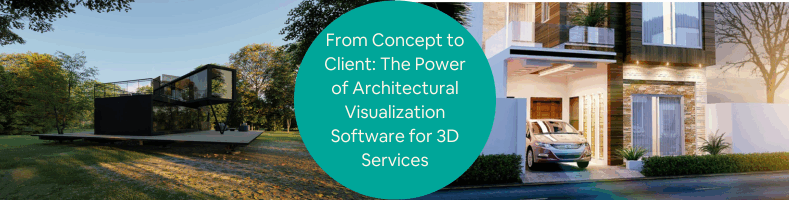
Imagine yourself as an astute architect creating the plans for a gorgeous modern home situated on a hill. Your design sheets dance with crisp lines, roomy spaces, and striking views. Now, imagine presenting the same concept to a client utilizing solely verbal explanations and 2D technical drawing services. Crickets.
This is where 3D architectural visualization experts take center stage like the star protagonist in a design play. Industry biggie Cad Crowd professionals make the best use of such software tools.
That used to be the time when clients would have to squint their eyes over floor plans and imagine with their own minds to fill up the spaces behind us. Professional designers, using 3D visualization software, can take clients on tours of buildings that don’t yet exist. Want to feel the sunbeam streaming through your open-plan kitchen in the morning? Or that cozy rustic stone feature wall radiating warmly in the evenings with ambient lighting? No worries. Click here and click there, and voilà—your dream comes alive.
So, just how accurately does architectural visualisation software actually grasp an idea and make it so realistic that clients not only understand it— Clients love it? Let us find out.
The design translator you never knew you needed
RELATED: How structural engineers improve custom home design when you hire architects & design firms
Architects are visualizers. They live in a realm of spatial geometry, scale, and structure. But come on—most clients aren’t blueprint literate. A 2D elevation will satisfy your design nerd inside, but to a client? It’s lines on paper.
3D visualization software is the translator of the architect’s vision and client comprehension that assists architectural design companies. In a way, it fills the communication gap and facilitates collaboration by translating floor plans into images or animation.
Visualizing being able to rotate a model 360°, zoom in to the master bathroom tile detail, or show what the kitchen island will be like with quartz versus butcher block. Customers never see it—it moves them. That emotional investment is invaluable.
Selling the invisible: Win clients before you break ground
Let’s discuss business for a moment. You can be the next Zaha Hadid, but if you can’t sell your vision to the people writing checks, your ideas remain in the sketchbook.
Architectural visualization software doesn’t just communicate ideas—it sells them.
Fly-throughs and good quality renders are today the norm in design pitches, proposals, and contests. Way before the first brick goes down, they help clients see the space. The gap between “let’s move forward” and “we’ll get back to you” can be based on that immersive experience.
When you’re pitching, do you want your client to get the feeling of walking into their perfect home? It is made possible because of visualization.
The toolbox: What the top 3D services are using
If you believe that 3D architectural visualization is a question of clicking on the “render” button and getting yourself a cup of coffee, then you’d better re-think that! The contemporary-day toolkit is so much more advanced, with technology breaking limits in ways that make your design come alive. What follows is an overview of the top tools that leading 3D rendering services are using:
Modeling tools (SketchUp, Rhino, Revit)
Any good design depends on good modeling tools. Models such as SketchUp, Rhino, and Revit are used to make exact, accurate, and scalable models. These help architects and designers draw from the structural plan level down to the material specification level. Right from skyscraper planning to cozy house planning, these models make the design correct and sensitive to change.
Rendering engines (V-Ray, Lumion, Enscape, Twinmotion)
After your model is complete, it’s time for some magic to occur. Rendering engines such as V-Ray, Lumion, Enscape, and Twinmotion bring your digital creation to life. These engines bring life to your design with dynamic lighting, real reflections, and even weather conditions such as fog or haze. It is this that turns a mundane model into a scene that’s alive and emotionally stimulating.
Post-processing (Photoshop, After Effects)
Even the best render is slightly incomplete. Final software like After Effects and Photoshop is applied in trying to get the final work on the finishing line. Color balancing, people filling up, or greens would be achieved, and this software allows you to reach the point where the render actually gives you a feeling of being within the environment. That is where you would make the infinitesimal fine adjustments and put on the finishing touches to the environment.
Animation & VR (Unreal Engine, Unity)
Static images are okay, but interactive experiences are where it’s really at. Programs such as Unreal Engine and Unity enable interior design experts to make animated walkthroughs or even virtual reality (VR) experiences, wherein clients can truly experience a space. It’s one thing to look at a static image of a room, but with VR, you’re able to move around the room, touch the space, and live through the entire thing before it’s ever constructed.
Ultimately, all these resources are brought together to form a responsive environment where technical precision and innovation exist side by side, allowing designers to take their ideas and turn them into interactive, immersive realities. With this powerful toolset, anything is possible!
RELATED: How 3D rendering helps collaboration between clients and design services companies
Complete design control: From mood boards to material textures
Mood boards used to be standard before the extensive use of architectural visualization experts. You may show samples to a client, such as color palettes, wood textures, and even a Pinterest board.
Today? Of course, you can replicate those colors and textures in hyper-realistic settings. That warm oak floor? Now customers get to experience what it looks and feels like in a real rendered space. Of course, experiment with different finishes, lighting, or even furniture layouts? Piece of cake. Just adjust the model.
This instant ability to iterate and provide “before and after” possibilities creates a sense of control and agency in customers. They are co-creators, not witnesses.
The psychological advantage: Seeing is believing
There’s something irresistibly compelling about a well-crafted 3D image. It stops traffic, begs to be touched, and, most importantly, generates trust.
Why?
Because it removes doubt, clients understand that they don’t need to guess or take their word for it—they can see what they’re getting. And that openness creates smoother approvals, quicker buy-in, and fewer edits down the line.
Good photos just mean good relationships.
Beyond pretty pictures: Visualizations as project management tools
This is the clincher: architectural visualization is not merely a gimmick marketing ploy. It is also an operational giant.
Visualization software can be linked to BIM (Building Information Modeling), which brings together information from various disciplines—architecture, MEP (Mechanical, Electrical, Plumbing), and structural engineering services. That is, your stunning pictures are also full of hard construction data.
You’re not just showing a wall; you’re showing its insulation values, the load-bearing calculations, and how it connects with HVAC. It’s form and function.
Even during construction, workers can refer to the 3D model to describe details and reduce on-site misunderstandings. That saves time. That saves money. That saves headaches.
Marketing marvel: Differentiate from the rest
In a competitive market, first impressions count. When you can present prospective customers with a scroll-stopping 3D walk-through of a concept instead of a groaning old set of blueprints, you instantly raise your game.
All architectural practices and freelance 3D artists now employ high-impact shots on all their marketing channels—sites, social media, brochures, even property websites. Not only is this beautiful, it’s clever, too.
For instance:
- A condo project can pre-sell 80% of its units prior to even breaking ground due to photorealistic rendering services and virtual reality tours.
- A small boutique architecture firm can enter high-end markets by offering its conceptual greatness in museum-standard imagery.
Your customers are overwhelmed with options and brilliant 3D content is your differentiator.
The feedback loop: Real-time collaboration and client feedback
Those are “design it, then send it out to approve” days. Computer visualization technology now allows remote collaboration.
Clients and architects may work together—remotely. It’s design charrette, steroids, too. Reposition the middle window height at the meeting. Alter the pitch of the roof while debating curb appeal. View ideas change at once on the screen.
This real-time feedback loop not only makes the process more efficient but also eliminates miscommunication. It’s design collaboration without the death by email thread.
Looking ahead: Automation, AI, and the next phase
Visualization of architecture is great, but what’s next? Buckle up.
AI is beginning to impact design today in the form of predictive modeling, generative design tools, and auto-layout suggestions. Would you like a building plot to get as much sunlight as possible? AI can do it for you. Would you like a dozen tea-themed façade options? It can be done automatically by rendering queues especially for CAD design services.
In a matter of seconds, visualization will not only represent your designs—but shape them.
We are talking about software that analyzes user likes, generates personalized choices, and even offers sustainable design options. Visualization is less documentation and more decision-making.
RELATED: Pros and cons of outsourcing 3D rendering services and visualization for your company
Who’s using it? Startups to global giants
Not just big players with well-known brand names are leveraging visualization tools. Freelance architects, boutique design firms, real estate developers, and even landscape design experts are hopping on the bandwagon.
And platforms like Cad Crowd, Fiverr, and Upwork are filled with capable 3D designers willing to make anything from a one-house abode to a complete resort complex.
It is never cheaper to get into the game, and the reward? Enormous.
Last word: Visualization is the new language of architecture
If architecture as a form is defined by storytelling in space, then 3D visualization is its most eloquent, most evocative language. It enables architects to express their vision, persuades clients to invest in it, and allows teams to implement it back to them with success and flourish.
Throughout the process from the first napkin sketch to the last walk-through, visualization is at hand every step of the way—describing, enriching, and astounding.
And in a culture where creativity is on the market, the ability to demonstrate—not explain—can be the ultimate design asset in your toolbox.
Struggling to produce amazing 3D visuals for your next endeavor? From solo acts to multibillion-dollar companies, hiring architectural visualization services from Cad Crowd might just be the catalyst that ignites your ideas off and chugging from idea to icon. Contact us today for your free quote!