There’s no universal pricing guide to tell you how much a 3D rendering should cost in the United States or anywhere else. Whether it’s architectural and product design visualization, the price varies as it’s dictated by various factors, especially quality. To make the discussion simpler this time, we’ll focus on architectural rendering experts and some of the major factors that affect its pricing.
Cost of visualizations
Renders and visualizations refer to the same thing here: photorealistic imagery of architectural designs. In some cases, they’re intended to be proof-of-concept as part of project planning, while in other cases, the visualizations are used merely as digital archives for hypothetical architectures to showcase ideas in portfolios, virtual exhibitions, and advertising content. So, if the purpose is to have a picture of architectural objects, why not just use photography instead?
Unlike photography where you need an existing building to be captured on camera, 3D architectural visualization services involve CGI objects created on screen from 3D models. To give you a general idea of how much it costs, the average price for high-quality rendering is between US$1,000 and US$2,000 for small and medium projects. You can expect to pay at least $3,000 if you’re talking about a large project like an entire residential area, complex interior designs, shopping centers, public parks, etc.
RELATED: How Architects Embrace Innovation for Modern Home Design Services with Companies
As the specification gets more intricate, the render artists deal with greater challenges and risks of mistakes, pushing the price higher accordingly. And those are only for static rendering. An animated architectural rendering is much more expensive, simply because the 3D animators have to build everything frame by frame. A resolution of 1920 x 1080p in 30fps is standard nowadays; the cost starts from $5,000 to $10,000 per minute.
Such a resolution is comfortable for online viewing or virtual tours, but you might need at least QHD (2560 x 1440p), or perhaps UHD/4K (3840 x 2160p) for business presentation purposes. Higher resolution and frame rate produce smoother motions overall. Every type of service has its own price range as well:
| Architectural Rendering Services | Estimated Cost | Note |
| 3D Floor Plans | $600 – $1500 | Prices are per image basis. |
| Interiors | $900 – $1800 | |
| Exteriors | $1400 – $2800 | |
| Animation | $6000 – $12000 | Every single object/element in the frame can be animated, such as door opening/closing, flowing water in the faucet, spinning fan, flicking switches, a walking person, etc. |
| Exteriors (Panorama/360° View) | $1500 – $2500 | Panorama is like an animated rendering, but the only thing that moves is the viewing angle, not the objects in the scene. |
When used in an actual project planning, an architectural rendering from architectural planning and design professionals serves as a powerful tool to visualize a concept in a realistic fashion. Instead of a sketch drawn with a pencil on a piece of paper, it’s a true-to-life depiction of an architectural design, conveying not only the physical shape and colors, but also materials, textures, spatial arrangements, and accurate lighting.
RELATED: How CAD Technology is Transforming the Future of Architectural Design Services Companies
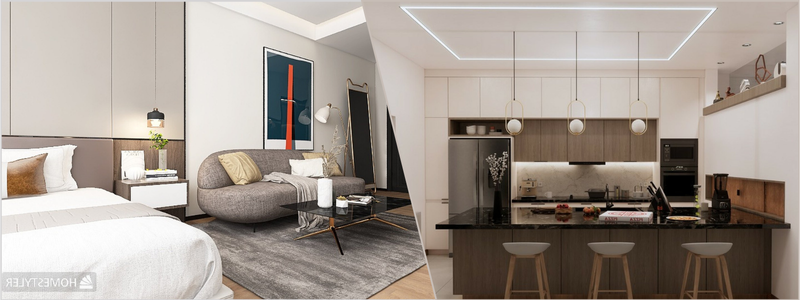
Think of it as a cinematic view of sketches – or the expressive version of a blueprint if you like – to visually describe a proposed structure in a way that everyone can understand. While creating an architectural render is pretty much a technical undertaking, the resulting product is meant to be as accessible as it possibly can. The imagery must be clear, unobstructed, and straightforward; there’s no busy annotation about the material properties, dimension, component fabrication, and so forth. An architectural rendering only has to do one job: make the otherwise conceptual idea look like a tangible final product.
Most, if not all, 3D rendering services won’t give you a cost breakdown that details how much they charge for each process in the workflow, and for good reason. Rendering process involves multiple steps indeed, but all of them are meant to be part of a single package. As such, you can’t order a rendering and then decide to stop halfway through the process. Let’s take the typical workflow of an interior rendering as an example; it starts with a project brief, followed by communication to define the specifics before getting into the actual modeling and adjustment, after which you get preliminary renders, and in the end final results.
RELATED: The Role of 3D Visualization in Winning Real Estate Clients for Your Firm
Now, the modeling alone consists of the following steps:
- Create 3D models of interior elements
- Apply colors and textures
- Select background scenes if needed, for example when the view offers a glance at the exterior through glass windows
- Configure the lighting scheme
- Adjust the cameras (or viewing angles)
- Start the rendering process
- Post-processing the image
- Deliver the final image
All those steps form a continuous workflow. In other words, the work has to include each and every step to actually produce a render. Using an exterior background for interior rendering projects is optional, but other than that, everything is mandatory. Just because the cost of configuring the cameras is more expensive than applying texture, it doesn’t mean you’re allowed to choose the latter and omit the former. Even if the 3D rendering professionals you hire are willing to provide a detailed cost breakdown, you still have to pay for the entirety of the service. That said, it’s not that difficult to pinpoint the factors that affect the pricing.
RELATED: The Impact of AI on 3D Architectural Rendering Services for Companies and Firms
Levels of complexity
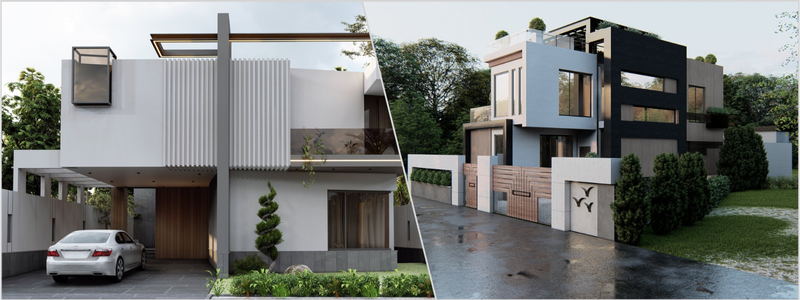
If we rank static architectural rendering from the least expensive to the highest cost, the order will be as follows: a single empty room, a complete interior, and an aerial view of an exterior. Much of the difference in pricing typically is dictated by size, environment detail, and the number of visible objects in the frame. You basically have three complexity levels:
- Low: perfectly suitable for small premises or compact rooms with minimum number of objects involved in the scene. In an interior setting, low complexity rendering should be more than good enough for (individual) areas like roof, corridor, balcony, or utility room. In the case of an exterior, it’s ideal for a garage, facades (close-up view), gazebos, pergolas, and so on.
- Medium: an apartment building and a small business center already look pretty impressive with medium complexity rendering. Those spaces may include a number of small objects, but not too many, as they potentially create the impression of a clutter rather than enhancing the aesthetics.
- High: the scale of things has everything to do with architectural renderings. For example, an aerial view of a manufacturing facility, skyscraper, an entire neighborhood, or educational intuition added with detailed surroundings is undoubtedly much more complex than an imagery of a stand-alone cottage.
The camera position – or viewing angle – also affects complexity of interior visualization services a great deal. For instance, the rendering of a lobby in a business center will include objects typically found in such a space, such as lounge chairs, elaborate ceilings, luxurious reception desk, massive chandeliers, and decorated walls, to name a few. But things change depending on the position of the camera. Every object aforementioned is visible if the camera is positioned at the door facing toward the inside; if the camera is positioned as if someone is looking outside from one of those chairs, the view must now include the door itself, and sometimes, one or two buildings across the street.
RELATED: From Concept to Client: The Power of Architectural Visualization Software for 3D Services
Level of details
Seemingly identical renderings of the same room don’t always cost the same. Resolution aside, the two images quite possibly have different levels of detail. Suppose one rendering comes with extensive texturing on the walls, sets of furniture, and flooring; the other appears to have similar-looking colors at a glance, but everything is flat and without additional treatment to apply texture.
When you zoom-in on a chair, for instance, the first image shows fabric upholstery with wrinkles and creases in all the right spots. In the second image, however, the 3D rendering artist included upholstery that is nothing but a plain color. There is also the issue with lighting. Just because the image is bright and everything looks clear, it doesn’t mean the visualization as a whole is realistic. There needs to be a good balance between natural and artificial lighting, shadow intensities, overlapping views of objects, and so forth.
Number of views
If the building or the room is complex enough, it’s very difficult to capture the entirety of the architectural style with only one rendering. Even when you’re working on a small room, you need at least two images with different camera positions: one at the door/entrance, and another on the inside/center of the room. A large-scale project, such as a shopping center or a high-ceiling apartment, requires more images. Many exterior renderings of houses only showcase the front side of the buildings, but this is barely enough to highlight the details.
RELATED: 5 Key Factors Influencing 3D Exterior Rendering Costs, Rates & Pricing for CAD Companies and Firms
Data and revisions
Providing enough information and 3D assets at the beginning of a project might save you a good amount of money in the end. Rendering is impossible without 3D modeling designers; the amount of time and labor spent on creating the 3D assets accounts for a sizable portion of the total cost. If you give the render artists just enough premade 3D assets to start the project, they don’t have to create everything from scratch. Also, thanks to the 3D assets you provide, the project is less likely to require too many revisions, which will also increase the cost.
Where Cad Crowd comes in
Architectural renderings are, first and foremost, communication tools to visualize design concepts and ideas before construction begins. They help encourage clients and stakeholders to provide feedback, and ultimately improve decision-making processes. Cad Crowd connects you with hundreds of 3D rendering services and independent render artists alike to help you visualize even the most complex architectural ideas with professional-grade CGI. Contact Cad Crowd today to get your free quote.