You’re finally embarking on that building project—perhaps it’s an apartment complex, a bespoke house, a warehouse, or a gleaming office tower. You’ve got architects on deck, timelines set, and renderings that take your breath away. But wait a minute—before you go live with an engineering design firm from industry giant Cad Crowd, there’s something that warrants a double-take: structural design mistakes.
These aren’t just technical footnotes. They’re the kinds of mistakes that can blow your budget, wreck your schedule, and in worst-case scenarios, compromise safety. Even best-of-class firms aren’t immune to missteps, particularly when the project complexity increases or communication falls apart. So, what are these prevalent pitfalls—and how can you avoid them? Can you even stay away from them in the first place?
Let’s take it all apart, with examples, advice, and some cautionary anecdotes to keep your project firmly on the ground.
Failing to consider site-specific factors
It’s easy to think of every project as a generic template. You might even go as far as assuming that all projects are pretty much the same inside and out. Alas, structural soundness doesn’t function like that. Weather, soil types, earthquakes, wind pressures, snow loads—all of these environmental factors directly dictate the manner in which a building must be built.
RELATED: How to choose the right BIM services provider for your architectural firm
| What goes wrong | What you’ll see later | How to avoid it |
| Certain architectural design companies leap to a structural design without performing an entire geotechnical analysis. Others apply canned loads from the building code and overlook the particular characteristics of the project site. | • Should your estimates appear drastically higher compared to similar endeavors, ask why. • If the firm promises “cost-cutting design,” ask what corners they’re cutting. | Has a site-specific geotechnical survey been done? Were wind and seismic loads computed based on your precise location? |
Overengineering or underengineering
This one’s the good old Goldilocks issue. A few companies go too cautiously, and others cut corners and gamble.
| What goes wrong | What you’ll see later | How to avoid it |
| Overengineering may be the perceived safer option, but it has a way of driving material prices up unnecessarily. Over-adding steel, concrete, or rebar might double your expenditure—without enhancing safety. Underengineering, conversely, is a time bomb. It may pass the inspection test in the initial stages, but light loads or environmental conditions can reveal weakness in no time. | • Should your estimates appear drastically higher compared to similar endeavors, ask why. • If the firm promises “cost-cutting design,” ask what corners they’re cutting. | Ask for a value engineering review. A good firm should be balancing strength, code compliance, and cost optimization—not swinging wildly in one direction or another. |
Inadequate coordination with architects and MEP designers
If the structural engineering experts are working in a vacuum, you’re in for a coordination nightmare.
| What goes wrong | What you’ll see later | How to avoid it |
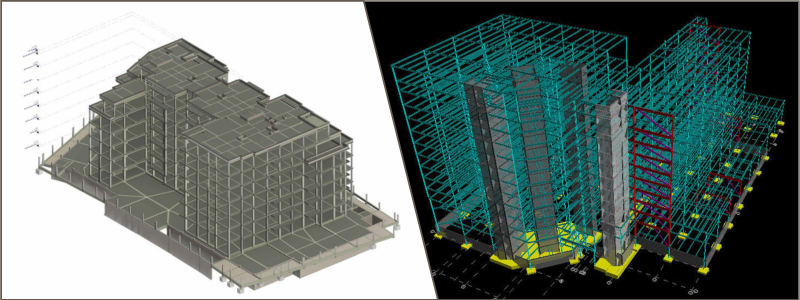
Structural elements might clash with HVAC ducts, electrical conduit, or plumbing lines. Beams might interfere with ceiling heights. Columns might land in the middle of a hallway or window. | Field fixes, redesigns, change orders, or even tearing down sections to rebuild. | Seek out engineering design companies with excellent BIM (Building Information Modeling) skills. Coordinating 3D with architects and MEP (mechanical, electrical, plumbing) drafting services prevents these errors prior to construction commencement. |
Communication skills also count. If the engineering team is not active in meetings or misses coordination calls, that’s a warning sign.
Insufficient load path consideration
Load paths are how forces travel through a structure—from the roof, down the walls, through the foundation, and into the ground. Mess this up, and even the most beautiful building could behave like Jenga under stress.
| What goes wrong | What you’ll see later | How to avoid it |
| • Missing lateral load paths • Unclear vertical load transfer • Oversimplified assumptions about load distribution | Construction delays, mounting labor costs, and on-the-fly design changes. | Don’t simply query, “Is this design to code?” Instead, request a quick walk-through of the load path logic. A self-assured engineer should be able to describe, in plain language, how the structure resists gravity and lateral forces. |
RELATED: How structural engineers improve custom home design when you hire architects & design firms
Disregarding constructability
A structure can be theoretically sound on paper but not feasible to construct economically on the job site. This is where theoretical thinking collides with job site realities.
| What goes wrong | What you’ll see later | How to avoid it |
| Designs call for custom steel members that are hard to fabricate or specify complicated assemblies that delay construction. Poor detailing may confuse contractors, leading to errors or improvisation on-site. | Construction delays, mounting labor costs, and on-the-fly design changes. | Select an architectural planning and design company that brings in contractors or construction managers early. Better still, inquire if they’ve worked on similar projects from design to build. Construction experience makes engineers more pragmatic in their detailing and design choices. |
Lack of adequate attention to structural detailing
Here’s where the devil resides: the details.
| What goes wrong | What you’ll see later | How to avoid it |
| Missing or unclear connection details, incorrect rebar layouts, and ambiguous annotations. These details may seem small, but they are crucial for safety and execution. | Contractors calling for clarification, misinterpretations, incorrect installations, or—worst of all—safety hazards during use. | Review a set of completed structural drawings from a past project. Are the details clear, complete, and well-notated? If they look rushed or vague, think twice before proceeding. |
Overreliance on software without manual checks
Structural analysis software has revolutionized the field. But it’s only as good as the inputs. If an engineer doesn’t question the output—or skips manual calculations to cross-check—you could be heading toward a digital disaster.
| What goes wrong | What you’ll see later | How to avoid it |
| Wrong load assumptions entered into the software, misapplied boundary conditions, or incorrect element properties. The design passes validation on the screen—but fails in reality. | Expensive redesigns, structural weakness, or collapse under actual conditions. | Ask if the company performs hand calculations to check important structural features. It’s not about being traditional—it’s about redundantly designing and catching errors before they hit the site. |
Not keeping current with local codes and standards
Structural codes change. They adapt to new science, new materials, and even shifting environmental conditions. Old ways, even if well-known, are risky or even against the law. This is where you can use services like structural analysis experts.
| What goes wrong | What you’ll see later | How to avoid it |
| Drawings using outdated seismic charts or expired wind loads may not pass current safety requirements. Worse, you could get red-flagged in the permitting process. | Permitting holdups, redesign expenses, or liabilities to litigation. | Ask: Which version of the building code are you designing to? |

A reputable firm will not hesitate to specify the exact code year and local amendments.
RELATED: How 3D commercial rendering services help present commercial architectural projects
Inexperience with the project type
A design team that specializes in bridges may not be ideal for a wood-framed multifamily housing project. Structural engineering is a specialty, and although most firms are generalists, it’s dangerous to take a one-size-fits-all approach.
| What goes wrong | What you’ll see later | How to avoid it |
| The team overlooks key architectural needs, uses inefficient framing systems, or simply isn’t familiar with the construction techniques typically used for your project type. | Frustration on both sides—plus redesign costs and wasted time. | Ask to see portfolio examples that closely match your project. If they haven’t done similar work, you’re paying for their learning curve. |
Lack of quality control and peer review
Even the most seasoned design engineering expert can miss something. That’s why peer reviews exist. Without them, small oversights snowball into major issues.
| What goes wrong: | What you’ll see later | How to avoid it |
| Undetected calculation errors, flawed assumptions, or missed detailing steps. | Expensive late-stage corrections, safety concerns, or structural inefficiencies. | Ask the company about their in-house quality control process. Is a second engineer checking over every project? Do they work from checklists? A proper peer review is one of the cheapest methods of finding errors before they make you pay through your nose. |
Final thoughts: Let the firm prove you trust them
Engaging a structural engineering design company isn’t merely checking off an item on your development to-do list. It’s a collaboration. A quality company will plan ahead, work cooperatively, and design responsibly. An exceptional one will challenge assumptions, clarify doubts, and stand behind their work from design to construction.
So how do you identify the great ones? What are the things you need to look for before anything else? Here are some pointers to consider to ensure that you don’t make a mistake that you might regret in the end.
- Ask difficult questions. Yes, don’t just inquire merely about timelines and deliverables, but about engineering principles.
- Ask for samples of their work and the clarity with which they can communicate.
- Verify credentials and interview for relevant experience on projects.
- Seek out curiosity—those engineers who query your project constructively are many times more personally invested in success.
Ultimately, structural design is not all about physics and mathematics. It’s about judgment, vision, and accountability. And when you discover a firm that places as much importance on those as you do, you’re already a winner. Browse Cad Crowd to search for that ideal firm for your requirements and ask for a quote for free today!