
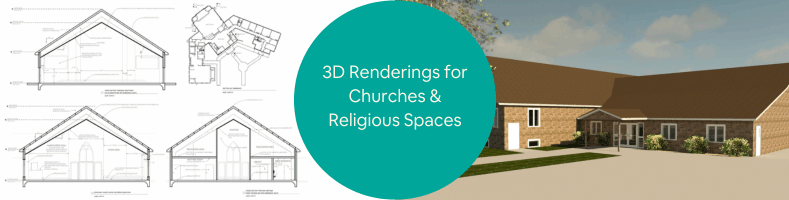
The designs of churches and religious buildings are often treated not only as architectural endeavors but also as reflections of spiritual values and doctrines. There have to be some profound differences between a reception area and a narthex, or between a hallway and a nave.
Just by looking at 3D renderings of churches, you can’t help but realize that somehow they give a different kind of vibe, unlike what you typically get from residential, commercial, or municipal buildings through architectural design services. While there’s no denying that churches, temples, synagogues, mosques, chapels, and kingdom halls are probably structurally similar to other types of buildings, places of worship are notably distinctive thanks to their unique ornaments, symbolism, and iconography.
Since 3D renderings are meant to reflect the unique qualities of physical objects, the visualizations of places of worship might require a slightly different approach as well. A place of worship isn’t just a structure made of brick and mortar; it’s supposed to be a sacred place filled with a heavy dose of religious undertones. But the good thing is that most of today’s render artists have mastered this intricacy and are well-equipped with modern software packages to produce photorealistic visualizations that reflect these undertones.
Because there’s fundamentally no difference in terms of techniques and methods, you’ll be hard-pressed to find any render artists who “specialize” in places of worship. Even in the AEC-focused and best freelancing platform, Cad Crowd, the term “3D renderings” or “architectural visualizations” basically covers everything from cabins and chapels to cathedrals and skyscrapers.
🚀 Table of contents
Is there really no difference?
From a technical standpoint, there isn’t any difference at all. Every architectural visualization service aims to depict a physical space in a photorealistic way. It’s not like the renderings of churches need different types of software, special 3D assets, or a peculiar technique of any sort. That said, you will need to create some kind of religious atmosphere in the scene. It can be more challenging than it sounds, but not impossibly difficult either.
Think of it this way: when you create an interior visualization of a home, you want the room to appear comfortable and relaxing, no matter the architectural style. To create that kind of atmosphere, you’d probably use details like ornaments, plenty of natural lighting, a huge potted plant in the corner, a spacious conversation area, furniture in natural colors, and so forth. And it’s pretty much the same with religious buildings, except that you need to focus on spirituality, calmness, and tradition.
We understand that conveying intangible qualities is often intricate, but if you can build a 3D rendering that depicts the feelings of comfort in a living room, chances are you’ll be able to create a visualization that displays a sense of divinity in a church. Also, you’ll be experimenting with the same tools anyway, such as lighting, decorations, ornaments, furniture, and color; you just need to apply a slightly different approach to achieve the goal.
To help you get a good grasp of how it can be done, we’ve compiled a short yet practical guide to identify the key points that distinguish the 3D renderings of churches from those of other buildings.
RELATED: Top design & drafting tasks to outsource for architects and architectural services firms
Narrative
Religious buildings, whatever they might be (churches, monastery, synagogue, temple, mosque, chapel, etc.) have one thing in common: they’re used as places of worship. The idea behind places of worship is to let people pray to their gods, connect or communicate with deities, or have a safe space for self-reflection, and this can be achieved through meticulous interior design services.
A lot of religious buildings are relatively small, like a chapel or musalla, while many others are pretty massive in scale and grandeur in detailing, like cathedrals or certain monasteries. A bigger space offers plenty of room to be creative, but it doesn’t mean that the smaller place of worship should suffer from any lack of religious narrative.
For example, an interior visualization can highlight specific areas of religious importance, such as the altar or the mihrab. If you make it the focal point and place the camera angle just right, it might actually represent the journey from the material world outside toward the tranquility inside. Take, for example, the altar in a church. It’s at the end of the passageway from the door, as if it’s the destination you’re heading to in the first place. And it’s the same story with a Torah ark in a synagogue or a mihrab in a mosque.
In contrast, the 3D renderings for residential building services or commercial buildings are usually all about personal style, functionality, or the regular flow of day-to-day activities. Suppose you’re creating a visualization of an office space; while you might want to showcase a sense of comfort in specific areas, the main narrative often revolves around the idea of efficiency, business activities, good customer experience, and branding. In institutional buildings such as schools and libraries, you’d want to showcase stories of accessibility, well-being, self-improvement, knowledge-sharing, etc.
Symbolism
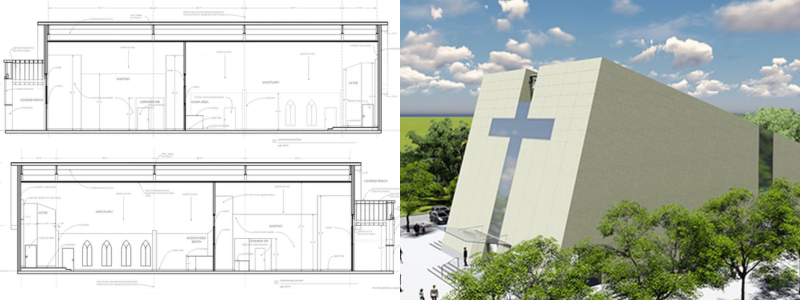
When architectural exercise is used in the context of religions, it’s difficult to separate it from the subjects of cultural traditions or even theological doctrines. This is why just about every element in a religious building carries a symbolic meaning related to faith and the idea of divinity. For example, the Christian cross represents and is a reminder of the crucifixion of Jesus, and the spires in a church tower are a symbol of reaching toward god. Decorative details may carry some significance as well, like the dove to represent the Holy Spirit, the lamb to symbolize Jesus as the lamb of god, and so on.
One of the most common symbols used in religious buildings is the mandala pattern. Christianity is known to use a variety of shapes evocative of the mandalas, such as the halo, rose windows, and the Celtic cross. The mandala pattern may signify the concept of holiness or basically everything about divine entities. Various spiritual traditions use the mandala to aid meditation and help focus attention. Tibetan Buddhism actually suggests that creating sand mandalas is a form of meditation in itself.
Churches and religious architecture, in general, have their own iconography and symbolism that set them apart from other types of buildings. Yes, you can also use a cross as an ornament in a 3D rendering of a home, but it’s rarely the highlight of the scene. Architectural design experts choose design choices in non-religious buildings that are typically influenced by contemporary trends, practical considerations, or even branding strategy rather than any particular belief system.
Space and light
We mentioned earlier that a big space offers plenty of elbow room for creative touches, but it might not be the case in churches. One of the main ideas behind a religious building is that it should provide a safe space for everyone seeking shelter against the bother of the material world. A massive cathedral, monastery, synagogue, temple, or mosque is supposed to be a sanctuary that also serves as a place for meditation; therefore, it should be grand and peaceful at the same time to deliver the sense of awe and tranquility. The point we’re trying to make here is that just because you have a lot of space to be creative, sometimes it’s best to leave it empty.
There’s no need to be playful with the decorations on the wall or chandeliers hanging from the ceiling; clutter-free spaces make a church feel enormous. If you combine that with all the symbolism positioned in the right spots, it’s a small wonder that being inside a cathedral feels like a spiritual experience. Seeing a rendering of the space probably isn’t at the same level, but at least it’s close to that. Vaulted arches and high ceilings seem to force you to look upward–the direction most people point to when they’re praying.
Just like with every 3D architectural visualization service, light plays an important role. The difference is that in the 3D rendering of churches and religious buildings, light isn’t just for illumination purposes. It can be a symbol of the divine, a spiritual presence, and, of course, enlightenment. For instance, churches often have massive stained-glass windows full of symbolism and iconography of Christ; when the sunlight filters through the window, not only does it cast colorful patterns but also creates an ambience of religious reverence. The visualization of a mosque might focus on the use of light and shadow to reveal intricate geometric patterns on the walls and floor, whereas a rendering of a temple might emphasize the use of candles to illuminate sacred objects and deities.
A clever interplay between natural light, artificial light, color temperature, and shadows is important in every architectural visualization. For a religious building, the interplay is supposed to give a spiritual ambience and the atmosphere of calmness. The rendering should reflect peacefulness instead of coziness, tranquility rather than comfort, divinity, but not fantastical. We’re aware that setting one apart from the other is kind of tricky, but you can always make use of the religious-themed ornaments and visuals to make the point.
Stained-glass windows
Speaking of light going through stained-glass windows, we must say that not every church has them, but they’re a common feature in church design nonetheless. More than just for aesthetic elements, stained-glass windows also serve for didactic purposes to some extent.
Every type of building, religious or otherwise, can have stained-glass windows. However, religious buildings almost always decorate the elements with religious symbols as well. In churches, these windows may depict the imagery of saints, biblical scenes, Jesus himself, the Virgin Mary, the angel Gabriel, and so forth. In mosques, the ornaments often include Islamic calligraphy, unique geometric patterns, etc.
If light is used for more than illumination, which can be taken to the next level using lighting design services, the stained-glass also has another purpose besides displaying religious ornaments–in this case, color. The complex patterns created using glass of various colors produce some stunning effects on the walls and floors. For example, the intricate stained-glass windows installed in the Nasir-ol-Molk Mosque, also commonly referred to as the Pink Mosque, cast a collection of mesmerizing kaleidoscope effects, flooding the interior with vibrant colors. The pinkish floor (hence the moniker) intensifies the color effects, too. In many Catholic churches, each color actually has a deep symbolic meaning. Purple signifies God the Father, red indicates martyred saints (as well as love and hate), green for generosity or charity, gray for mourning, black for death, and so on.
Admittedly, stained-glass windows add to the complexity of the 3D rendering. But at the same time, they’re the most eye-catching signs to show that the rendering is, in fact, for a religious building.
Unique challenges
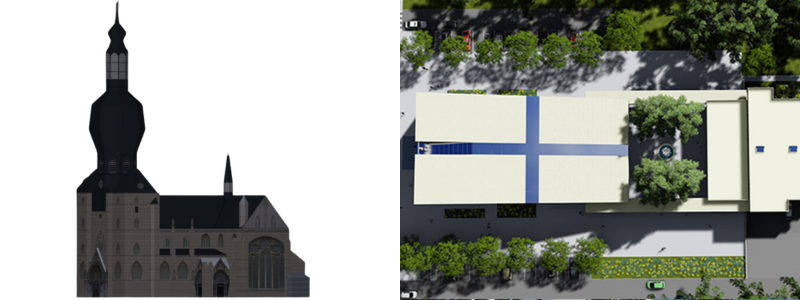
Although the fundamentals of the 3D rendering process are all the same no matter the building type, the architectural visualization of a place of worship does come with some unique challenges that might separate it from, say, residential and commercial types of 3D rendering services. All these challenges–more like specific nuances rather than actual hurdles–stem from key points we’ve established earlier. Chief among these are the following.
Upholding faith-based sensitivities
Every religion has its own iconography and symbolism (which play important parts in relation to building ornaments and decorations) as well as layout arrangements and architectural traditions. Regardless of the religion, the 3D rendering of its place of worship must display a respectful portrayal of those sensitivities.
Accuracy and aesthetic aspects are essential, but avoiding offense is of the utmost importance. Imagine a scenario where the architectural visualization of a church omits a crucial icon, such as a Christian cross or a depiction of Jesus; such an error might be regarded as a brazen misrepresentation. The placement and the traditional orientation of architectural elements like altars, Torah arks, or mihrabs must be taken into account as well. All these necessitate proper research into the traditions and tenets of the specific religion.
Facilitating religious rituals
A place of worship is meant to provide a safe space for people to exercise their faith and engage in religious rituals. Therefore, the architectural design often provides hints about how these practices are conducted; the layout should tell you how people move about and make use of the available space.
For example, a mosque usually has an open courtyard where people do their communal prayer; the lack of major furniture pieces in the interior might suggest that people sit on the floor during certain rituals. Churches, on the other hand, have pews where people sit during sermons and ceremonial/processional services. The point is that the 3D rendering of a place of worship needs to showcase how the architectural planning and design service accommodates a religious purpose.
Incorporating spiritual ambience
Functionality, efficiency, and productivity might be the main points when you’re creating a visualization for residential and commercial buildings, but that’s rarely the case with a place of worship. Instead of portraying a personal or professional atmosphere, your primary goal is to incorporate an ambience of spirituality into the scene. For instance, a Buddhist temple emphasizes mindfulness and tranquility; for a chapel, a sense of self-reflection and serenity; for a mosque, an atmosphere of allegiance and devotion; for a cathedral, a feeling of transcendence and reverence. All these ambiance qualities are admittedly subjective; they can be difficult to visualize, but clever use of color palettes, lighting, and composition can help evoke the intangibles.
Balancing artistry and accuracy
Precise measurements and accurate geometry are the foundations of good 3D renderings. In an architectural visualization of any other building type, putting accuracy as the top priority should be the only thing you need, and it will serve you well. For a place of worship, however, accuracy alone might not be enough because it takes some serious artistic sensibility to evoke the intangible spiritual qualities of a building. The 3D rendering of a religious structure should not look sterile. It cannot suffer from any lack of religious tones. At the same time, sacrificing accuracy for the sake of artistry is an equally terrible idea, and it is something that is kept in mind even for 3D modeling design services for various objects and sections inside the space. Balancing between accuracy and artistry often involves the use of atmospheric elements (such as dust motes in light beams, soft mist, colored refractions through stained-glass windows, etc.) and, of course, clever camera angles.
Injecting cultures
The architectural styles of places of worship are often a blend of historical elements and regional contexts. For example, churches in London should (and inevitably) look different from those in Tokyo, in the same sense that mosques in Istanbul are notably unlike those located in Beijing. The differences in appearance are all affected by the types of materials (wood, stone, bamboo, concrete, and so forth), ornamentations, color schemes, and spatial arrangements. In some cases, the supposedly similar buildings have vastly different structural constructions. And when you’re creating the visualizations, even the surrounding landscape can contribute to this cultural context. In general, all architectural visualizations must be sensitive to the local cultures. But this issue intensifies when the building in question is a place of worship, because it’s supposed to reflect cultural backgrounds, historical contexts, and religious atmosphere all at the same time.
RELATED: How to hire freelance CAD design talent for your project: Tips for design companies and firms
Conclusion
The rule of thumb in creating an architectural visualization of a church or any other religious building is to first understand how they’re different from residential, commercial, or institutional structures. A place of worship is not a place where people live, work, and conduct businesses; they’re supposed to be sanctuaries for practicing religions, worship, community gathering, contemplation, and displaying devotion to the divinity. Much of their designs are influenced by religious symbolisms, historical context, and cultural backgrounds.
At the end of the day, an effective 3D rendering of a place of worship requires not only technical proficiency but also artistic and cultural sensitivity on the render artists’ part. It’s more than just a sterile depiction of a religious building; it’s about capturing the spiritual essence and injecting religious atmosphere into the scene.
Whether your visualization is for a new build or renovation project, it’s a job best left to professionals, perhaps even a rendering firm with proven track records and years of experience. The freelance render artists at Cad Crowd would be a good bet, thanks to the platform’s pre-screening process and overall due diligence in the approval process. Get a free quote today!



