
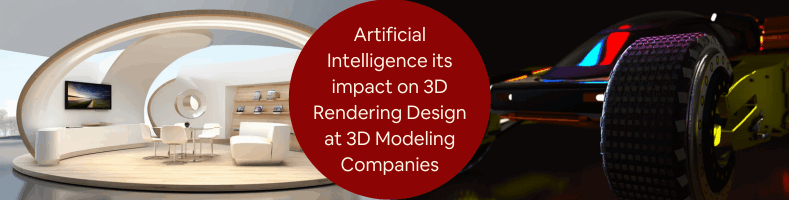
The platform for 3D modeling and rendering has changed radically and amazingly in recent years because of the advancement and distribution of artificial intelligence (AI) software and their integration step by step within the working process. For the best 3D modeling design firms on the market, giants like Cad Crowd, AI is no longer a word; it is changing their work into unprecedented levels in terms of stages of productivity and creativity.
Whereas traditional 3D rendering once depended so much on human intervention, AI-aided developments now are synchronizing everything from conceptualization to visualization with accuracy, saving time, and even opening new paths of innovation.
Hereafter, we will observe how AI is revolutionizing 3D rendering design, the technology utilized, and the impact on designers and clients both in the constantly changing arenas of architecture, interior design, product modeling, and beyond.
The emergence of AI in 3D rendering
AI’s introduction to 3D rendering started with the increasing necessity for quicker and more streamlined workflows for those industries that were highly reliant on high-fidelity visual output. Conventional 3D rendering was very time-consuming with extensive human intervention at almost every phase—concept and modeling to lighting and texture. Rendering would take hours or days based on the complexity of the model, with each detail being manually adjusted by designers.
Enter artificial intelligence: a game changer for reducing both time and labor-intensive processes while improving results. AI’s core strength in 3D rendering services lies in its ability to automate repetitive tasks, simulate realistic environments, and predict the best visual outcomes based on existing data. With machine learning and neural networks, AI can now help 3D modeling companies create lifelike renders in a fraction of the time.
RELATED: How to hire freelance CAD design talent for your project: Tips for design companies and firms

Speeding up the rendering process
Rendering, in short, is the operation of generating a two-dimensional image from a 3D model by mimicking light, shadow, and texture in a virtual world. Previously, it was a task that demanded copious amounts of computing power and long processing times. A perfect case in point would be rendering photorealistic images of architectural models, which could take a few hours or days to produce, especially when dealing with complicated models or high-definition textures.
AI-driven software like NVIDIA’s DLSS (Deep Learning Super Sampling) or AI-driven real-time rendering software such as Unreal Engine’s MetaHuman can now cut down rendering time by orders of magnitude. They can render lighting, shadows, and textures in real time, and designers receive instant or near-instant feedback. This has enabled 3D modeling firms to deliver high-quality visuals at a quicker speed, while pleasing the clients as well as the designers with quicker project timelines.
For designers and product designers, quicker rendering translates to more iterations, tighter feedback cycles, and overall better design. What used to take days now takes hours, with more time for creative development and refinement.
Increased realism and accuracy
One of the biggest benefits AI contributes to 3D rendering experts is the ability to render scenes more realistically. Machine learning algorithms can be trained with millions of pictures, videos, and patterns of real-world environments and can scan large amounts of information about them to make incredibly realistic models of natural worlds. This translates into product design and architecture as meaning 3D rendering can now reproduce real-world lighting effects, materials, and textures with breathtaking accuracy.
Software such as Chaos V-Ray and Autodesk’s Arnold is a case in point. These render algorithms utilize AI to simulate more accurately how light works, thus creating more textured outputs that are representative of the way light behaves around objects in reality. For instance, light transmitted through glass windows or shading cast on an irregular surface is simulated better now, incorporating yet another level of realism to the resulting render.
In addition, AI can be used to automate material and texture generation. Software such as Adobe’s Substance utilizes AI to automatically recommend the optimum textures for a model’s geometry and environment, saving a significant percentage of time spent on manually creating and applying textures. Apart from accelerating processes, it also gives the optimum quality of textures for a range of materials, adding visual interest to a design.
Enhancing user experience with AI-based solutions
In addition to altering the manner in which designers produce images and render them, AI is also enhancing the manner in which expert CAD designers engage with the creation process. Before, creating and working with 3D models involved learning complicated software and having vast knowledge of 3D geometry. However, AI-based solutions now ease the process through easy interfaces and intelligent assistants that can help designers navigate the process.
Take the case of AI-based design assistants like Autodesk’s AutoCAD and Revit. These aid design elements include auto-completion, auto-error checking, and even auto-tuning of models. These applications use machine learning to detect patterns and suggest design elements most likely to get the desired result. For interior designers and architects, this can substantially reduce the learning curve on 3D modeling software, allowing them to focus on creativity and innovation rather than technical challenges.
The potential of AI to predict user behavior also enhances productivity in the workflow. It can then recommend lighting schemes, camera positions, or even object positions that maximize the overall structure, something that would have required designers to spend many hours experimenting manually. This proactive, predictive method not only streamlines the process but also leads to more evolved and more harmonized visual arrangements.
RELATED: How 3D product design, rendering, and animation services can benefit companies and increase sales
AI and the future of virtual reality and augmented reality integration
The convergence of AI with other technologies, such as virtual reality (VR) and augmented reality (AR), is another space where a gigantic future lies for 3D modeling experts. VR and AR are already revolutionizing industries such as real estate, interior design, and entertainment by virtue of the fact that interactive experiences can be provided to end-users and consumers. If the VR and AR systems are combined with AI, even designers can provide more realistic, personalized, and interactive experiences.
AI-driven VR environments, for example, can adjust lighting or texture in real time automatically based on the user’s interaction, so it becomes an adaptive experience. It is simpler to work through architectural designs or product designs with this integration, providing a more enhanced user experience as well as a better understanding of how a space or product will perform in the real world.
For 3D modeling businesses, having AI available for the creation of quick VR or AR-ready models equips them with smoother presentation and interactive checking capabilities in design. Customers can walk through fully immersed 3D spaces or critique mock-ups of products as if they were really touching actual products, and improved communication and decision-making result from it.
Predictive AI in design innovation
Not only is AI a method of augmenting existing workflows; it’s also opening up new possibilities for innovation in design. With predictive analytics and pattern matching, AI will enable designers to predict future trends and propose substitute design solutions. Through analysis of large sets of data on past designs, customer behavior patterns, and industry trends, AI can propose suggestions for design elements that would otherwise remain hidden, which is especially useful for product design firms.
Artificial intelligence can also be used in 3D modeling to generate generative designs, wherein software goes through an enormous range of design options based on specific parameters. These algorithms generate out-of-the-box and new solutions that may be challenging or time-consuming for humans to accomplish on their own. This generation-based philosophy of design is increasingly popular among product designers and architecture firms when attempting to exceed the bounds of designing, creating new ideas, and operational solutions that integrate form, appearance, and functionality.
The impact of AI on client relations and expectations
AI also benefits 3D modeling firms by enhancing the quality and speed of the design, but also by enhancing client relations. Customers prefer to receive not only static renders but also a sense of how a space or an object will evolve over time, how it will interact with other objects, and how it will behave under different conditions. AI-based tools can make it feasible to facilitate such dynamic vision, with real-time, interactive, and fully immersive experiences for the clients of consumer product design firms.
Additionally, the capability of AI to produce highly accurate and photorealistic renders allows clients to better visualize what the final product would look like without having to be built or created yet. This minimizes the risk of miscommunication and misunderstanding between the clients and designers, resulting in more successful projects and greater client satisfaction.
RELATED: How AI innovations transform modern consumer product design at agencies & companies
The ethical implications of AI in 3D design
As AI is increasingly incorporated in 3D rendering design, the ethical consequences of deploying it have to be considered. One of the biggest issues is employment loss. As more and more automated work is done by AI in the design process, designers’ and technical experts’ positions may be perilous. But almost all of the experts are sure that AI shall never replace human beings, but assist them so that the designers may use their energy in more strategic and inventive activities, and enable AI to do dull work.
The second issue is the utilisation of AI to enable diversity and inclusion in design. The AI systems are as good as the data with which they have been trained, and if the AI systems are created with biased or restrictive data, then chances are that they might actually end up reinforcing prevalent stereotypes or overlooking underrepresented design viewpoints. There is a need for HDR rendering design services to make sure AI software is used responsibly with blended input and control, not to inject biases into final products.
Conclusion
Artificial intelligence is turning 3D modeling and rendering into a more realistic, quicker, and more innovative process for solving design problems. For 3D modeling businesses, AI can produce higher-quality output in less time, enhance the user experience, and provide clients with more interactive and engaging design experiences. Though there are challenges ahead in the form of ethical issues and job displacement, the future of AI for 3D rendering is bright.
Cad Crowd is here for you
With each step into technology in AI, the applications of AI for design will multiply, offering novel ways of creative design, productivity, and customer satisfaction in 3D modeling. Don’t miss this opportunity to learn Cad Crowd and find your perfect 3D partner for your upcoming projects. Contact us now and request a free quote!



