
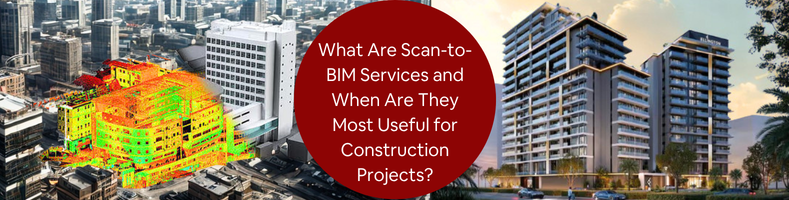
As technology rapidly advances, the construction and architecture industries are also opening their doors to more effective ways to deliver projects that are accurate and efficient. And one of the most popular and fastest-growing solutions is Scan-to-BIM. Scan-to-BIM is the process of scanning a real building or structure and transforming it into a precise, detailed digital model. Using this digital model, maintenance, planning, renovations, and construction projects are accurately created and built. Most of the industries now don’t just rely on old drawings or the traditional measurements. Instead, they use laser-scanning technology to capture accurate data for every building.
This high-tech approach helps in reducing errors, saving time, and improving every project planning. Scan-to-BIM services is useful, especially for renovation projects and buildings with complex measurements. It may be difficult to find and hire experts, but through Cad Crowd, businesses can connect with experienced BIM and CAD professionals more easily, as they offer an accurate, reliable process for connecting with experts who deliver high-quality Scan-to-BIM services.
🚀 Table of contents
What is scan-to-BIM?
Scan to BIM is a modern process that is widely used by the construction and architecture industries, wherein they scan real buildings or structures in order to turn them into a detailed and precise 3D digital model. It’s a way to create a digital copy of an existing space for construction, renovation, planning, or even maintenance. It is very convenient because, instead of taking the usual measurements, this advanced scanning technology captures accurate building data more efficiently and quickly.
RELATED: Fundamentals of BIM & Modeling Design Services at Building Information Modeling Companies
In this process, a major step is laser scanning. Laser Scanning collects the exact measurements by capturing millions of points from different surfaces, such as ceilings, walls, floors, and structural elements. After that, the captured points are going to be combined in order to create a point cloud. A point cloud is a digital representation of a building made up of millions of tiny dots that show its shape and dimensions with greater accuracy and detail.
After completing the point cloud, professionals then use the Building Information Modeling (BIM) software to transform scanned data into a smart 3D model design. This is not your ordinary 3D model since BIM models contain important information regarding the structure, building systems, materials, and dimensions. This really makes the work of contractors, architects, and engineers more efficient and accurate throughout the entire project.
How scan-to-BIM services work
Site scanning and data collection
Scan to BIM process starts with site scanning and the collection of data. At this early stage, professionals are bound to visit specific buildings or structures where they begin using advanced laser scanners to capture accurate measurements of certain spaces. With these scanners, detailed information is being recorded from floors, ceilings, walls, windows, pipes, doors, and other important structural elements.
RELATED: Scan To BIM: Advice for Working with an Architectural Design Services Firms
Laser scanners work by sending out laser beams that bounce back almost immediately after hitting specific surfaces. After it, the scanner measures its distance from the object, and then it collects detailed measurements in just a short span of time. Compared to manual measurement methods, laser scanning is much faster and more efficient, with more accurate results, especially for large and complex structures
Point cloud creation
After completing the scanning process, the collected data is then processed into a file called a point cloud process. A point cloud is composed of millions of tiny measurement points that represent the exact shape and dimensions of a scanned structure. You can think of it as a highly detailed digital map of a scanned building or structure, made entirely of small dots. At each point, there is location data that helps recreate the structure more accurately in a digital environment. And the more data points collected, the more precise and detailed the digital representation. Point clouds serve as the primary basis for creating the BIM model.
BIM model development
If the point cloud data is already prepared, BIM specialists then convert it into a detailed BIM model using specialized software such as Autodesk Revit. In this stage, professionals carefully trace and model the structure’s mechanical elements, structural, and architectural components based on the scanned data. The BIM model is far more than just a standard 3D visual representation. It also provides intelligent information about the building, including its layout, systems, dimensions, materials, and structural details. Through this, contractors, architects, and engineers are able to use the model efficiently for construction, planning, maintenance, renovation, and even in project coordination.
RELATED: How BIM Objects Play an Important Role in Construction Companies and Project Lifecycle
Review and quality checking
Before delivering the final BIM model output, the project undergoes review and quality checks. Professionals verify its accuracy by comparing it with the original scan data to ensure that every important detail is represented accurately. In this stage, any cases of corrections and adjustments are thoroughly made if needed.
This way, they could identify potential errors and eliminate them to improve accuracy and ensure the BIM model strictly meets industry requirements and standards. Once everything is checked and proven to be completed, the model is prepared for delivery and can then be used for construction, design, or any facility management purposes.
Key technologies used in scan-to-BIM
3D laser scanning
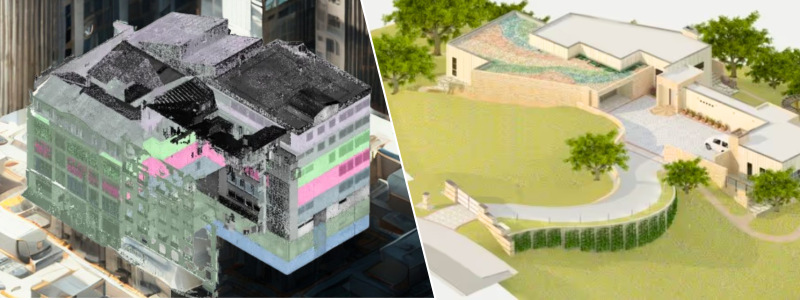
One of the main technologies used in the Scan-to-BIM process is 3D laser scanning. It specifically works by sending laser beams that hit surfaces such as ceilings, floors, walls, and structural components. Once it hits the object, it directly bounces back to the scanner, which would directly measure its distance and record the exact position of that specific point.
This is repeated a million times within seconds to ensure accurate measurements of that specific building or structure. It is a very important technology because it enables professionals to collect precise data efficiently and quickly. Compared to manual measurements, 3D laser scanning is more detailed, reducing errors, saving time, and providing a more accurate representation of the structure. It is mostly used for complex spaces, large buildings, and renovation projects where accuracy and reliability are critical.
RELATED: 3D Modeling for the Construction Industry: How 3D Models Help Construction Companies
Drones and aerial scanning
Another tool that is widely used in the process of Scan-to-BIM is drones and aerial scanning technology. It is usually used for infrastructure projects, large-scale buildings, and hard-to-reach areas. Drones are known for being equipped with cameras or laser-scanning devices that capture aerial images and obtain accurate measurements from above. It makes scanning of towers, rooftops, bridges, and other elevated structures way easier, safer, and more efficient.
Using drones eliminates the need for manual inspections, which are much easier, especially in difficult and dangerous locations. It speeds up data collection as well and delivers broader site coverage even in just a short span of time. This technology is really useful, especially for industrial facilities, construction sites, and any outdoor infrastructure projects that need to be captured from above, especially when ground-based scanning alone is not enough.
Point cloud software
After completing the scanning process, specialized point cloud software is used to process and organize all the collected scan data. This mainly combines millions of measurement points into a specific digital point cloud, which accurately represents a certain building’s dimensions and shape. Point cloud software helps professionals align, clean, and manage scan data before converting it into an actual BIM model. It also helps remove any scan noise or issues and ensures that all data is accurate and ready for modeling. With the use of this software, a large amount of information is being handled smoothly when gathered during scanning.
RELATED: Differences between 3D Modeling, CAD, and BIM Explained
BIM software platforms
In the Scan-to-BIM process, software platforms are undeniably essential, as they transform scanned data into 3D building models. One of the most used BIM tools is Autodesk Revit. It mainly helps professionals create accurate digital representations of buildings or structures based on point cloud data gathered during scanning. Through these platforms, engineers, architects, and designers are allowed to model important building components like ceilings, walls, doors, floors, windows, and other structural systems with accuracy.
It is not your ordinary 3D model since it contains precise information about the building, like its layouts, dimensions, materials, and even its mechanical systems. BIM software helps improve collaboration between the parties, as all information for the specific project is organized in a single digital model. Through this, different teams who work together ensure it is managed efficiently, detecting potential errors early to make better decisions throughout the project. By using tools like Autodesk Revit, they can create and organize accurate and data-rich building models, especially for renovation, construction, and facility management projects.
Benefits of scan-to-BIM services
Improved accuracy
One of the benefits of Scan-to-BIM services is that they improve accuracy. Compared to traditional measuring methods, which rely solely on manual measurements and often lead to human error. Scan-to-BIM uses laser scanners to measure precise points. It accurately scans structural or building details, creating reliable digital data. Through this, engineers, architects, and construction teams can have a reliable reference as they work throughout the process. Accurate and precise models help reduce the risk of design conflicts, incorrect measurements, and, most of all, the costs of revisions during construction and renovation.
RELATED: Features and Benefits of BIM Services for Architectural Design Companies
Faster project completion
Scan-to-BIM services certainly speed up project timelines by creating an efficient digital workflow. It no longer requires manual measuring and drafting plans, since professionals can already gather building data by the use of laser scanning process and easily convert it into a BIM model. It also benefits every business, since there’s no need to rely more on traditional measurement methods, allowing internal teams to focus on other important work.
With accurate, fully available digital models, project teams can start planning, coordinating, and designing faster. This allows everyone involved to work smoothly, reducing delays, boosting productivity, and enabling every project to move forward more efficiently from the very beginning to the end.
Better collaboration
Scan-to-BIM services really improve collaboration among industries such as contractors, architects, engineers, and other key project teams. Since BIM models contain organized and precise information about the specific building that is being focused on, everyone involved can get access to the same data.
RELATED: Should Your Company Invest in Architectural BIM Modeling Services for Construction?
They share this digital model to ensure clear communication between teams, smoothly coordinate designs, and easily identify potential issues before construction begins. In this way, misunderstandings and miscommunications would be less likely to happen, and project execution would be smoother as it progresses.
Reduced costs and rework
Scan to BIM effectively reduces costly mistakes and unnecessary revisions by providing highly accurate building data. If this process isn’t applied, it has more chances to result in multiple errors since inaccurate measurements and outdated drawings can really lead to a lot of rework, additional expenses, and project delays.
However, with the help of detailed BIM models, project teams can easily identify conflicts and issues as early as they can. This really helps avoid expensive changes during construction and improves the overall project’s efficiency. As the process goes on, reducing multiple errors and rework can really save businesses a significant amount of time and money, and everyone would be satisfied with the project result.
Efficient facility management
Scan-to-BIM services are also highly valuable, especially for facility management in planning future structures design or building maintenance. BIM models contain all the important information about a building, such as its layout, systems, components, and materials, so facility members can easily manage and monitor the property.
RELATED: BIM Design: Compelling Reasons to Use it for Architectural Projects and CAD Design Firms
These digital models significantly help with future upgrades, renovations, or repairs, making it more ready and readily available. So instead of working from scratch, teams can use the existing BIM model to plan the modifications or changes they need.
When should you use scan-to-BIM services?
Scan-to-BIM is highly recommended, especially for businesses seeking renovation projects, as this service provides accurate, detailed information about a building. There are many cases where old building plans are outdated, contain missing details, and no longer reflect the current condition of the structure due to past modifications or repairs. And using manual measurements can really take a lot of time and could possibly lead to multiple errors and issues that could affect the entire project process later on.
However, through laser scanning and BIM technology, project teams can easily capture detailed, accurate measurements of the building and convert them into a reliable, efficient digital model. This allows contractors, architects, and engineers to have a clear understanding of the intricate details about the structure before they hop into the renovation. With an accurate BIM model, professionals and project teams can effectively plan renovations in advance by detecting issues early and avoiding construction conflicts in the long run. This specifically helps minimize delays, reduce unnecessary and expensive costs, and improve overall efficiency in the renovation process.
Why scan-to-BIM is useful: renovations and remodeling
Historic building preservation
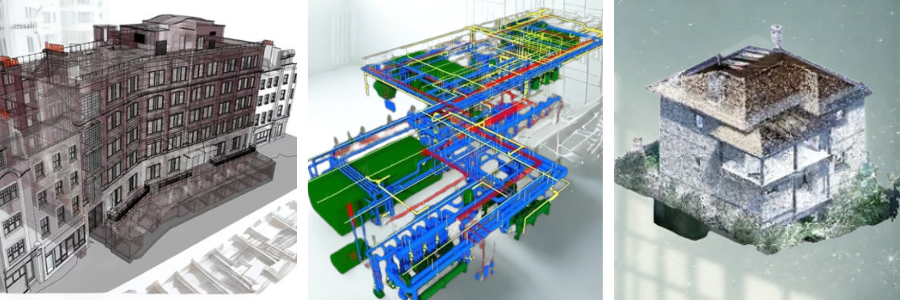
Historic and heritage buildings often feature delicate architectural details that require careful preservation. Scan-to-BIM services help create accurate, precise digital records of these structures without physically affecting or damaging the buildings themselves. Using laser scanning technology, project teams can capture accurate measurements, designs, and the condition of their structures.
RELATED: Do you Know the BIM Best Practices for Architectural Design Firms?
After scanning, it will be transformed into BIM models to support renovation, restoration, and other long-term preservation efforts. By using these digital models, project teams can protect important historical features while ensuring they remain organized and accurate, especially during repair planning and maintenance.
Facility management and maintenance
Facility managers and building owners often use BIM models to improve day-to-day operations and long-term maintenance. Since BIM models contain all the important information about a building’s components, layout, and systems, it becomes easier to track maintenance schedules, equipment management, and repairs.
So instead of just focusing on paper documents or outdated plans, they can access more detailed digital information whenever they need it. In this way, maintenance is improved efficiently, downtime is reduced, and future innovations or upgrades are supported in a more efficient and effective way.
Construction and infrastructure projects
Scan-to-BIM services are really valuable, especially for large-scale construction and infrastructure projects. Roads, airports, bridges, commercial buildings, and industrial facilities often require precise measurements and careful planning due to their scale and complexity. Using laser scanning and BIM technology, professionals can quickly create accurate digital models, improving coordination among contractors, architects, and engineers. In this way, errors are reduced, and the workflow is improved, all while supporting every project management team throughout the construction process.
RELATED: How Construction Drawings Enhance Safety and Efficiency with CAD Design Companies
Complex structures and hard-to-measure spaces
Not all buildings and structures have the same measurement points, and some are very difficult to measure manually because of their complex designs, shapes, or hard-to-reach areas. In situations like this, Scan-to-BIM technology is really helpful because it uses laser scanners to capture accurate data, even in high areas, and does so quickly and safely.
This is really useful, especially for structures with detailed interiors, industrial plants, curved surfaces, or areas with limited access. So, instead of relying on traditional measurements that often miss important details, laser scanning provides complete, precise data that is really useful for transforming into reliable BIM models, which are significant for planning and the entire construction process.

Common challenges in scan-to-BIM projects
Large data files
One of the most common challenges in Scan-to-BIM projects is managing a large volume of scan data. Laser scanners capture millions of measurement points, creating very large files commonly known as point clouds. These heavy files require powerful computers, large storage space, and specialized software to be processed efficiently.
RELATED: Top Tips You Need to Know for Choosing a BIM Company for Architectural Design & CAD Services Firms
Being unable to handle large data files can significantly slow down workflows, especially when the team doesn’t have the proper equipment or technical experience to work with them. That is why optimized software tools and proper data management process are crucial to keeping these projects organized and running smoothly.
Accuracy and quality control
One of the most important parts of any Scan-to-BIM project is having accuracy and quality control. Even the smallest error in scanning or modeling can significantly affect the final BIM model and lead to major conflicts or issues during the construction process. That is why it needs to have professionals who are experienced in the field to do the work since it is a very skill-based job.
Scanning to BIM specialists who are skilled and experienced are really equipped with knowledge and have the proper training. So, they really know how to appropriately capture scan data, process point clouds, and accurately create BIM models that surely meet the project requirements. It is also important to conduct regular quality checks and verify the model, as this helps ensure the final output is delivered reliably and precisely.
RELATED: How to Choose the Right BIM Services Provider For Your Architectural Firm
Coordination between teams
In every Scan-to-BIM project, there is always a team of people working together, such as contractors, architects, engineers, and BIM specialists. That is why it is important to have clear coordination among all the people involved, since poor communication can lead to significant inconsistencies, delays, and misunderstandings that would adversely affect the final model.
So, to avoid these potential issues, teams should set clear communication standards, manage and organize the workflow, and provide regular updates as the project progresses. Using BIM models and collaboration tools, everyone would surely stay aligned with the vision and work efficiently with one another throughout the entire project. It just feels lighter to be working with people you get along. It makes the workflow more engaging and more likely to maintain its productivity.
Cost of equipment and software
Scan to BIM projects require equipment that is high-tech, like powerful computers, laser scanners, and specialized BIM software, which are all very expensive to purchase and maintain for every business. That is why it is important to properly train employees to use these tools, since it can really cost a lot if they are damaged or broken.
But as businesses become wiser and smarter, they opt for an approach that benefits them more: outsourcing Scan-to-BIM services rather than building a full in-house setup. Outsourcing gives companies an advantage by allowing them to access a wide pool of experienced professionals, avoid buying expensive advanced technologies and equipment, and invest in software. So it really helps cut costs as well, since they no longer need to train, provide extra benefits, or pay salaries, since, through outsourcing, they are guaranteed to work with experts who really meet their project requirements.
RELATED: Embracing BIM: The Future of Building Information Modeling for Construction Companies
The cost of Scan-to-BIM services is typically calculated based on factors such as building size, project complexity, required level of detail (LOD), and the amount of scanning and modeling work involved.
| Project Type | Typical Building Size Estimated | Scan-to-BIM Cost |
|---|---|---|
| Small Residential Building | Up to 2,000 sq ft | $1,000 – $5,000 |
| Medium Commercial Building | 2,000 – 10,000 sq ft | $5,000 – $15,000 |
| Large Commercial Facility | 10,000 – 50,000 sq ft | $15,000 – $50,000 |
| Industrial Facility | 50,000+ sq ft | $25,000 – $100,000+ |
| Historic Building Preservation | Varies | $10,000 – $75,000+ |
| Infrastructure Projects (Bridges, Airports, etc.) | Large Scale | $50,000 – $250,000+ |
Conclusion
As more industries adopt digital construction technologies, Scan-to-BIM services will continue to grow, and their importance and reliability will be further fostered. It really feels different working with experienced professionals, as they help ensure every project is completed with accuracy and efficiency. There are a lot of platforms that provide businesses with BIM and CAD professionals, but nothing really works like Cad Crowd.
Cad Crowd offers a smoother, easier process for hiring professionals who are guaranteed to deliver dependable Scan-to-BIM solutions tailored to every project’s needs. If you or your business is planning a project that really requires accurate digital building models, you are in the right place. Since Cad Crowd can really help you connect and match with the right professionals who are technically and literally well-suited for the job.
RELATED: BIM Consulting & Drafting Services by Cad Crowd Freelancers
How Cad Crowd can help
Cad Crowd can connect you with a variety of professionals who can significantly impact your business and make your project more achievable. This platform covers a variety of fields and expertise rather than just one specialization that you can choose. It implies you will have the opportunity to experiment with various concepts that may meet your project’s requirements. Learn how it works or contact us today for a free quote!



