Arya S.
Parametric CAD Designer | STEP/STL, Drawings & Evidence-Based Design Checks
 Mumbai,
India
Global rank:
8,548
/
155,888
Skill pts: 10
CAD Design
build123d 0.10.0 | Python CAD / OpenCascade
About
I take care to make the geometry, calculations and handover files tell the same checkable story.
I turn defined product-design problems into editable parametric CAD, clear review drawings and a handover that explains what has been checked.
My focus is small product forms, hollow bodies and geometry changes where dimensions, wall thickness, file quality and manufacturing constraints matter. I work as an independent designer using AI-assisted Python CAD with build123d/OpenCascade. Deliverables can include STEP, separate STL part files, source parameters, review drawings and a check report. Required native software formats are agreed before work starts.
CARE IN PRACTICE — THE HOLLOW-BODY CASE STUDY
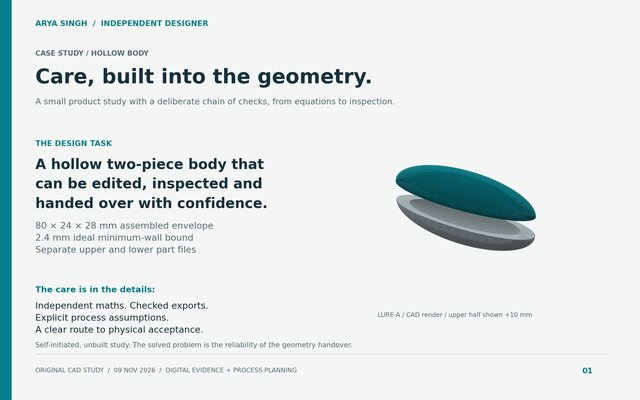
For an original 80 x 24 x 28 mm two-piece body study, I built a mathematical reference for volume and a 2.4 mm ideal minimum-wall bound. Comparing that reference with the CAD calculation exposed a roughly 0.23% default-integration discrepancy. Explicit-precision integration brought the STEP volume to within 0.0026 mm3 of the equation. I also removed collapsed STL pole facets, tightened the mesh and verified each half's edge pairing, winding, volume and scale. The two printable parts are checked separately from the assembled visualization.
The work continues beyond a clean model: the static mass/displacement ledger includes cavity air and ballast, and sensitivity calculations show why density, printing variation and water ingress must be measured. The drawing and test gates connect digital checks to process setup, dimensional inspection, sealing and physical balance. This is an unbuilt, self-initiated study; physical test results are still open.
HOW I CAPTURE COMPLEXITY
I break a design into parts, material layers and interfaces, then link each critical requirement to a quantity, units, operating condition, acceptance limit and evidence. Depending on the task, that includes geometry, fit, loads, energy and electrical paths, information flow, manufacturing and measurement uncertainty. Check coverage is defined for the project; an unmeasured assumption stays visible.
Start with a bounded review: share the task, current model or dimensions, intended process and required file format. We agree the deliverable, acceptance checks and first milestone before expanding the scope.
Arya Singh | Innovative Solutions Contractor
... more »
« less
I turn defined product-design problems into editable parametric CAD, clear review drawings and a handover that explains what has been checked.
My focus is small product forms, hollow bodies and geometry changes where dimensions, wall thickness, file quality and manufacturing constraints matter. I work as an independent designer using AI-assisted Python CAD with build123d/OpenCascade. Deliverables can include STEP, separate STL part files, source parameters, review drawings and a check report. Required native software formats are agreed before work starts.
CARE IN PRACTICE — THE HOLLOW-BODY CASE STUDY
For an original 80 x 24 x 28 mm two-piece body study, I built a mathematical reference for volume and a 2.4 mm ideal minimum-wall bound. Comparing that reference with the CAD calculation exposed a roughly 0.23% default-integration discrepancy. Explicit-precision integration brought the STEP volume to within 0.0026 mm3 of the equation. I also removed collapsed STL pole facets, tightened the mesh and verified each half's edge pairing, winding, volume and scale. The two printable parts are checked separately from the assembled visualization.
The work continues beyond a clean model: the static mass/displacement ledger includes cavity air and ballast, and sensitivity calculations show why density, printing variation and water ingress must be measured. The drawing and test gates connect digital checks to process setup, dimensional inspection, sealing and physical balance. This is an unbuilt, self-initiated study; physical test results are still open.
HOW I CAPTURE COMPLEXITY
I break a design into parts, material layers and interfaces, then link each critical requirement to a quantity, units, operating condition, acceptance limit and evidence. Depending on the task, that includes geometry, fit, loads, energy and electrical paths, information flow, manufacturing and measurement uncertainty. Check coverage is defined for the project; an unmeasured assumption stays visible.
Start with a bounded review: share the task, current model or dimensions, intended process and required file format. We agree the deliverable, acceptance checks and first milestone before expanding the scope.
Arya Singh | Innovative Solutions Contractor
Portfolio
Other experience
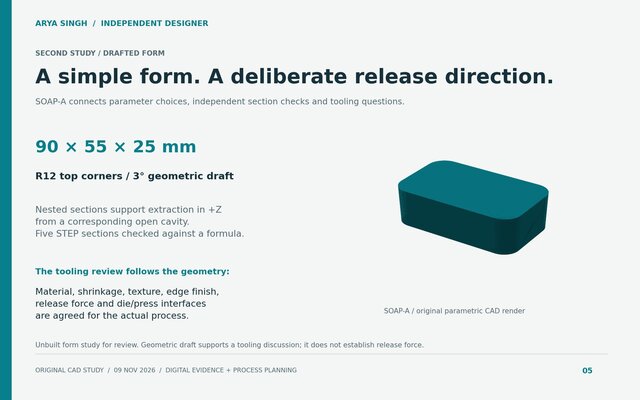
- Original CAD studies November 2026 — self-initiated LURE-A hollow-body and SOAP-A drafted-form studies. Developed editable AI-assisted Python CAD, STEP/STL handovers, review drawings and independent mathematical checks. Investigated numerical integration discrepancies, corrected collapsed mesh facets and checked the individual part files. Extended the review into process orientation, wall budgets, mass/displacement accounting and measurement-aware acceptance planning. Published visual case studies document the reasoning and evidence. These are original unbuilt studies, not prior client commissions or a physical product qualification.
Stats
0 followers, 0 following
Joined: November 9, 2026
Last seen: November 9, 2026
Area of Expertise
Location
Mumbai, India