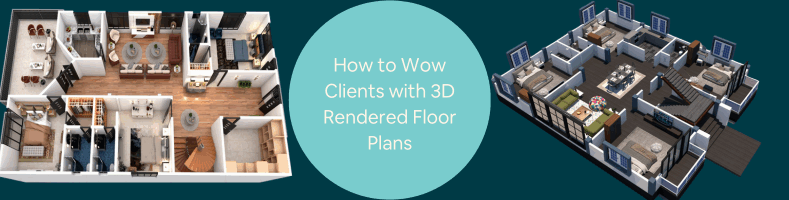
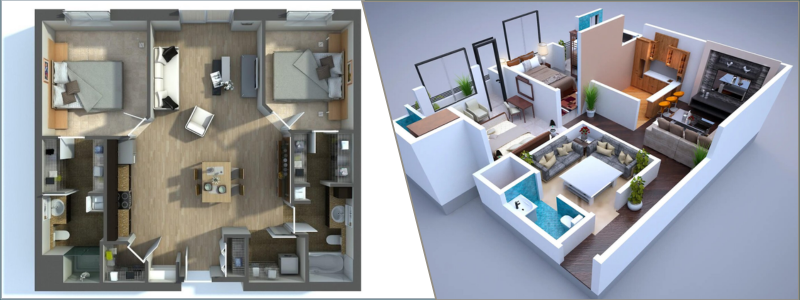
The idea behind a 3D floor plan is to let your client see the room layout and the overall interior design of a house/office from above, as if there’s no roof on the building. While a floor plan is traditionally a two-dimensional image filled with symbols and flat icons to represent furniture, fixtures, and every other object, you can now make it in 3D. As expected, it’s much more visually pleasing, simply because it depicts all the objects more realistically. For example, instead of using a flat and plain rectangle to represent a table and another, yet only slightly different, rectangle as a bathtub, you can actually use photorealistic models of an actual table and a lifelike bathtub in a 3D floor plan. For a contractor or an interior designer, a two-dimensional floor plan is likely good enough as a visual reference to do their jobs. However, for most clients, the image might look somewhat too technical, and the design gets too difficult to envision.
In general, without technical know-how and a bit of familiarity with construction project workflow, a traditional floor plan might be as good as practically useless to a typical client. In contrast, a 3D-rendered floor plan is pretty much self-explanatory. It doesn’t take someone with an architectural degree to grasp the proposed design. Now, a three-dimensional floor plan is a little more expensive and time-consuming to make than its conventional counterpart, but the result is worth every penny if you appreciate visual clarity and effective communication with the client.
Thankfully, Cad Crowd is the leading agency that can help you find thousands of professional 3D render artists who specialize in interior design and offer their services at competitive rates from AEC-specific platforms.
What makes a 3D floor plan good?
The answers shouldn’t be too far from the ideas of accuracy, clarity, and realism. On the subject of accuracy, even a 2D floor plan can do the job well enough. It’s indeed flat, filled mostly with outlines of walls, doors, windows, and objects, but undoubtedly accurate. What about clarity, then? Does the floor plan give clear enough information to help understand the design? It can be, as long as the room is pretty plain and simple without much going on in terms of furniture arrangement and decorative features. And on the subject of realism, well, there’s only very little of it for anybody to enjoy.
On all three criteria, the 3D floor plan is definitely the better choice. However, it wouldn’t be entirely wrong to say that they should be the bare minimum requirements; in other words, if you have a 3D floor plan, your client expects it to have all three at the very least. And if you want to impress the client, you’ll simply need to exceed expectations.
So, what can you do to improve it? What other values can you bring to the table to showcase an interior layout and to actually sell it to the client? Here are some ideas for 3D floor plan services.
RELATED: How virtual staging enhances 3D interior home design for freelancers and firms
Make sure you understand what the client wants
It’s standard practice that you make the 3D floor plan exactly in accordance with the client’s preferences. You have a discussion with the clients, ask them as many questions as you need, and let them elaborate on the details. You probably also make some notes during the discussion. As soon as the clients leave your office, it’s down to you to decipher their answers, study the notes, and try to understand what the clients really want. A word of caution: it’s not always obvious.
Bear in mind that some clients are probably not very technical in their description of an interior design. It’s also possible they’re unable to articulate their preferences in an easily understandable fashion. For instance, clients like to throw around certain buzzwords like warm, classic, cozy, minimalist, or modern, but there’s no denying that those words can mean different things to different people. To be on the safe side, make sure to frame your questions in a specific yet open-ended way.
For example, ask them about their favorite room in their current home, the materials they like best, the styles they dislike, their opinions on minimalist design, etc.
Just like an interview, it pays to observe the client’s body language during the discussion. If during a conversation they pull out their phones to show you dozens of pictures of industrial furniture designs, well then probably it’s what they’re looking for; if you show them many pictures, but they’re flipping through the pages without saying a word, perhaps they’re still not sure about what they want, and that’s where you come in to offer some guidance as an architectural design service.
Don’t forget to touch on the more personal topics like jobs, family, children, leisure activities, hobbies, interest in art, etc. While the information might not relate directly to interior design, at least it offers an insight into their everyday life, which in turn, gives you some sort of inspiration for the design. A client who works from home can probably prioritize a modern-style office space, whereas someone with small kids might find the idea of having an open space to spend time together appealing. Every single detail matters and will play a role in making the design look and feel properly tailored.
Start with 2D sketches
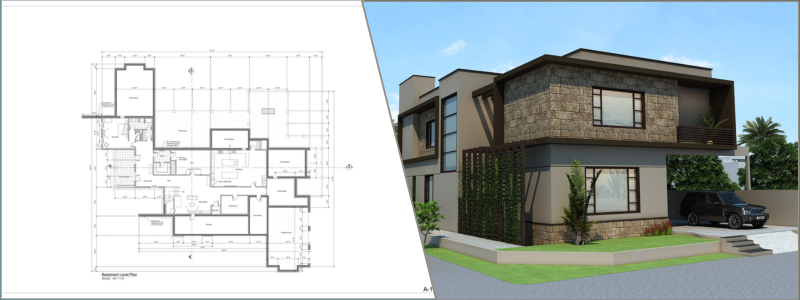
Is it counterproductive? Of course not. You can’t just fire up a design software and build the 3D floor plan on the fly. Even if you don’t actually make it yourself, i.e., having it made by a professional render artist, the best thing you can do at this point is to draw a sketch or two to get a concept of what you’re after. The sketches will be the foundation of the 3D floor plan; this is where you pay attention to the dimensions, accurate room layout, and proper furniture arrangement. Make sure to write down as many annotations as you can muster.
Crafting a 2D layout might not be the most interesting part of the process, but it’s a crucial step nonetheless. An accurate sketch will minimize mistakes in the final 3D floor plan. After all, it’s better to make mistakes and fix them while you’re still sketching than find them out later and have it all revised. When sketching, be mindful of the dimension (measure twice, cut once is still a great principle), the placement of structural elements like beams or columns, and use only common symbols and abbreviations.
Think of the 2D drawings and floor plans services as the skeleton for your 3D floor plans. The flat symbols will be replaced by realistic, fuller 3D models, the floor will transform into something that resembles real materials, and everything should look realistic at the end. If you get this step right, it’ll save you (and the client) a lot of headaches.
RELATED: 8 commercial construction drawings types used by architects and CAD services companies
Fire up the tech
Given that the two-dimensional sketch is accurate to every little detail, you’ve practically removed a big chunk of a tricky variable from the actual 3D rendering process. While it still won’t be exactly as if you’re drawing using tracing paper, the workflow should be much easier now that all the measurements and object placements are done. As far as the software is concerned, there’s no shortage of tools you can use: from floor plan-specific software like Planner 5D and RoomSketcher to the more general CAD tools such as AutoCAD, Revit, and SketchUp, to name a few–you’re spoiled for options. But as always, a tool is only as capable as the person wielding it. What matters the most is how you use it, or rather, who you ask to use it.
Either way, the transition from manual sketching to the more techy work begins with importing the two-dimensional layout into the software. Most software tools have the option to extrude walls, quickly giving the outline of walls some height and turning the flat sketch into a 3D space. But the walls really are the least of your concerns; once they’re up, it’s time to introduce some details to the flooring, furniture, and lighting. This is where you’ll have to experiment with many different materials, textures, colors, styles, patterns, placements, finishes, and so forth.
The good thing is that 3D software can apply those details instantly. Do you want to use a combination of natural and artificial lighting in specific rooms? What if your client asks for a rainbow-colored wall in one of the rooms? Can you mix and match different types of flooring? It’s a big resounding yes to all of them. Many of these functionalities are easy to use (particularly with a drag-and-drop interface), and most software also comes with preloaded libraries full of 3D models for furniture pieces, decorations, fixtures, home appliances, various types of flooring, upholstery, and more for 3D modeling design services.
Give some personality to it
Understandably, there’s nothing particularly special about the second and third points above–it’s how a 3D floor plan is supposed to be made, and it’s how most people do it. But now is the part where a perfectly adequate 3D floor plan should transform into a truly memorable visualization.
When people say you need to be very detailed with a 3D floor plan, chances are they’re talking about the high level of clarity from high-resolution models and images; this is also the standard practice. However, the term “details” can also refer to the kind of personal touches that make an already visually-pleasing floor plan resemble and feel like a real home.
It’s not just about the walls and furniture being all in the right places; there are plenty of other little things scattered all around the room that make an interior design appear lively. You’re not just drawing an interior design–you want to introduce evidence of liveliness to the design. Start with the usual suspects like a seemingly random toss pillow or two on the couch, a throw blanket draped over the bed, a few potted plants in the corner of the kitchen, pairs of slippers next to (not on) the shoe rack, random magazines on the coffee table, toys on the floor in the children’s room, etc.
When adding these little details, you’re basically translating the client’s personality into the image. If the client likes outdoorsy stuff, perhaps pairs of boots work better than slippers; for clients who prefer minimalist design, stick to neutral colors and avoid any visual hint of randomness. This is why it’s important to ask questions about design during the consultation and have a genuine conversation about their typical day-to-day activities.
Let’s not forget about lighting, as well. Different lighting design services can change how the same room looks. For example, spotlighting can deliver a sense of intimacy to a living room, whereas natural daylight makes it playful. It also applies to every other room, so it might be a good idea to experiment with various lighting scenarios to find the right balance. However, this also means you have to make two or more variations of the 3D floor plan to showcase the different atmospheres at different times of the day.
RELATED: 5 reasons freelancing studios are the future of 3D visualization services
Flow is important
Be mindful of how the different rooms and spaces connect to build a cohesive interior design. Imagine having a walkthrough of a house. It makes sense if the living room leads to a dining room before you eventually end up in a kitchen. The layout seems natural, and the connection between the spaces feels seamless. Now, imagine a scenario where the dining room flows into a random door that leads to a garage or a bathroom; that’s an awkward flow.
When you’re at home, you want everything to be where you expect it to be. That’s why natural flow is important. The rooms and spaces must connect with each other in a logical manner. You need to be able to navigate the interior intuitively and comfortably. An interior design needs to have clear pathways where you can walk without bumping into small things and smooth transitions between one area to the next, but also noticeable divisions among them. Now, combine all those thoughts and try to see everything from your client’s perspective. Even if your clients never actually mentioned the issue, they certainly can appreciate a good flow. If something just doesn’t look and feel right, like a weirdly positioned window or an overly cramped corner, perhaps some tweaking can help.
Always have a plan B
When all is said and done, it always feels better if you have a Plan B (or Plan C) because you have to manage the client’s expectations in relation to budget. Everybody wants the best 3D floor plan with stunning details and impressive lighting scenarios, but the reality is that you can only do so much given a limited budget for even the most talented architectural planning and design companies. Instead of playing with the client’s mindset by claiming that you can produce a visualization beyond what the budget allows, the thoughtful thing to do is to be honest about what’s feasible, considering all the constraints, not just the budget, but also the timeline and the available square footage.
Say the client yearns to have a walk-in closet or a pretty substantial kitchen island. Unless the client has the required space for either, well, then it’s your role to guide the client into a more practical direction–that’s your Plan B. For instance, if a walk-in closet takes too much space from an already constrained square footage, perhaps a custom wardrobe can be a good alternative; a kitchen island makes the room feel luxurious, but when the budget can’t cover the cost, a breakfast bar is quite possibly the next best thing.
Sometimes, the key to “wow’ your client with a 3D floor plan lies beyond the visualization itself but in your ability to decode their interest. The clients expect you to craft a beautiful layout they can enjoy, but more often than not, it also means you have to be an adept problem solver to present an admirable interior design despite all the limitations.
Conclusion
Creating a custom, personalized 3D floor plan involves more than just listing all your client wants and cramming everything into the design. It’s not merely about ticking boxes on a checklist but also about trying to understand and find the right balance between the client’s preferences, personalities, needs, constraints, and resources. This is why it matters to really listen to what they say, learn about what they like (and dislike) in a design, and finally, collaborate with them as much as possible. Stunning visuals remain essential in a 3D floor plan, but relatable and functional designs are equally important. Remember that you’re not just creating a floor plan–you’re designing a space so that it may feel like home to the people living in it.
One of the main purposes of a 3D floor plan is to let the client know what they’re getting for their money. A rendered 3D floor plan shouldn’t be misleading in any way. Think of it as a WYSIWYG (What You See Is What You Get) approach to interior design services. The visualization, first and foremost, has to be accurate.
RELATED: Top design & drafting tasks to outsource for architects and architectural services firms
How Cad Crowd can help?
No matter how much personalization you put into it, everything needs to be realistic and reflective of the expectations. To ensure accuracy, it’s advisable that the actual task of producing a rendered 3D floor plan is done by a professional render artist. Although this is going to add a few more steps in the workflow, Here at Cad Crowd, you get the assurance of stunning photorealism and precision in return with the experienced 3D modelers and render artists we can help you connect with. Your best bet is to achieve the highest-quality floor plan visualization at affordable prices. Contact us today!