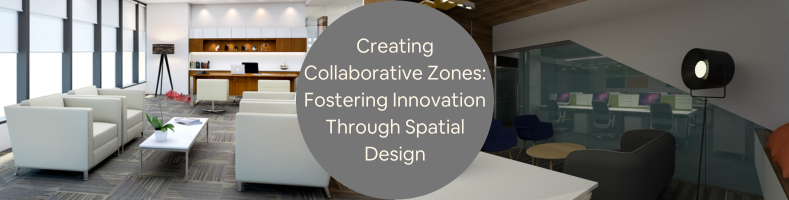
Breakthrough concepts seldom emerge from solitude. They’re ignited in communal areas—over whiteboard sketches, across casual desk conversations, or in deliberately constructed spaces that encourage teams to think outside the norm. That’s where collaborative spaces step in.
Far from being an office fad, they’re intentional design elements designed to drive innovation, foster interaction, and translate unbridled creativity into tangible outcomes. But how do you literally design a space that does so?
The solution? You need more than a few open floor plans and bean bags. You need outsourced 3D and design services from the market leader, Cad Crowd, that are attuned to how spatial psychology intersects with strategic intent and how to find the correct talent to maximize your organization’s spaces.
What is a collaborative zone, really?
Let’s sort this out up front: Collaborative zones aren’t simply open areas with seating. They’re carefully crafted environments with a mission—to create engaging teamwork, spontaneous brainstorming, cross-functional interaction, and nascent project work. They aren’t generic lounges. They are intentional spaces designed to stimulate communication, productivity, and creativity.
A collaborative space could be a warm breakout nook with natural light that is perfect for casual chat. It could be a high-tech war room with digital whiteboards, video conferencing capabilities, and data sharing technology for intense planning sessions. It could also be a modular area with moveable walls and flexible furniture that can be rearranged during the day to fit different work styles or group sizes.
What distinguishes great design is intention. Solid architectural design firms don’t use collaborative spaces as filler or afterthought space—they integrate them into the office’s overall design language and workflow. Structurally, these spaces are located where individuals tend to gather naturally. Visually, they spark creativity. Functionally, they enable particular activities with the proper tools and atmosphere. Simply put, collaborative spaces are the contemporary engine rooms of innovation.
RELATED: Improve furniture catalogs with CGI to market your products with design service companies
From space to strategy: why design matters
You can’t simply add innovation to a business by saying, “Let’s be more innovative!” It must be infused into the way people work—and where they work.
Design space has a silent but significant function. While it’s easy to think otherwise, how an area looks has a lot of effects on the people using it. Acoustics, lighting, ceiling height, material finishes, circulation layout—these all contribute to whether individuals feel comfortable working together. Do they feel that they own the space? Do they feel secure enough to contribute? Is there sufficient space to move around? Can two individuals huddle up for a fleeting idea share without disrupting the remainder of the office?
The best architectural design experts can turn those psychological and behavioral subtleties into constructed spaces. When they succeed, the office becomes a living, breathing innovation facilitator.
The architectural blueprint for innovation
Let’s go through how top-notch architectural design services design collaboration spaces that get the job done—not in theory but in practice.
Understanding the culture before drawing the floorplan
Before taking pencil to paper (or mouse to CAD), successful architects get deeply into the culture of the organization. Are we dealing with a law firm or a tech firm? A non-profit or an online marketing company? Each has its own style of communication, hierarchies, work environments, and meaning of “teamwork.”
Some interior design firms dive deep by conducting interviews, observations, or even job shadowing. They gather data: who needs to talk to whom daily, who prefers visual boards, how often teams brainstorm, and what makes them tick. The insights drawn here determine where collaborative zones should be placed and how they should be configured.
Zoning with purpose: collaboration isn’t one-size-fits-all
Not all collaboration is created equal. That’s why architectural companies divide zones by collaboration type:
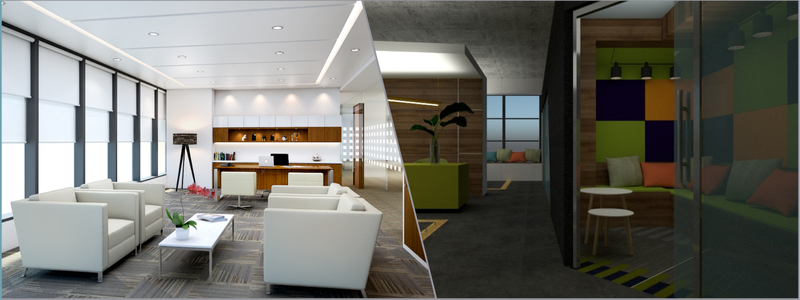
- Casual collaboration zones: Lounge spaces, kitchenettes, or open café-like corners that invite spontaneous interaction. These areas should be unstructured but purposeful. Soft furnishings, warmer lighting, and biophilic touches tend to excel here.
- Team-focused rooming areas: These are acoustically designed, partly enclosed rooms to solve problems collaboratively, host strategic meetings, or have design sprints. Consider writable walls, built-in technology, and mobile furniture.
- Collab hubs: Shared spaces that need to accommodate the co-presence of in-house and remote coworkers. These have specific AV installation needs, where camera ergonomics and microphone noise management play critical roles.
Architects create not just variety but also fluidity—giving users enough flexibility to glide easily between states of work without interruption.
RELATED: How 3D rendering enhances virtual furniture showrooms & shopping with company services
Flexibility is the foundation
Static spaces suffocate creativity. Individuals must have the capacity to reorganize their space—rearrange chairs, switch from presentation to breakout mode, or open up the space for workshops. That’s where modular design comes in, and at the very least, a goal-oriented architectural planning and design service.
Companies increasingly rely on mobile partitions, foldable tables, rollaway whiteboards, and power stations that don’t need fixed wall outlets. The trick is designing zones that breathe with the team’s rhythm, not strangle it.
Light, acoustics, and materials: the hidden drivers
Design is not purely visual—it’s sensory. Architectural practices with a focus on human-centered design are acutely sensitive to this.
- Light: Natural lighting enhances mental acuity. Skylights, light wells, and reflective surfaces can be used to distribute daylight farther into collaborative spaces.
- Acoustics: Reverb and noise bleed can destroy a brainstorming session in an instant. Architects carefully strategize materials and barriers—acoustic panels, fabric-covered furniture, or even smart insulation selection.
- Textures & colors: Earthy tones and touch materials (such as felt, wood, or cork) may help decrease stress and increase involvement, making individuals feel grounded and open in collaborative environments.
RELATED: How freelance CAD designers create custom smart furniture for modern living spaces
Bringing in the outside: biophilic design in collaborative zones
Nature is just not nice to have—it can actually boost collaboration. Adding biophilic design features such as plant walls, indoor trees, natural textures, and views out onto outdoor green spaces can increase people’s relaxation level, concentration levels, and level of openness.
Various architectural design businesses are integrating this into their philosophy, as it has been discovered that innovation flows better when humans are connected—not to each other, but to the environment they’re in. 3D landscape design, or an indoor offshoot of it, can be incorporated to create a more soothing, biophilic environment.
Working with the right architecture firm: what to look for
Now, let’s switch hats for a moment. Say you’re the one seeking a firm to help reimagine your workspace. The success of your collaborative zones rests heavily on your partnership with the design team. Here’s what to prioritize:
| Reputation + cultural fit | A flashy portfolio is not sufficient. Get into whether a firm has worked for firms like yours—not just in terms of size but in terms of function and values. Cultural fit is important. You need architects who listen, adjust, and get your team’s DNA. Review case studies. Interview previous clients. Don’t ask what the completed project looked like—ask how it felt to work with them. |
| Process transparency | Great CAD and 3D design services don’t leap to solutions—instead, they guide you through the process. From visioning to space planning, concept to construction drawings, they describe each step and include you. Companies that provide clear step-by-step directions minimize risk. You need a partner, not a vendor. |
| Collaborative technology use | Modern firms are leveraging 3D modeling, VR walkthroughs, and digital twin tools to help clients experience the space before it’s built. That’s especially useful when refining collaborative zones, where visualizing flow and interaction is crucial. |
| Budget alignment and realistic proposals | You’ll want a commercial drafting firm that’s upfront about costs and doesn’t inflate expectations. Smart architectural firms will align their design aspirations with your financial boundaries—and even offer phased approaches if needed. |
Real-world impact: what happens when you get it right
In well-designed collaborative spaces, here’s what happens:
- Cross-pollination increases: Teams that didn’t interact before start sharing ideas.
- Employee morale improves: People feel more engaged and valued when their workspace supports them.
- Innovation cycles get shorter: Good design speeds up ideation, testing, and feedback loops.
- Attraction & retention improve: A well-designed office can be a big talent magnet.
And probably most importantly, people stop seeing the office as a place they have to be in—and begin seeing it as a place they want to be in.
RELATED: Using 3D visualization to increase your real estate company’s vacant lands and property sales
Small business or startup? You can still think big
Don’t think this kind of spatial planning is only for corporate behemoths. Interior design experts today partner with startups, co-working operators, non-profits, and small businesses. You don’t require a mega-budget to create effective collaborative spaces. You require a vision, a versatile partner, and a willingness to align your space with your purpose.
A few companies provide design-only packages wherein they do the concepting and planning and you work with your desired builders. Others do tiny, phased-over-time renovations—a floor, wing, or even a single zone at a time.
The future is fluid—and your space should be too
As hybrid work continues to develop and AI upends the way teams operate, spatial adaptability will be even more essential. Forward-thinking architectural design services that plan for movement, modularity, and human requirements will be the ones that enable businesses not only to survive but to thrive.
So, when you’re reconsidering your space, don’t simply pursue the next coolest office feature. Start with one question: How can this space make collaboration feel natural, exciting, and meaningful?
Then, collaborate with a design team from Cad Crowd who can translate that question into an answer you can walk through, work in, and build the future from. Ask for a free quote today!