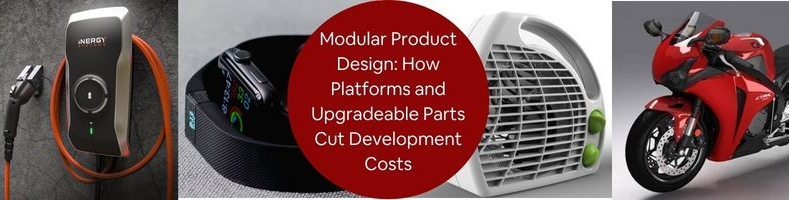
In modular product designing, these are created using replaceable and reusable parts instead of creating every version from scratch. The modular approach makes use of interchangeable components within one product, as it uses the same core foundation across multiple products.
With this, the design and process timeline is much shorter and much easier for future upgrades. It can also significantly reduce the development costs. Cad Crowd has a network of vetted professionals who can help in designing the module architecture before proceeding to detailed engineering and tooling.
RELATED: Trends Shaping the Future of Product Design for Industrial Design Services
🚀 Table of contents
What’s the difference between modular and platform architecture?
These terms are mostly interchanged in the field, but each actually solves a unique problem.
Modular architecture: one product, interchangeable parts
A modular product firm refers to a design built from swappable modules, such as a battery, camera, and ports, or anything that a user or technician can remove and replace. This can be done by changing the rest of the design and can still stay as one production while its components are changed. This allows the product to evolve over time and keep up with the technology. This approach can extend the product’s lifespan and make product improvement a lot easier. It needs careful planning, though, since all module connections should be designed precisely to fit each other. The parts and components, when fit, should still work as one system.
In platform architecture, it allows companies to create and build multiple products using the same core foundation. This means that instead of designing every product from the ground up, the design team can just develop a common system. An example of this is when an automotive company can use the same vehicle platform for several years with different body styles, features, and price points. The customers may think they’re all different products, but the company sees them as having the same engineering, validation, and manufacturing expertise.
This approach can help in reducing the overall development costs and speeds up product launches, which makes it an efficient approach. It also needs careful planning because the core system should be flexible enough to support variations without design limitations.
Why the distinction changes your design brief
Understanding the distinction between the modular and platform approach can help in solving different business problems. It can help in coming up with a better decision in choosing what’s the best fit. The modular product is best designed around the user, making repairs, upgrades, and replacements easier. It focuses on creating accessible parts and simple connections.
Platform strategy is more focused on the optimization of the manufacturing firm needs. Its goal is to create a shared foundation to allow the company to develop multiple products faster at a lower cost. It builds a flexible system that can support multiple variations.
RELATED: Why Design for Manufacturability (DfM) is Essential for Product Success When Hiring a Design Firm
| Attribute | Modular Architecture | Platform Architecture |
| What it means | A product is built using separate parts or modules that can be replaced, upgraded, or repaired individually | A shared base design is used to create multiple different products or versions |
| Main benefit | Helps users to maintain and improve their products over time | Helps manufacturers and develop products faster and lower the costs |
| Example | Fairphone’s swappable camera and battery | Volkswagen’s MQB chassis across 40+ models |
| Main cost driver | Designing the connections between modules so they can work together properly | Develops the core platform once and spread the cost across many products |
| Typical goal | Extend product lifespan, and reduce e-waste | Create more product variations while saving development and manufacturing costs |
What business benefits does modular and platform design deliver?
The modular and platform design can actually create advantages that go beyond “easier repairs” or upgrades. By being able to reuse proven components, the companies can significantly reduce development costs and shorten the production timelines. It would be possible to create more products with less engineering effort and resources. This is considered an efficient approach since it doesn’t have to start at zero for every product. The design team can just build it based on the existing foundation and focus resources on areas that would need development.
Faster variant development
One of the most valuable advantages of platform design is its ability to create a new product version without starting from scratch. Once there’s already a shared architecture designed and established, the team can reuse and focus only on the parts that would make it look different and new.
An example of this is an electronics company that keeps on using the same internal hardware platform while changing the exterior design, screen size, battery capacity, or features to create different models. Reusing the same existing engineering work can reduce development costs, lower costs, and speed up the creation of new variants in the market.
RELATED: How CAD Modernizes Product Concept Design at Industrial Design Services Companies
Lower tooling amortization across SKUs
Another major advantage of using a platform design is how it can reuse the same tooling and manufacturing investments across multiple products. This way, they don’t need to create completely new production equipment for every model. It only needs a shared platform that can allow the same core components and processes to support different product variations.
One good example of this is Volkswagen’s MQB platform. The company invested heavily in developing a shared vehicle foundation, and it was used for more than 40 models. This includes their Golf and Tiguan. It has significantly distributed the costs of the investment across multiple vehicles. This made the cost impact lighter and lower compared to designing for each vehicle (Wikipedia, Volkswagen Group MQB platform, 2026)
Simpler repairs and upgrades
An advantage of using a modular design is extending the product’s lifespan. This is by allowing the components to either be replaced or upgraded. The whole product design services does not have to be replaced; only a specific component that fails is to be replaced/upgraded. This can reduce waste and lower the cost while improving the overall user experience.
RELATED: How Successful Companies Use Industrial Design Services for Product Development & CAD Design
One good example of this is Framework’s modular laptop. It has allowed users to replace its major components like its mainboard, storage, and expansion ports without requiring specialized tools. This is a good strategy since users can upgrade the laptop’s performance over time accordingly instead of just buying a new one. (iFixit, 2026)
Reduced e-waste and extended product life
As per studies, the global e-waste generation hit a record 62 million tonnes in 2022. It has increased significantly over the past decade, and only a portion of discarded electronics has been formally collected and recycled. Global E-waste Monitor 2024, UNITAR/ITU)
Modular design services can help in reducing electronic waste by making products that are a lot easier to repair, upgrade, and maintain over time. This lessens the chances of disposing of products that have outdated or damaged units. This helps users to use the same product even though it has an affected module or so.
RELATED: Innovation is Ongoing: Next-Gen Product Design Strategies with Industrial Design Firms
Mass customization economics
By using a shared platform, a company can now offer more choices and variants without much additional cost for each development of each version. In this approach, the manufacturers are able to produce models, features, or configurations while reusing the same core engineering and production process.
An example of this is how automotive companies can offer multiple trims, body styles, and feature packages just by using the same vehicle platform. The customers can see it as a new product, but it only changes some parts to make it appear new.
Parallel development across module teams
A well-designed modular system can allow different teams to build and work on separate components simultaneously. Once the necessary connections, requirements, and interfaces have been clearly defined, the team can develop each module independently. This can now be done without having to wait for one part to be completed before proceeding to start the other.
RELATED: How to Save Money On New Product Design and Development Services for Company Prototypes
Lower inventory and SKU complexity
The modular and platform design can simplify how the companies manage parts, suppliers, and inventory. By using this approach, there’s less effort needed to stock, make, and store products/ the overall supply chain management is more efficient. An example of this is that instead of having to separate batteries, connectors, or other internal components, a company can just develop a shared module that works across the entire product family, which would help in reducing the number of suppliers to manage.
Need help designing a modular or platform-based product strategy?
In need of an architect for your modular or platform strategy? Reduce development costs and improve the overall flexibility of your product by hiring a vetted mechanical or electrical engineer from Cad Crowd.
What are the honest trade-offs of modular design?
The modular design can definitely deliver major benefits, but it’s not always a guaranteed solution for reducing costs or improving the product. It is important to look beyond the marketing claim and first analyze whether it can benefit your product. For instance, as per the analysis of Volkswagen’s MQB platform, the 20% cost savings was questioned, and the study suggests that the realistic savings may be closer to 2–5% in certain areas. (The Truth About Cars, analysis of a Bernstein Research report)
RELATED: Streamline the manufacturing processes with CAD automation services at your company
Interface engineering overhead
One major challenge the modular design faces is the extra engineering services required to make separate parts work together. Each module has to be clearly defined, and the components should be correct. A definite tolerance has to be established to ensure that the components will really fit.
For fully integrated products, the engineers can optimize the complete system as one unit. However, in modular design, they should create boundaries that can allow the parts to be separated while still maintaining their performance, durability, and reliability.
Larger enclosures and added weight
One known trade-off of modular design is that its flexibility often requires additional physical space. Since the replaceable parts needed room for connectors, locking mechanisms design, and protective structures, it would require the size to be larger or heavier than a fully integrated design.
RELATED: Best Practices for New Product Design & Development with Services Companies & Freelancers
This added size is not really much of a major concern for certain products like laptops or other industrial equipment. But it could be a big deal for products that prioritize compactness and products with critical weights.
Higher per-unit cost at low volume
Most of the modular and platform strategies can actually pay off through a large scale or support multiple variants over time. It doesn’t work much for low-scale production, but it doesn’t mean it’s always the wrong choice. It can still depend on the long-term strategy. This could include considering future versions, repairs, or upgrades that are expected.
What do real modular and platform products look like?
Fairphone: modularity built for repair, not variety
An example is Fairphone’s design, because this product is designed around repairability rather than simply adding more product variations. They feature a modular internal design with key parts instead of just treating it as one sealed device. So that technicians can either remove or replace parts like the battery, camera, and USB-C port.
This approach has helped users to repair or upgrade their phones without really replacing the entire model, reducing electronic waste and extending their lifespan. Fairphone 6 has a significant feature of 12 individually replaceable parts and a commitment to software support services through 2033. (iFixit / TechEBlog, 2026)
RELATED: A Startup Guide to Concept Design for Hardware with Product Design Services Companies
Framework: a laptop designed to be upgraded, not replaced

Framework laptops have allowed users to replace their parts like the mainboard, storage, RAM, and even port types via expansion cards. All the replacements can be done without the use of specialized tools or soldering. This approach has given the users more control over their laptops’ lifespans. Framework laptops have consistently received high repairability ratings from iFixit because they can also be upgraded based on preference. This is a game changer and a remarkable feat, highlighting how a company’s focus is on making the repairs more accessible for its customers. (iFixit, 2026)
Automotive platforms: one architecture, dozens of models
The automotive industry consultants has been one of the strongest fields to use platform architecture in practice. They create and use a shared foundation that can support multiple models with different sizes, designs, and target customers.
One well-known example is Volkswagen’s MQB (Modular Transverse Matrix) platform. It has supported vehicles ranging from compact cars like the Golf to larger models like the Tiguan SUV. All their vehicles would look different on the outside, but they share the same underlying elements.
RELATED: Tips for Physical Product Development: How to Design & Develop Concepts at Design Studios
How do you define module boundaries and interfaces?
One of the most important steps in every modular product development is to define module boundaries. Engineers have to decide which parts or components should become separate modules and how they will connect. If this is designed poorly, it can create compatibility issues that would lead to costly redesigns and delays in production.
Start with what each part does, not how it looks
One of the best ways to divide the product into modules is by looking at and assessing its functions first. For instance, in an electronic device services, the battery, power management system, and charging components may belong together since they work as one functional group. Knowing their functions can also help you design the product. In the case earlier, it would cause complications to separate these parts because of the extra connections needed.
A good reminder and rule is that if two parts usually get upgraded, replaced, or customized together, they should probably be grouped in the same module.
RELATED: How to Find the Right Industrial Design Company for Successful Product Development
Control complexity with clear documentation and ownership
To make the modular system successful, it requires strong documentation and management. The engineers would have to create an Interface Control Document (ICD), which generally defines all important details like dimensions, connection points, electrical pin layouts, tolerances, and load requirements. The internal team should consider planning for future upgrades. They have to decide whether the newer module versions work with the older ones. It’s important to test each module separately before the full integration to address problems early. The interface should also have a clear owner responsible for approving every change. This can help in reducing unexpected issues across the entire product system.
Frequently asked questions
Is modular design always cheaper than an integrated design?
It is not usually cheaper in low volumes. It can only pay off through an amortized interface investment across many units or variants.
What’s the difference between a module and a platform?
The module is the swappable component within one product, and a platform is the shared architecture underneath multiple distinct products.
Does modular design always mean a bulkier product?
Most of the time, yes, to some degree, because the interchangeable connections would need a physical space, a permanently bonded joint doesn’t.
Can a small company realistically use a platform strategy?
Yes, it’s possible at a smaller scale. A shared core electronics board across 2-3 variants can be done, using the same tooling and development benefit.
Conclusion
The modular and platform architectures have significantly made an impact in reducing the product’s development costs. It has only improved the product’s flexibility and sped up future product releases. It can only be a working strategy if done carefully during the initial design stages. The biggest advantages come from clearly defining the right module boundaries, interfaces, and shared foundations before proceeding to detailed engineering design and CAD work. It’s important to invest time when considering this strategy. To help you in creating the module system, hire your freelance mechanical and electrical engineers in Cad Crowd now.
RELATED: Design Agency vs. End-to-End Product Development Partner for Successful Products
How Cad Crowd can help
Whether you’re developing a modular product from the ground up or improving an existing platform, Cad Crowd connects you with experienced product designers and engineers who can help optimize every stage of development. From modular architecture and component design to prototyping, manufacturing preparation, and design refinement, our global network of experts delivers solutions that reduce development costs while maintaining product quality and flexibility. Whether you’re creating a scalable product family or designing upgradeable components, Cad Crowd makes it easy to find the right specialists for your project. Contact Cad Crowd today for a free quote and bring your modular product to market with confidence.