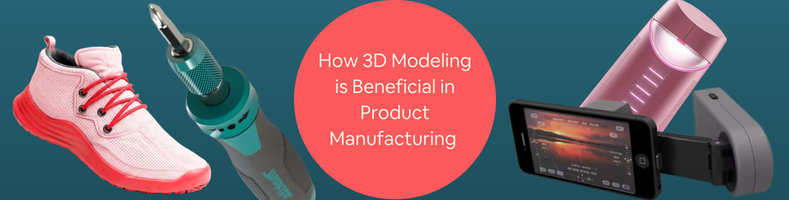
How is 3D modeling beneficial for product manufacturing and new product development services? Everybody likes to talk about how rapid prototyping services are now the new face in New Product Development (NPD) and touted to be the future of the manufacturing industry in its entirety. People seem to forget that rapid prototyping, whether by 3D printing or CNC machining, just doesn’t happen without 3D modeling (well, CNC machining doesn’t always need 3D modeling, but we’ll have to gloss over that for now). Don’t get us wrong, rapid prototyping is, without a doubt, a major breakthrough in product design and the development process.
But this doesn’t change the fact that no matter how advanced your 3D printers are, they’re nothing but overpriced paperweights if not for 3D modeling. You don’t have to be an expert to do the printing, but you certainly need a skillful artist (sometimes a team of skillful artists) to produce high-quality 3D models of your product. No disrespect to all the 3D printers and CNC machines everywhere, but they’re only as good as the models fed into them. In other words, even the most sophisticated tool can still create a terrible prototype unless you give it an accurate 3D model to begin with.
Before you even think about building a physical prototype, it’s always advisable to first figure out if you can build a digital version of it on a computer. You’re not living in the 1980s when powerful computers and CAD software cost a fortune and then some. Today, everyone can get a perfectly decent laptop capable of running the latest 3D modeling apps without breaking the bank. This also means that there are plenty of CAD design professionals out there offering their services at affordable rates.
RELATED: How Innovative Product Design Simplicity and Honesty Help Your Brand Grow
And if anything less than an experienced digital artist with a proven track record won’t tick your box, Cad Crowd is always a good place to start the search. Thanks to its rigorous vetting process and a heavy focus on NPD, the freelancing platform is home to thousands of the most talented 3D modelers from all around the world.
🚀 Table of contents
What can a 3D model do?
It really does quite a lot for new product development services and manufacturing processes. You can almost say that it’s the backbone of all manufactured products you find in the market today, from small toys and big cars to industrial equipment and skyscrapers. Let’s put it this way: every product begins as an idea, often an abstract one at that, too. An idea can be an improvement over an existing product or a brand-new invention. An idea is usually followed by a concept generation, where you draw ugly sketches on paper sprinkled with barely readable handwritten notes.
Each sketch represents the shape and form of a possible product. You can make as many sketches as you like, but you still have to discard most of them and pick only the best concept to develop further into a prototype, and eventually an actual product. While there’s nothing wrong with such a process, the journey from the moment a cartoonish yellow lightbulb appears above your head to the production line is typically riddled with mistakes and redesigns.
If you have to use a physical sample every step of the way, the effort becomes impractical and unnecessarily expensive. 3D modeling services move nearly the bulk of the design work into the screen, and this apparently offers more than a fair share of advantages to the NPD process.
RELATED: The Importance of Iteration in Product Development & Working with Product Design Companies
A clear all-around view
Let’s assume that last night you dreamed about receiving an award for the best product design, say for an ergonomic computer mouse. You still remember very well in the morning when you wake up, about where the award ceremony was held and even the shoes you’re wearing, but strangely enough, you don’t remember anything about the mouse itself. Like any good inventor, you’re now determined to make that dream a reality. The idea has presented itself, convincingly, in a dream, and now it’s time to try to remember every single detail about the mouse design.
Being ergonomic, the mouse is likely a little bit curvy and made of high-quality material. It must be excellent for office and gaming purposes, with a great battery life thanks to reliable wireless connectivity. You have two options to approach the concept generation here for your product design company. Either manual drawing on a sketchbook using a pencil or 3D modeling on a computer. The former, old-school method means you have to translate the design into two-dimensional sketches. It may take a dozen or so sketches to cover one big mouse, including its sleek wheel and contoured edges.
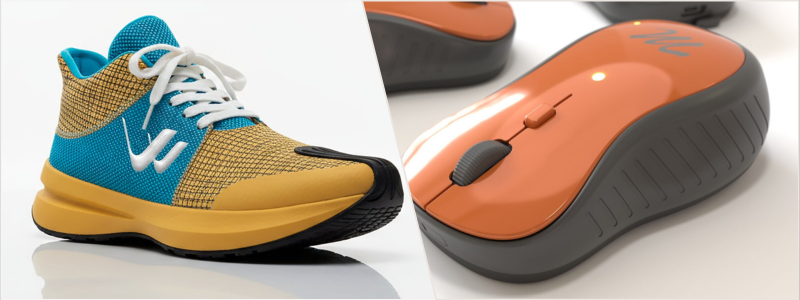
Because they must all be drawn to scale, the award-winning dream quickly turns into a conceptual nightmare. In contrast, the new-school approach with computerized 3D CAD allows you to visualize every aspect of the design on a single page (or window, technically speaking). The 3D model is inherently interactive, meaning you can zoom and rotate the design as you like. It lets you see how good or bad the design is from all sides by simply sliding a screen slider, rather than flipping through pages of black-and-white drawings.
RELATED: Why 3D Product Models Are Replacing Traditional Photography for Product Design Companies
And making changes takes only a few clicks. Well, maybe more than a few clicks, and you definitely need at least two buttons, but you get the idea. Once the model is finished, even if the design doesn’t look very ergonomic or worthy of any kind of award, at the very least, you have something that resembles a computer mouse, presented before your eyes, thanks to 3D visualization services. Whether or not the model actually comes close to the design in your dream is another question entirely. You don’t remember, remember?
Prototyping made easy
Given the right models to work on, 3D printers can do wonders for your NPD. Imagine designing a computer mouse in a world devoid of rapid prototyping. After you sketch the design in black and white, the first thing you do is to try to find a skillful handyperson to build a physical sample of the product. Because a lot of other people also develop their own products and have booked most of the competent craftspeople in town, which does happen more often than you think, you have to settle for the less experienced one. You send the sketches and wait for a few weeks until the prototype is done, only to realize that the scroll wheel won’t turn at all because somebody used too much superglue.
It’s a slow and expensive process, especially if you have to repeat the whole thing many times over. But we live in a world filled with an abundance of 3D printers. The only thing you need to make them work is, once again, a 3D model. So long as you have the model saved in the right format (usually STL for non-colored model, but other formats like 3MF and OBJ also work if you want to print the model in multiple types of materials and colors), the process is just as easy as printing a photo, except for the typically long waiting and the occasional mishap of a clogged nozzle.
RELATED: Prototyping Techniques Utilized for Complex Products at New Product Design Companies
If the product consists of multiple parts, for example, a computer mouse, obviously, the usual approach is to print all the individual parts first and then assemble them later. Depending on model complexity and how expensive your 3D printer is, the printing time may take several hours to a full day. Still, this is faster than manual fabrication. It’s worth mentioning that additive manufacturing services and 3D printers are getting more affordable these days. Even if you don’t plan to buy one anytime soon, there are plenty of rapid prototyping services you can hire to help build your prototype.
Most, if not all, of these services include post-processing as well. This means that at the end of the printing process, you won’t have to deal with messy models with smudges and jagged edges. The trick for efficient rapid prototyping is to never print an unfinished model. Just because 3D printing is (relatively) affordable, at least for plastic parts, doesn’t mean you should rush it. Instead of spending resources on printing a model that you know won’t work, it’s always better to allocate the time and money to optimizing the model first.
Scrutinize the details, check and double-check the dimensions, have the model rendered, run FEA, and then triple-check if you have to. Launching a product to market is indeed a race, but it’s not a race where the winner is determined by the number of prototypes you make. One of the marks of a good NPD is resource efficiency. You don’t want to go back and forth from physical prototyping to fixing mistakes and spending valuable time and money in the process over and over again. An efficient NPD is marked by a thoughtful 3D modeling effort followed by a thorough virtual simulation.
RELATED: How to Use 3D Product Modeling and 3D Product Photography for Company Advertising
Only when you’re sure that the 3D model is exactly as you want it to be can you send the file for 3D printing services. You don’t need dozens of printed models throughout the project. Two, maybe three physical prototypes should be plenty enough, unless you’re so careless that most of your 3D models turn out to be of poor quality. The same thing applies to CNC machining, which is probably more relevant here since your mouse is supposed to be made of metal. That said, 3D printing technologies have gone a long way from their early days of plastic-only fabrication to full-scale metal prototyping. The range of available materials is pretty decent, including aluminum, stainless steel, titanium, and even alloys.
Design for manufacture and assembly
On the subject of printing individual parts, 3D modeling and rapid prototyping also help confirm that your product is manufacturable and can run through an assembly line smoothly without frustrating factory workers. Sure, your computer mouse looks great on screen as a 3D model and photorealistic rendering, but are you really sure the design is also optimized for manufacturing and assembly? Let’s make this clear, first. Many product designs are harder and more expensive to mass-produce than others. When the design is complex enough, the manufacturing facility may need to create new tooling just to produce a single part, significantly increasing costs.
Design for manufacturing services (DFM) aims to minimize production costs while maintaining high quality. The easier a product is to manufacture, the cheaper it is to mass-produce. There are many factors at play here, from the availability of raw materials and tooling requirements to the number of parts and potential for automation. Just like with 3D printing, chances are a production line doesn’t make a complete product in a single run. It builds the individual parts first, then sends everything to an assembly line for the final processing. But unlike 3D printing, where every part can be fully customized, most factories aren’t very fond of creating and installing new tooling for every new design.
RELATED: Product-Centric vs. Customer-Centric: Which Is Best for Consumer Product Design Companies?
They prefer using the existing equipment because this saves them time, money, and headaches. No wonder a lot of computer mice look very similar to the one you’re using right now. When the time comes for you to work with a factory partner, one of the first steps in the partnership is to entrust them with the final version of the 3D model, with an NDA attached for sure. They take a look at the 3D models and will never fail to propose some changes to the design. Bear in mind that these changes are not intended to modify the design, but only to make the parts more easily manufacturable.
Say the top metal enclosure of your mouse design originally consists of multiple separate parts: left click, right click, and a body secured to a base plate using three titanium screws. The factory can fabricate all those individual parts, but it’s much easier just to make them into a single component. After another FEA simulation from the product engineering expert, the new design apparently makes the mouse even stronger. It’s, of course, a lot more complex in reality, but the example will do for the purpose. The factory workers will also find it easier to put the product together in an assembly line. Instead of installing multiple parts to build just the top enclosure, they now have to deal with just one component to fit the rest of the product.
CGI for the marketing
Each time you bump into someone who tells you that product photography won’t work for a brochure, step away immediately and avoid confrontation at all costs. Product photography does work, but not as well as CGI for marketing purposes. CGI, or more specifically, photorealistic rendering services, allows you to create an image of your product in the most flattering fashion imaginable. Unlike photography, where you actually need physical objects, otherwise the camera won’t focus, a rendering is a completely made-up picture that accurately depicts the actual design. You don’t want to mislead some gamers into thinking that your mouse is made of sterling silver when in reality it’s just gold-plated.
RELATED: Product Rendering and 3D Visualization – A Full Overview
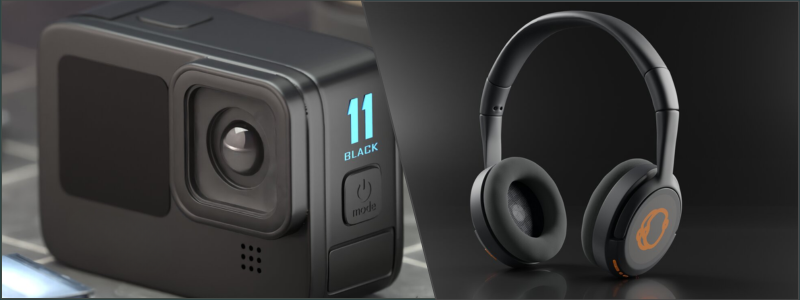
In all seriousness, make sure to be truthful with the product imagery. While it is possible to build a CGI of a computer mouse that can transform into a small robot or one with a design so futuristic it’s used by the Terminator, consumers always appreciate honesty in marketing, even gamers. A photorealistic rendering doesn’t happen without 3D models. A 3D render artist takes the model, applies the right textures, sets the lighting, and runs it through specialized software to produce a high-fidelity image. The product might be rendered against a plain white background for clarity, or alongside complementary objects to mimic a usage scenario.
A rendering can be an animated video to show an exploded view of the design, or interactive to allow the audience to take a closer look at the design. Another benefit of rendering is that you can reuse the base 3D models as many times as it takes and apply different styling, colors, graphics, etc. This is particularly useful when you have a variety of aesthetic options for the same product. With 3D modeling, all this can happen without having to hire a photographer and using props of any sort.
Final thoughts
3D modeling is much more than just a convenient tool in new product development projects and the manufacturing industry at large. It’s the foundation of modern product concept design services, where efficiency and accuracy are of the utmost importance. Virtual simulation, rapid prototyping, and photorealistic rendering open the door wide to getting down to the nitty-gritty of a design process. A 3D model makes for the perfect ground to experiment with everything about the design, from the single largest component to the tiniest parts of it, including the visual appeal of the finished product.
RELATED: Top 51 3D Product Rendering Design & Best 3D Visualization Services Companies in the US
How Cad Crowd can help
Unsurprisingly enough, just like everything else, 3D modeling is easier said than done. Nobody in the history of 3D modeling could pick a laptop, download Blender cause it’s free, and master the trade overnight. No need to be alarmed. Cad Crowd can help you connect with tens of thousands of professional digital artists from all around the world. The platform is here to facilitate fruitful collaboration between experts and clients throughout all stages of the product development cycle. With strict vetting and screening, Cad Crowd ensures you’ll work only with the best-qualified 3D modelers in a bespoke, managed partnership that benefits all. Request a quote today.