

When entering a new apartment or house, the prospective buyers or lessees usually attempt to get a feel for how the rooms will be. How will the rooms be? How much light will pour into the living room? Will the dining table fit against that wall? Historically, this was always a guessing game, based upon blueprints, floor plans, and imagination. Those days are long gone.
Real estate has changed fundamentally with the advent of 3D apartment rendering technology. Those days when the potential of a space had to be imagined by prospective tenants or buyers based on photographs or hand sketches are now past.
Today, the best 3D architectural visualization companies that form the enormous membership base of industry titans, such as Cad Crowd produce photorealistic models that present properties in exquisite detail. This revolution in technology has not only revolutionized how properties are presented but has also redefined the property development process overall.
Let’s take a look at how 3D apartment rendering works, its advantages, and why it’s become such a vital tool for real estate agents and developers these days.
🚀 Table of contents
What is 3D apartment rendering?
In simple terms, 3D apartment rendering is a method of creating realistic images or animations of an apartment using sophisticated software. 3D artists or rendering firms produce these visualizations by applying architectural plans, blueprints, and specifications and transforming them into a realistic, detailed picture. The result is so real that potential buyers visualize themselves entering a finished building, although it has not yet been built.
The technology allows for realistic representations of anything from the shadows and light in a room to the texture of materials like wood, glass, and metal. The developers can customize the visuals to display furniture, décor, and various finishing options. Additionally, 3D rendering services can be used for still images and virtual tours, giving a complete and comprehensive experience of the space.
RELATED: From concept to client: The power of architectural visualization software for 3D services

The power of realistic visualizations
One of the most important reasons 3D apartment renderings have become so central to real estate marketing is that they are able to impart a real sense of space and atmosphere. A two-dimensional floor plan is inanimate—it will inform you of dimensions but fails to capture the full sensory reality of being in an apartment. With a 3D rendering, prospective buyers or renters are able to explore the layout naturally.
Imagine this: you walk into a virtual simulation of an apartment and instantly sense how big or snug a room is going to be. You’re able to look at the path that the light takes through the windows, see the changing shadows as the sun moves across the sky, and even catch a glimpse of how things like reflective marble countertops or warm wood paneling will look in different lighting conditions. This level of realism helps individuals make more confident, rapid decisions, and for developers, it is a way to bond with clients at a much stronger level.
For real estate agents and architectural design firms, these high-definition images also give them an edge over their competitors who have not yet caught up with more advanced photographs or hand-drawn floor plans. They are able to present properties in interactive, high-definition detail, and this is a game-changer when customers are making expensive purchasing decisions.
How 3D apartment renderings are streamlining the design process
Not only are 3D apartment renderings and new residential design services of great marketing value, but they also create a more streamlined design process for developers. 3D renderings allow designers and architects to make changes to designs, adjust layouts, and view possible changes before any dirt is ever turned.
For example, a client might not know about a color scheme or arrangement. Instead of back-and-forth discussion or attempting to imagine changes by using sketches, 3D rendering allows them to see exactly how changes would influence the room overall. This shortens decision time and avoids expensive changes made along the way. It basically removes the guessing factor.
Also, the instant iterations and quick changes in the virtual world allow architects to simulate several design schemes without having to re-create actual physical models. They can trial various flooring options, paint finishes, lighting accessories, and furniture arrangements without performing any actual changes on the construction site. Besides saving time, this also lessens the danger of construction blunders, finally saving developers their money.
3D apartment renderings for pre-sale and marketing
Those days are over when developers relied on physical models or simple sketches to market properties before they were built. Now, 3D renderings can bring the entire potential of an apartment to life long before the first brick is laid. This flips the property marketing dynamics around.
Buyers are more likely to engage with a home if they can see a real and aesthetically pleasing image of what it will look like. Rather than only using words to describe details and finishes, 3D visualization can show everything from room layouts to precise design elements like countertops, cabinets, and fixtures through 3D architectural rendering services.
This kind of promotion is particularly appropriate in the premium property market, where there is huge competition. Rich buyers wish to enjoy the complete thing prior to setting foot in a property. Real estate agencies are able to deliver a level of detail that enhances purchasing confidence, enables them to picture themselves inside the atmosphere, and speeds up the process of making a sale with 3D renderings.
Furthermore, these 3D renderings are appropriate for online advertising and digital marketing. With more and more homeowners making home purchase decisions online, being able to offer stunning visual content is necessary. Real estate brokers and developers can incorporate 3D renderings into websites, listings, social media sites, and online marketing brochures, giving their sites, listings, and websites a high-quality and engaging look that turns heads.
RELATED: How to choose the right BIM services provider for your architectural firm
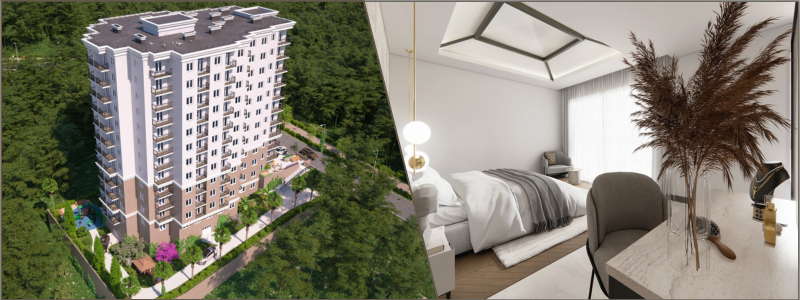
Virtual staging and 3D rendering
Yet another revolutionary feature of 3D apartment rendering is the staging of virtual apartments. Conventional staging is the actual placement of furniture, artwork, and accessories within a building to present the property in the best possible way to potential customers. However, 3D rendering makes it all possible virtually. Developers can introduce digital accessories and furniture within the space, so they can try out various appearances and moods with little effort.
For instance, if a builder is selling a house with an unfurnished room, a 3D render can illustrate what the room would look like furnished. Virtual staging for architecture services enables various room styles to be shown, be it a sleek, minimalist design or a more bohemian, vintage feel, without the inconvenience of having to physically move furniture. It also offers a wonderful solution for houses that are still being built or in the initial stages of development.
For customers, this gives them a more familiar and concrete idea of the area. For developers, it allows them to sell properties more clearly, even if the property has not yet been constructed or set up. This generates greater interest and eventually quicker sales.
How 3D apartment renderings are helping developers
For developers, perhaps the single biggest benefit of 3D rendering is its potential to gather early feedback from prospective buyers, investors, or stakeholders. Rather than waiting for a building until it is nearing completion—or better yet, completely done—3D renderings provide early availability of in-depth visual material, which can then be shown to prospective investors or partners.
This visual material helps raise funds or gain approvals by presenting a concise, convincing image of the final product, whether showing to investors, town planners, or potential purchasers, a 3D visual acts as an instrument for persuading stakeholders that the project is an investment worth making.
In addition, these renders also enable developers to anticipate potential problems at the outset of the design process. Even before the costly construction stage, developers can assess how the building looks or how its form could function in the context of its setting. For instance, 3D rendering experts can assess the building’s size compared with surrounding buildings or its appearance under varying light conditions, which may necessitate adjustments.
The role of 3D visualization firms
At the heart of this revolution are 3D visualization companies specializing in producing top-quality renders and animations. Such companies utilize state-of-the-art software and highly trained designers working in close cooperation with developers, architects, and real estate professionals to transform architectural designs into life. The end result is an effortless, expert service that adds tremendous value to the process of marketing the property.
By working with a 3D visualization company, developers have access to the latest technology and professionals who can make their projects soar. From conceptual renderings to virtual tours, these companies produce precise, photorealistic images that can significantly increase property sales and draw in investors.
RELATED: Ten questions to ask a structural engineer before hiring an architectural design firm
Conclusion
The introduction of 3D apartment rendering has revolutionized the real estate market, making it a dominant force for developers, real estate agents, and buyers. With the capacity to display properties in detailed and realistic fashion, 3D rendering presents infinite advantages ranging from facilitating marketing to enhancing design choices and potential sales. With technology improving each day, it’s certain that 3D apartment rendering will continue to be a crucial instrument in real estate, simplifying processes and guiding the future of property development.
For everyone in the real estate game, the potential to tap into this technology translates into getting ahead of the game, providing a higher quality experience for customers, and making more intelligent decisions every step of the way in the development process. No wonder then that 3D visualization has fast become the standard—and only keeps improving. Don’t lose the opportunity to get in touch with Cad Crowd and receive a free quote today!



