
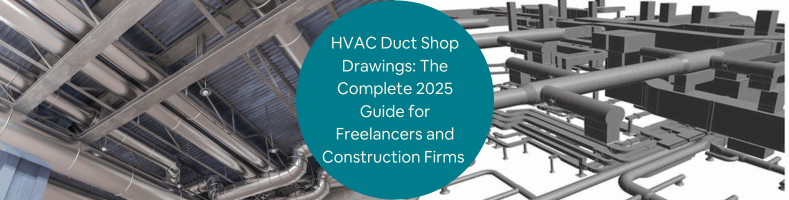
Nothing is as important in construction as precision and efficiency. Especially with mechanical settings such as heating, ventilation, and air Conditioning systems, as it really makes all the difference. The presence of small errors in a mechanical system could easily create huge delays or massive inefficiency in completing work for a given client. Cad Crowd has long supported professionals and businesses as the best platform to help bridge such technical gaps through vetted experts in mechanical design services.
Duct shop drawings by HVAC avoid such pitfalls. Special diagrams are called for in the planning, fabrication, and putting up of ductwork systems. Here, we will introduce what HVAC duct shop drawings are, why they are so important in construction projects, and how freelancers and firms can use them to maximize the achievements of the projects in 2025 and many more.
🚀 Table of contents
- What are HVAC duct shop drawings?
- Why are HVAC duct shop drawings important?
- How to design HVAC duct shop drawings
- The best freelancing and construction companies practices in 2025
- HVAC duct shop drawing software 2024
- How to market HVAC duct shop drawing services as a freelancer
- Wrapping it up
- How Cad Crowd Can Help
What are HVAC duct shop drawings?
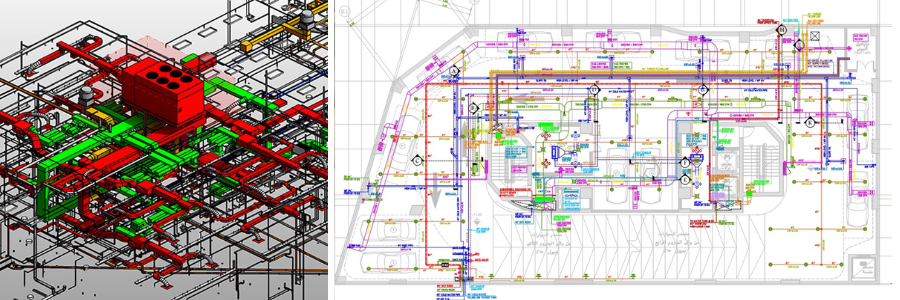
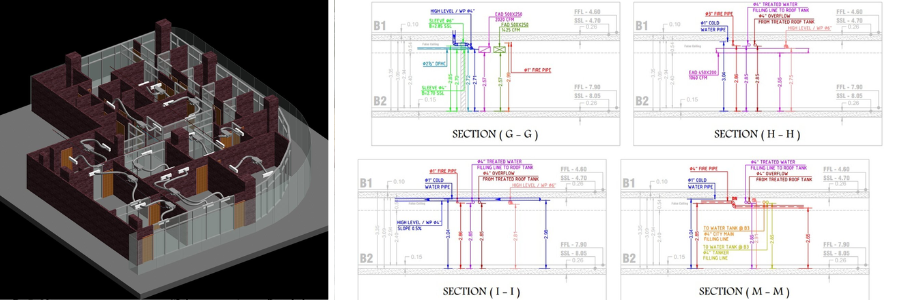
Detailed technical Heating, Ventilation, and Air-Conditioning Systems (HVAC) duct shop drawings refer to the detailed view of the comprehensive ductwork system of a building. It is more than the ordinary blueprint, as these drawings reveal the exact details related to fabrication and installation needs of ducts, fittings, and components of an HVAC system that are contrary to general construction design drawings. Unlike general construction design drawings, shop drawings give the accurate information required in the manufacturing and installation stages. These are often prepared by specialists in HVAC design services.
Major constituent elements that comprise typical HVAC duct shop drawings:
- Duct layout: Include the layout and all positions of each duct, together with its overall length.
- Dimensions and elevations: Measures and heights should be applied to the space correctly.
- Component information: fittings, dampers, grills, vents, and the rest of the HVAC devices.
- Material specification: type of material used, such as sheet metal gauge.
- Coordination: It means that the duct system does not get in the way of another building, such as electrical or plumbing.
Usually done after preliminary design but before construction, these drawings act as a connection between design and execution.
RELATED: Relevance of MEP drafting services for architectural design firms & construction companies
Why are HVAC duct shop drawings important?
HVAC duct shop drawings are not just some sort of requirement; they are part and parcel of any construction that includes an HVAC system. Why is it so?
1. Improves the accuracy and reduces the errors
Shop drawings serve as a guide to the fabricators and installers. There is less chance of error in construction, and teams can clearly view in detail the ductwork layout in order to pick up conflicts ahead of time with other systems, structural beams, or electrical conduits. This will save time and money. For this reason, many teams rely on construction drawing services for accuracy.
2. It ensures code compliance
HVAC systems must follow the codes prescribed by the local building codes and also the guidelines of the specific industries. Shop drawings will ensure that all elements are installed within the law; otherwise, failed inspections would be at a minimum. Services such as code compliance services are critical in reviewing these.
3. Increases efficiency
Shop drawings show the specific details of materials, dimensions, and layouts as they help the contractors to purchase accurate materials, therefore reducing waste and ensuring the HVAC system functions optimally.
4. Facilitates team coordination
Construction of buildings has been a very labor-based and team-based activity, with several trades working side by side on-site. The common reference is the shop drawings; thus, they facilitate high-coordination work for HVAC installers, electricians, plumbers, and general contractors. That’s why many firms turn to MEP drafting services to ensure smooth coordination between trades.
5. Increased client satisfaction
If the installation process goes well and the HVAC system proves efficient, contractors will meet better timelines for the project, even in the clients’ expectations. It can bring about further client satisfaction and recommendations.
How to design HVAC duct shop drawings
HVAC duct shop drawings are prepared by a step-by-step procedure that involves designers, engineers, and contractors. Here is how it goes:
1. Preliminary information
Shop drawings will only be prepared after the project design team has passed on the architectural plans, mechanical designs, and specifications for reviewing purposes to ensure that what is being created indeed reflects the proper building layout, height of the ceiling, structural elements, and other mechanical systems.
2. Shop drawings
A draftsman makes use of specialized CADs such as AutoCAD, Revit, or SolidWorks in order to create an outline of the basic layout of the ducting using the design documents. Drafts include dimensions, elevations, and general routing plans. These are typically handled through 2D drafting services for foundational accuracy.
3. Coordination with other trades
This coordinating meeting ensures that no clashing takes place between the ductwork and the other systems. This is considered a clash detection wherein the shop drawings are compared with an electrical, plumbing, or structural layout to avoid clashes.
4. Finalization of drawings and verification
After the coordinated drafts, checking against building codes and all the requirements are provided for fabrication and installation. The drawings are finally finalized.
5. Approval of client and engineer
Final drawings are submitted to the project engineer or architect for approval, such that the stipulated standards of the design project are met at the correct regulatory levels.
RELATED: Ultimate guide in choosing freelance structural engineer for companies and firms
The best freelancing and construction companies practices in 2025
With the approaching year 2025, the requirements for energy efficiency and environmental sustainability related to heating, ventilation, and air-conditioning systems will be more challenging. Freelancers and construction firms offering shop drawings for HVAC ducts should adopt the following best practices in order to stay ahead in the market:
1. Utilization of BIM (Building Information Modeling)
BIM Software like Revit offers quite a lot of facilities for high-end 3D model development in HVAC systems. Visualized clash detection and auto-updation in real-time are done more accurately than in any other common BIM software. With the adoption of BIM, freelancers and firms will be able to offer shop drawings of high quality and thereby get a chance to stand points above their competitors. Teams with experienced 3D HVAC modeling experts are increasingly in demand.
2. Cloud-based collaboration tools
The cloud-based platforms like Autodesk BIM 360 are going to provide an opportunity for team collaboration where all the members can have instant access to drawings and even edit them together. That means coordination may improve, communication delay may be reduced, and thus this would make the efficiency of the project better.
3. Implement sustainable design practices
With ever-stringent energy efficiency mandates, low-energy design of HVAC systems should be developed. Shop drawings should also be provided for energy-efficient features such as VAV systems and DCV. Specialists in energy modeling services are key to integrating these into your plans.
4. Invest in training and certification
Maintain all the industry standards, software tools, and technologies in HVAC. Also, consider certifications through organizations like ASHRAE, the American Society of Heating, Refrigerating, and Air-Conditioning Engineers.
5. Value-added services end
Professionals who go beyond drawings—offering HVAC load calculations, documentation, or commissioning reports—stand out in a crowded market. Many firms work with sheet metal design professionals to extend their capabilities.
HVAC duct shop drawing software 2024
RELATED: Overcoming errors in outsourcing with architectural drafting services firms
Quality and efficiency are accomplished in the production of HVAC duct shop drawings with the proper software. Here are the best ones for that in 2024.
- AutoCAD – In demand due to its flexibility and feature set, AutoCAD is perhaps a very popular perennial in creating 2D and 3D shop drawings.
- Revit – Revit is an example of a BIM software that can create models of 3D HVAC systems, very detailed, coordinated, and precise. Projects with extensive collaboration between several trades are well-suited to be done on Revit.
- SolidWorks – Recommended for freelancers who already have an advantage in quality, detailed component design, because advanced 3D modeling capabilities are also supported.
- Navisworks – This is the best choice for clash detection and project coordination, as it works best for large-scale projects.
- Trimble SysQue – SysQue is an MEP systems solution that integrates with Revit to auto-generate detailed, code-compliant duct shop drawings. Professionals in sheet metal design services often rely on this software to deliver shop-ready drawings.
How to market HVAC duct shop drawing services as a freelancer
If you are one of the freelance shop drawing specialists in HVAC ductwork, it is then easier to market your services amidst a competitive market. There are five things you can do.
1. Optimize Your Online Presence
Create a professional website that displays your portfolio of shop drawings. Then, you should apply your SEO technique in targeting specific keywords like “HVAC shop drawing freelancer” or “ductwork CAD services” to attract the desired clients.
2. Use LinkedIn
LinkedIn could also be an option for networking connections for construction companies, project managers, and architects. Post case studies, client testimonials, and project updates often to gain credibility and for your profile. Be sure to highlight your freelance CAD services in your profile description.
3. Free Consultations
Offering free consultation initially and a reduced fee for your initial projects attracts new clients. The amount of trust gained through a free consultation drives those clients eventually towards long-term contracts.
4. Industry Forums and Networks
Networking and exposure occur here through forums like ASHRAE, HVAC-Talk, or Construction Specifier. Word-of-mouth referrals become an offshoot from here.
5. Build Strong Customer Relationships
Quality and accurate shop drawings, along with excellent customer service, are the key to customer satisfaction. Their satisfaction will prove to be your best source of referral and repeat business.
RELATED: 10 tips to improve photorealistic 3D renderings for design companies & freelance 3D artists
Wrapping it up
Shop drawings of HVAC ducts will never not be trendy as these drawings provide accuracy, efficiency, and compliance. Together with freelancers aiming to expand their HVAC drafting services and construction firms wanting to streamline their processes, investing hard-earned money in the right tools, training, and marketing strategy sets you up for success in this growing market. Familiarizing oneself with the specifications of code-compliant HVAC duct shop drawings assures interference-free project execution through optimal resource utilization and client satisfaction. This business is built on the latest technologies and developments related to sustainable practices.
How Cad Crowd Can Help
At Cad Crowd, we make it easy for companies to connect with top-tier CAD professionals who specialize in HVAC duct shop drawings and mechanical design. Whether you need 2D drafting, clash detection, BIM coordination, or support for an energy-efficient HVAC system, our network of vetted freelancers is ready to deliver. Cad Crowd leads as the top marketplace to find the best freelance talent. We take the guesswork out of hiring by matching you with qualified experts based on your specific project requirements. Our flexible, project-based approach helps businesses save time, reduce overhead, and get results faster. Ready to streamline your HVAC documentation? Get a free quote from Cad Crowd today and hire with confidence.



