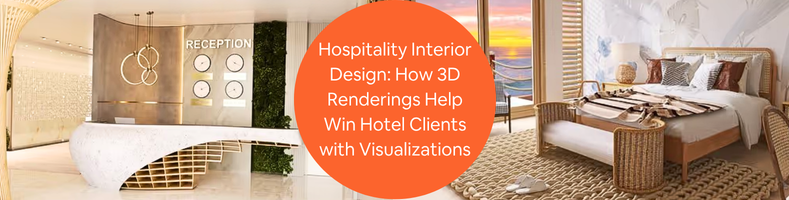
Say you want to buy a product from an online store. You already know the brand, the model name, and the price range, but you still want to spend time taking a closer look at the pictures of that product on the webpage. Even if you can’t touch and experience the product firsthand, those pictures turn out to be convincing enough for you to make the purchase. Things are no different with hotel rooms. The images that appear on the hotel’s official site or travel agencies’ platforms are important marketing tools, designed to give you great first impressions and encourage you to make the booking. Good pictures are as persuasive as the bad ones, in different manners of course. If good-looking photos are among the main reasons travelers choose any particular hotel, the bad-looking ones can easily make them rule it out.
An image gallery can tell a holistic story about all sorts of properties, and even more so about a hotel. It is therefore a common practice that hotel owners or managers put up as many high-quality images of the buildings they run, including the lobby, the rooms, the amenities, the bathroom, and even the views of the surrounding area. They expect those images to create strong impressions and build some kind of emotional connection with viewers, and perhaps set the right expectations as well. Ultimately, the images are supposed to be alluring enough to attract visitors. CAD professionals at Cad Crowd offer some of the best hotel visualizations money can buy. Home to thousands upon thousands of digital artists from all around the world, you’ll be hard-pressed to find any other freelancing platform that can even remotely match Cad Crowd’s hiring options, affordability, and guarantee of accuracy.
What if you too run a hotel and want to improve your marketing with better imagery? Is there anything you can do to make the photo gallery improve your chances of winning clients? If so, how do you go about making the improvement? You might find it surprising that the answer actually has little to do with photography. What you really need is a different type of imagery in the form of 3D rendering services. In other words, you need CGI (computer-generated imagery) visualization to get the most out of your hotel image gallery. While CGI is in most cases more cost-efficient and versatile than traditional photography, it’s also a specialized trade best left to professionals. It’s true that photography too takes real expertise to get right, but the degree of flexibility (as in detail adjustments, customizations, level of detail, and reusability, to name a few) you get from CGI outshines traditional photos by a large margin.
RELATED: The Proven Impact of 3D Interior Rendering Services For Boosting Hotel and Resort Bookings
🚀 Table of contents
What is a good hotel interior rendering?
Well, that’s a little too broad a question, and there doesn’t seem to be a single satisfying answer, but based on our experience in CGI visualization services, we might have some ideas as to what you should look for in hotel interior 3D rendering services.
A study published in Nature Portfolio’s Humanities and Social Sciences Communication in 2023 reveals that images of hotel properties are directly correlated with positive customer perception. Images are important factors in customers’ booking decisions. But it’s not just any image, as there are several aspects that turn out to be strong selling points, namely the lighting (or time of day indicated by the image), the color scheme, human presence or the lack thereof, and shooting angle.
It has everything to do with “intangibility” because obviously the customers seeing the images aren’t exactly present at the hotel. They’re unable to perceive the location, experience the room interior firsthand, enjoy the room view, try any of the available amenities, and feel the ambiance. It makes perfect sense since, as far as you’re concerned, the customers can be hundreds if not thousands of miles away during the time of the booking. The most important purpose of the hotel imagery is to reduce this sense of intangibility down to a minimum.
RELATED: How to Create Stunning Room Renderings: Your Guide for Interior Design Services
There are a number of visual directions or framing tools you can use for this purpose, such as directional lines, rule of thirds, image orientation, color adjustment, perspectives, depth of field, image symmetry/asymmetry, time of day/light, and object planning. You won’t be able to completely eliminate intangibility, but those framing tools at least provide creative approaches to bring about a greater perception of immersion.
All these aren’t prohibitively difficult challenges to overcome with traditional photography; it’s just that they’re much easier to handle using CGI visualization with 3D renderings. The thing is, a CGI visualization is created entirely on a computer screen. You don’t need to use any physical object at all. Everything on and about the image can be manipulated using digital tools to find just the perfect balance for photorealism.
There is no limitation to what you can produce with CGI. You can create as many digital versions of any space in the hotel as possible. Perhaps you want to have half a dozen visualizations or more of just the lobby, multiple images of the same room from different viewing angles, an entire set of imagery for the dining room, another collection to cover the swimming pools, and so forth. Again, there’s no photography involved here. Everything is 3D modeled using CAD (computer-aided design) software and rendered into photorealistic image services for visual treatments.
RELATED: Exploring 5 Key Elements of Hotel Lobby 3D Design and CAD Interior Detailing Services
Name any mood, weather, time of day, composition, perspectives, and dramatic flair you want; the digital artists at Cad Crowd have the know-how and the tools to create just the right imagery. Backed by our 15 years of experience in CAD applications and CGI visualizations, there isn’t much that our professionals haven’t seen and done over the course of their history in the industry.
But be very careful about the number of images you use on the booking page. Offering too many visualizations might bring about an effect of ambiguity within the context of hotel marketing on online platforms. In this particular instance, “more” isn’t necessarily better. Quite the contrary, a bombardment of imagery can lead to a marketing situation typically known as “choice paralysis” in booking intention. It’s the notion of providing too many product options, causing indecision. When the customers get confused or overwhelmed with options (such as massive collections of imagery just to visualize two or three different rooms), they tend to postpone the booking at best or look for alternatives at worst. There’s also the danger of pushing too hard to the point where you inadvertently include less relevant, maybe even misleading visualizations.
Now if there’s such a thing as too much information from too many visualizations, naturally it’s also possible to provide too little. While there’s no strict formula on how to strike the right balance between the two extreme ends, you can always play it safe with six types (not number of images, mind you) of visuals on the booking page or any other online marketing platform: (1) hotel rooms, (2) conference rooms, (3) hotel room bathrooms, (4) entrance and lobby, (5) hotel premises and services, and (6)hotel exterior design services.
RELATED: Can a 3D Interior Rendering Services Company Boost Hotel and Resort Bookings?
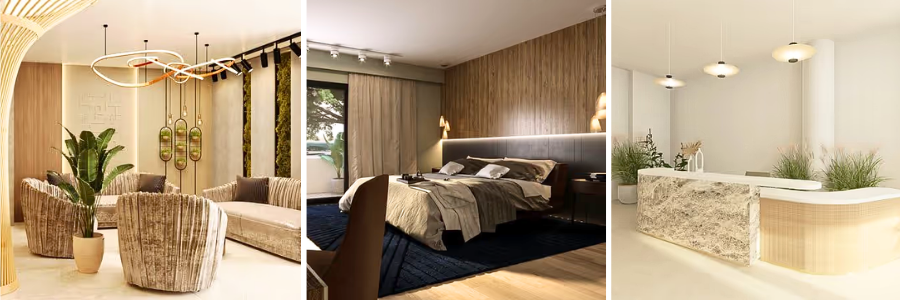
Since we’re only talking about interior design services, the exterior is to be omitted. You can still showcase a little bit of the exterior, but make sure it’s actually shown as visible from inside the hotel. For instance, resort hotels may utilize images of the landscape seen from a room balcony or large windows in the lobby. All six types function as some kind of physical evidence of the quality and services your hotel promises to deliver to the guests.
Another important thing to consider is the “transportation theory” of persuasiveness (there’s an entire page dedicated to this discussion on Wikipedia, of course). Essentially, when used within the context of hotel visualizations, the theory suggests that image size matters. It turns out that larger digital visualizations make customers more inclined to complete the booking and positively affect their willingness to pay extra for accommodation.
This positive effect, however, only happens if the image doesn’t feature any person in the frame. It’s said that larger images work better for aspirations, but the presence of a person in the frame might hamper the imagination. Guests want to picture themselves (as opposed to anybody else) living in the environment depicted in the image. The good thing is that the opposite also applies here, as small images yield more or less the same level of persuasiveness given the presence of humans.
RELATED: Interior and Exterior 3D Commercial Rendering Services: All You Need to Know
Browsing enjoyment must be taken into account as well. 3d Visualization services is great, and people believe that a picture is worth a thousand words. Still, customers might need some clues about what they actually see in the image. It’s not that complicated, really. All you need to do is add a caption under every image to tell the viewers what room it is, what amenities they can get in the lobby, how many seats can be fitted to a dining area, etc. A little bit of additional information can go a long way to keep the customers browsing the page. The longer they stay on the page, the more chances you have to persuade them.
Typical costs of 3d rendering
| Service | Estimated Cost (USD) | Description |
|---|---|---|
| Hotel interior rendering | $300-$1,000 per image | Photorealistic renderings of guest rooms, lobbies, restaurants, or other interior spaces. |
| Luxury interior rendering | $1,000-$2,500+ per image | Premium-quality visuals with advanced lighting, materials, and fine details. |
| 360° virtual tour | $500-$2,000 per scene | Interactive panoramic views that let guests explore hotel interiors online. |
| Animated walkthrough | $2,500-$15,000+ per project | Cinematic animations showcasing hotel spaces and amenities for marketing. |
| Complete hotel visualization package | $3,000-$15,000+ per project | Includes multiple renderings, common areas, amenities, and marketing-ready visuals. |
How 3D rendering attracts clients
Like with every other product, the photographic images of a hospitality interior design should help customers perceive information about a hotel in a clear and accurate fashion. It is this very perception that does the heavy lifting to influence people to book a room, pretty much similar to how a product image sways you into spending money. People take their time evaluating the photos before they come to a booking decision. But how exactly does 3D rendering services do its part in bringing more potential guests? Again, there might not be a single satisfactory answer to that. There are at least five.
Spatial understanding
A standard wide-angle photograph can be misleading as it often distorts room dimensions, making a space look wider than it really is or perhaps concealing some unflattering details. Let’s not forget that on many travel agencies’ websites and social media, photos posted by previous visitors aren’t always set to give the biggest marketing impact. CGI visualization, especially 3D interior rendering services, is almost impossible to look bad. It’s generated entirely on a computer to be an exact replica of a hotel interior, presented as a lifelike visualization. All the details, including the perspectives, are made for comfortable viewing that allows easy spatial understanding of the room layout, ceiling heights, furniture placement, distance from the bed to the bathroom, and lighting colors. If you want, the rendering can even highlight how thick and soft the carpet is.
RELATED: 3D Visualization for Bars, Businesses, and Restaurants
Visualization for every season
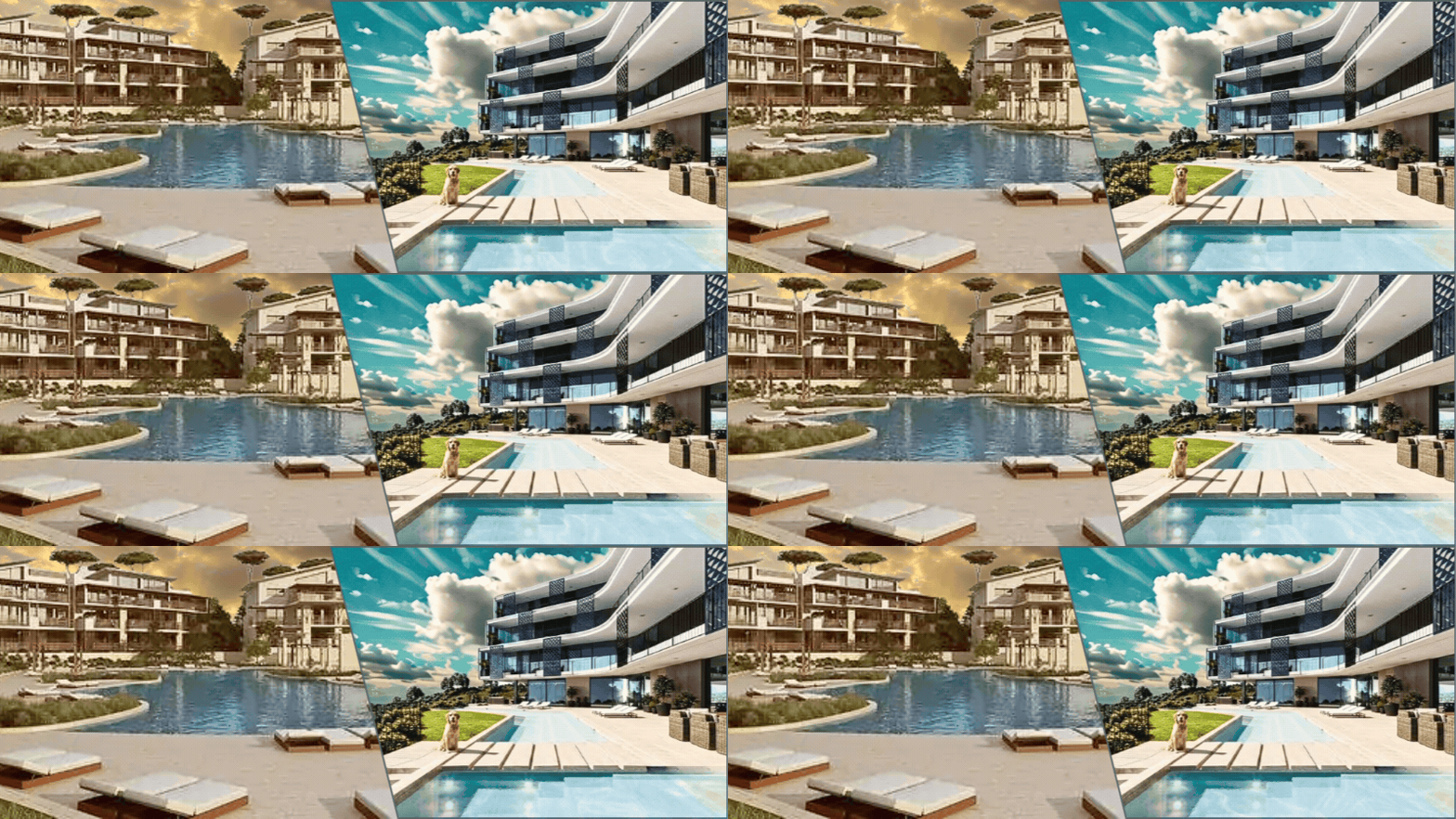
Imagine yourself being a professional photographer tasked with producing promotional pictures for a hotel. There have to be photos of the lobby with a view of the landscape visible from a large glass window. In addition, the views must showcase how good the scenery is during summer and winter. With conventional photography, there’s little you can do except wait for one of the seasons to arrive, which can be months away. With 3D rendering, on the contrary, it can be done within a week or two. Remember about CGI having no need for physical objects to produce imagery? It’s the same thing with weather. In the hands of professionals from Cad Crowd, you get to choose what objects to include, what season it’s in, and what viewing angle to use. And you can actually have the exact same image displayed in two or more different atmospheres. Whether it’s thick snow outside, or pouring rain with water droplets on the window, a bright summer day, or warm orange fall, we have it all covered.
Animated walkthrough
One of the biggest selling points of CGI visualization is that it enables digital artists to build an animated rendering of an architectural walkthrough services. Think of it as a video guide that shows customers what it looks and feels like to be inside a building, or in this case, a hotel. But unlike conventional videos recorded using a camera, an animated walkthrough is created by combining a series of static renderings into, well, an animation. It’s not interactive in the sense that you can’t control movement direction or change the viewing angle, but an animated walkthrough offers all the best things from static visualization added with cinematic flair. See the curtain swaying in slow motion as you walk into the room, clouds of white steam coming out of a kettle on the table, sunlight coming through as the window opens; you get the idea. Everything that you see is deliberately made that way.
Flexible space configuration
A hotel isn’t just a collection of rooms where people spend a night or two while they’re away from home. It’s a hospitality building that caters to various events, from business conferences to weddings and all sorts of social and professional gatherings. As previously mentioned, 3D rendering allows you to showcase the same exact space or room with completely different configurations. We gave an example earlier about how it’s possible to visualize the different views of summer and winter from the same lobby window; well, you can do the same with the lobby itself. Why not visualize a room configuration for a business conference in one image, and for a rave party in the other? A single space can be a versatile venue for many different occasions, and 3D rendering grants you the ability to visualize any or all of them, without once resorting to expensive interior staging.
RELATED: Turning Concepts Into Stunning 3D Renderings with Architectural Visualization at Your Services Firm
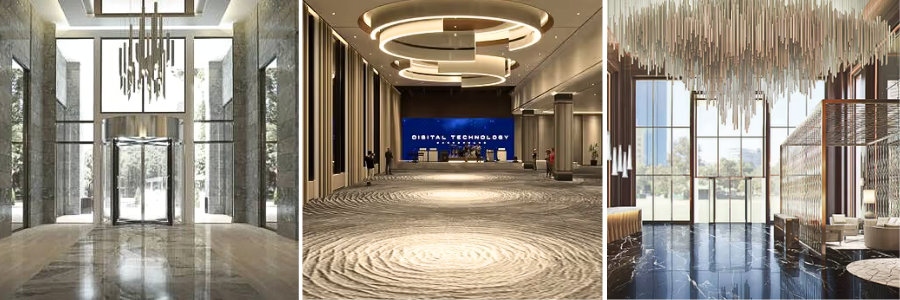
This kind of flexibility also opens the doors to tailoring visualizations to specific customer segments, or guest profiles if you like. Different travelers have different preferences for accommodation and environments. For instance, business-minded guests (as in people who stay at your hotel in some kind of professional capacity) might prefer a room with a functional work desk and a quiet atmosphere. On the other hand, families often prioritize an open floor and safety features. But guess what, 3D visualization has just the tools to showcase the same room with two or more configurations. This means you have more marketing options aimed at different targets, albeit using only one room.
Sometimes the simple answer gives the best explanation. 3D visualizations, whether animated walkthroughs services or stylized renderings (watercolor, cel-shading, oil paint, ink sketch, or basically anything other than photorealistic), are much more striking than conventional photographs. And striking imagery more easily catches people’s attention on social media. Users are far more likely to share and react to unique content, increasing positive engagement with your hotel. With every single “share,” you’ve successfully added another potential client, and this kind word-of-mouth digital marketing remains a powerful tool to attract more. Not every single lead might end up booking a room, but social media have always been great platforms to start reaching a wider audience.
RELATED: 3D Rendering Techniques in Architecture: CGI Conundrum for Architectural Companies
Closing thoughts
At the end of the day, what you really want is effective imagery that works like an expert marketing agent to persuade every viewer to make a booking. You might have to experiment with different styles, formats, sizes, and moods before you come to the perfect formula. This is something that CGI excels at, but conventional photography struggles with. 3D visualization affords you the opportunity to play with different lighting setups, compositions, viewing angles, and dramatic flair, without even leaving the screen. And with Cad Crowd on your side, you start with the confidence and peace of mind that the end product will be nothing short of high-quality interior renderings that reflect the best your hotel has to offer.
How Cad Crowd can help
Cad Crowd connects you with experienced CGI artists and architectural visualization experts who create photorealistic hotel interior renderings for marketing and hospitality projects. From guest rooms and lobbies to amenities and animated walkthroughs, our professionals deliver compelling visuals that help attract more guests and increase bookings. Contact Cad Crowd today for a free quote.