From simple drawings and designs came an evolution year by year until architectural visualization services became the top choice of every client. Before, we could be very difficult when it comes to design choice, but with this new trend, it becomes a very important element for decision-making. The reason behind it is that clients no longer want plain design, measurement, and highlighting. They now choose a story that comes from design to design. From a purely ideal, it now shifts to a real-like as well as immersive design. If you are thinking of what makes it different compared to other designs, the real element is lighting.
It is the culprit that makes the design liable for being the best-selling design. The perfection of a picture is not captured without proper lighting. I said proper lighting because if you choose the wrong lighting for a picture, it will only be vulgarly ugly rather than attractive. An example of this is a dark picture. Here, you should use brighter lighting to complement the dark. If you use dark lighting on a dark picture, it will only create chaos. In using 3D lighting rendering firms, you will only build trust, accuracy, and clear communication.
Lighting indeed tells stories without words. Compared to a book, stories are told by the words incorporated therein. It is easier to communicate using words. But in pictures, it is a different thing to discuss. It gives the artist or the architect the freedom to choose an element that would express the real intention behind a picture. Lighting is the best tool for it. The texture, the function, even the mood, it is being shown by the lighting choice.
RELATED: Transform Marketing for Lighting Products with 3D Rendering Services & Design Firms
Understanding the role of light in architectural visualization
To continue the importance of light in the design, you know what, one of the best things to realize about lighting is that it enters the picture even before the main picture and its element set in. In most designs, the architects are always thinking about how to create daytime lighting. Its shade, illumination, and the element of how air breathes in the picture. Without it, the eye can be very free to move as to what to see and focus on in the picture.
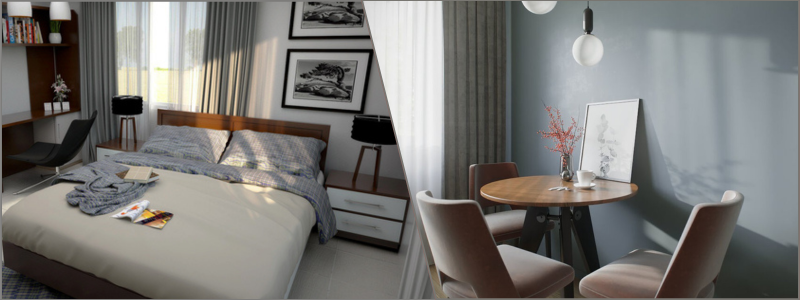
But if you incorporate lighting in the picture, it directs the viewer as to what comes first to see, then next, and so on. If a book uses a dictionary to know the meaning of every word that you find for the first time, or you find difficult to understand, in a picture, the lighting becomes a translator of stories. It lends the viewer the story that was molded by the architect. It may be without words, but the lighting makes it easier to convey what story the architectural designer wants to tell the audience. For example, an empty bed with a crumpled bedsheet has no meaning if seen in the blink of an eye. It may be a clutter to some.
But if you use the daylight element, or rays coming from the sun, it signifies that it is morning time, and the owner of the bed probably went out for a jog or for breakfast. The renderings begin to captivate creativity when proper lighting is used. It gives us the feeling of a natural and real-world picture. Poor lighting, on the other hand, will only ruin the reality. That is the reason why I told you earlier that not all lighting is proper. It must complement the main picture and its elements.
RELATED: Lighting Techniques In 3D Renders: Essential Tips for Companies
Natural light simulation and daylight accuracy
There are lights that come from a bulb. There are also those coming from a candle. Natural light, however, comes from the sunlight and is reflected in the window pane of a building. If the lighting design expert try to capture it in the morning, around 9:00 in the morning, it is a perfect picture for sure. You know why? The clients nowadays are being delicate as to what kind of design to view. They want to see how the light coming from the sun lights the entire room. It makes the rendering real when there is a physical connection between the sun and the sky.
There are a lot of lights that you can use with the sunlight. First, there is what you call morning light. This is the kind of light from 6:00 to 9:00 in the morning. Second, we have the midday light. Here, we can start from 10:00 AM to around 12:00 at noon. The light here is much firmer and stronger compared to the soft and smooth light at 6:00 to 9:00 in the morning. The last one is the late afternoon light. This kind of light is much softer than all. This is like a reminder that we should have time to rest. Like, forget about the problems we have faced the whole day, and just focus on revitalizing and recharging your body.
Artificial lighting and interior atmosphere
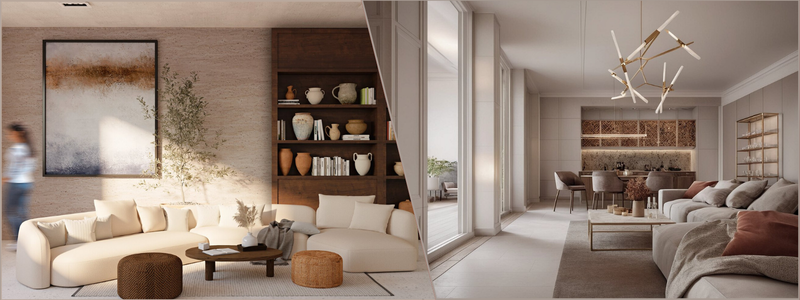
Apart from the sunlight, there are also artificial lights that can be used. As a lighting designer, you can choose from the bulb light, the candle light, or anything that does not naturally come from sunlight. It just becomes much better when combined with some sources of brightness, like the color temperature. For example, warm tones creates a comfortable tone inside your home.
We have this diffused illumination which we always use in our ceiling. When you are inside a house, you would always check on the lights, and without them, there is no focus. As I have said above, your eyes are free to see whatever comes into sight. But if you are guided by the light, you can have a complete grasp of the first thing to focus on inside the house.
RELATED: High Quality CAD Lighting Fixture Design for Architectural Firms
Global illumination and realistic light behavior
Carrying the intensified light could make or break a view. The secret to realistic light behavior in interior rendering services is to carry it bouncing from surface to surface. What does it mean? The light may be so intensified that it is either too bright or too shallow. If you put too much of it, it will either beautify or ruin the picture. The best thing to do is to balance it with the correct amount of intensity to give a particular surface, and then apply another amount of intensity on another surface, and so on.
Material interaction with light
We are focusing too much on lighting. It means lighting is important in a picture. Apart from that, we must know that lighting is not the only element that is important in 3D interior visualization services, nor does it go alone. It always has some elements mixed with it. It also has a great connection with the materials, the finishes, and the textures of the building. For example, if you have a glossy marble design, then you should choose a light in order to feel the matte concrete much better. There is a careful connection between the lighting and the texture of the building. You just have to balance it and use it properly.
Camera settings and exposure control
For every rule, there is an exception. For every success story, there is a challenge. For every solution, there is always a problem. The same is true with the lighting. There may be times when the lighting issues are present. The culprit here is, sometimes if not always, the camera. At first, we would always say no, it is not the camera because we are using the most up-to-date and modern camera. But, believe me, it may still be the camera. Check the settings and the exposure control. Through that, you can check if the brightness is too high or too low. Also, you may check the mixture of colors, if they are too pale or too loud. It always lies in the settings of the camera used.
RELATED: Architectural Lighting Plan Budgets & Tips to Reduce CAD Drawing Service Costs
Common lighting mistakes in architectural rendering
Lighting mistakes are sometimes the reason why rendering fails. I am always saying, repeatedly saying above, that proper lighting must be chosen and not just any lighting available. I even told you about the mixture, the combination of the lighting and its texture, and everything. This warning is not only for those who are newbies when it comes to architectural rendering.
It is also available to experts. Even those who may be considered experts when it comes to rendering sometimes experience common lighting mistakes. For example, there are dark materials as well as poor exposure. Then, the designer or architect wants to fix it by incorporating too much light. Instead of fixing the error, it just makes it worse.
Choosing the right rendering software for architectural lighting
From camera to software, yes, because why not? In choosing the right rendering software, you have to think technically and strategically. Autodesk 3Ds Max is considered the leading platform when it comes to visualization because of its flexible and wide plugin. When it comes to lighting, I do not recommend Autodesk 3Ds Max modeling services. Instead, I recommend V-Ray and Corona Renderer. The reason for this is that it balances the realism as well as the efficiency of the lighting. If you are also looking for a cost-friendly software, you may use Blender and its Cycles engine. Not only is it affordable, but it also offers strong lighting tools.
Collaboration between architects and visualization specialists
Architects and designers or visual artists are the ones responsible for the creation of a perfect picture. They need collaboration that is both smart and disciplined. Collaboration is when two professionals use their expertise to arrive at a perfect output. Discipline is when they know their limits. The architect knows the limit of his contribution, in the same way that the visual artist knows when not to interrupt the work of an architect. Through collaboration and discipline, the work is surely a masterpiece.
In architectural rendering, proper lighting may be considered as a part equal to science, and other expert fields like communication, as well as design. Not everyone will understand this, but technical understanding is required when incorporating lighting in a picture. From the accurate lighting choice, the artificial illumination, the foundation that is solid enough to create a firm picture, and everything, therefore, technical understanding is a must. That is why it’s worth hiring a 3D rendering professional for the job. The common mistakes mentioned above, like the camera settings and the technicalities of the view, must also be avoided. If you do it, for sure, the collaboration will be a resounding success.
Advanced lighting techniques for high-end architectural renders
Good lighting can make a simple architectural design into a perfectly made one. The secret to this is using a mild kind of light, not a strong one. Striking lightning will only ruin a good view. Sometimes, it is good to combine different kinds of lighting. We have the main light, the softer kind of light, the small accent lighting, and a combination of all. If you do the layering of these kinds of lighting, you will turn it into a naturally made view. Did you ever think of putting sunlight indoors? It might sound difficult, but all you have to do is use some light portals inside the house near the windows.
You may also use some software like V-Ray or Corona. I knew it, the glass, water, or any shiny object like a stone? These are perfect when combined with light. The patterns that they will create surely bounce and sparkle. For example, in water, sometimes it might look like a rainbow. You need to balance everything because with everything in balance, you will always have a good result. Too much light is bad, too little light is also bad. It should be an equal balance of both.
RELATED: How to Determine the Quality of Architectural 3D Renderings with Design Services Companies Firms
Exterior lighting and night scene mastery
There are four things that a 3D exterior rendering expert must consider under this section. First, the lighting outside of the building or house offers an opportunity to convey the story. Second, the night or dark scenes are very delicate – they need to be taken care of. Third, never ever overdo or make an exaggeration of it. Fourth and last, we know the so-called good night lighting, it sometimes conveys the story of the building fitting into the environment and not having a place of its own. It is like blending with the environment, and not independently standing out.
Balancing realism and artistic direction
Under this part, there are also four things to understand. The first one is the balance between the accurate architectural design and the beauty in it. The thing is, do not focus on one element only, and that is beauty, for example. You have to complement beauty with the correct architectural design. Second, use slight tweaks in order to make it better. For example, if you have a pattern from a different 3D designer, you have to tweak it a bit. In some areas of specialization, it is called benchmarking.
You will just get an idea from it and create a version of your own. Third, you have to set a very clear set of rules. Rules that are not susceptible to two or more interpretations. Rules must have only one interpretation. Fourth and last, the goal is communication. You have to communicate with your partner architect so that the design or virtual design that you have in mind will be complemented by the architectural design itself.
RELATED: 3D Rendering in Project Presentations: Expert Night-mode Scenes for Architectural Firms
Workflow optimization for lighting efficiency
When we speak of efficiency, we only focus on four things. First, the use of templates is a must. It only makes your life easier, it also makes your work organized. Second, you have to work smarter after the production of the output. It means that you should not put your best foot forward before the actual sale, and then go back to normal after the sale.
The real performance is after the production or the sale. You have to be confident enough that your client will be able to appreciate it when they already have the output in their hands. Third, you have to get quick or fast feedback. To be efficient, the client must have an outright comment on the product you made. Fourth and last is that you have to document your entire process. For architectural drafting freelancers, it’s crucial that they have all drafts on file. You have to know the progress and document it.
Managing noise and render performance
Noise is actually one of the effects of realistic lighting. Not to create noise, but to minimize it. There are some things that you need to understand about it. First, where the noise is created, you have to put it in direct sunlight because sometimes, and most of the time, it is the indirect sunlight that makes it noisy. Second, you’ve got to have a quick time to fix everything. Yes, if you are efficient enough, slight problems are no problem at all.
You must have this mindset that everything that might come along the way will surely be resolved in an instant. Third, you have to use software in moderation. Do not rely too much on the software, you must create your own design based on traditional style. Fourth, you need to boost your performance and simplify everything. Overdoing it will only ruin the view. Lastly, aim for a clean kind of lighting. The first thing to do is create good lighting, and after that, you may already explore the combination of all.
Color theory and lighting psychology in architecture
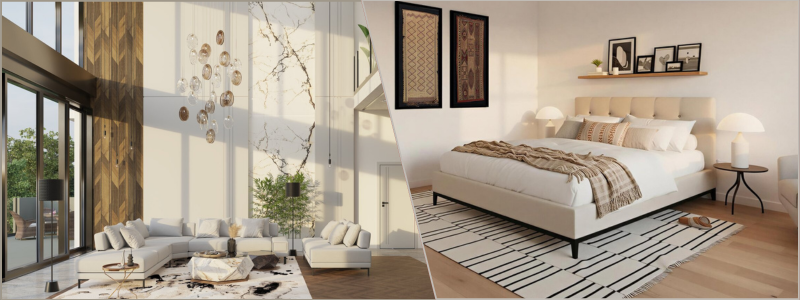
If there is a psychology in mental health, there is also a psychology when it comes to lighting in architectural design services. Why psychology? It is because lighting has some effects on the emotions of the viewer. For example, the warm light signifies the feeling of comfort, intimacy, and a welcoming vibe. Another one is a cool light. It has an implication that the light is modern, a clear one, and efficient also.
Another example is neutral light, which means the light looks flexible and can easily adapt to the changes of time. Another thing is matching the light with the space. The combination is much better than a solo one. Indeed, the psychology of lighting is an important thing to consider. For example, your home feels like home. It means it gives you comfort, relaxes you, and as such, it must have warmer tones.
RELATED: 3D Architectural Rendering: How Your Company Shapes Mood, Weather, and Season
Using real world references for lighting accuracy
Reference lighting will make it believable when you make a combination of lighting realistic. You have to be observant when it comes to soft as well as sharp kinds of shadows. It will either help you or create a problem at once. Then you have to build a library. It means you need to collect photos of before and after, and during the process.
Lighting for different architectural sectors
Clients are also various, so their needs differ from one another. With the lighting approaches, you will surely say that lighting is indeed a language. It gives the story even without words.
Integrating lighting into real-time visualization
It is now called the hybrid kind of 3D visualization services, and most architectural companies use it. You have to know the strengths as well as its limits. Also, you have to focus on the interaction.
Professional pro tips from industry experience
As compared to becoming a billionaire. You cannot be rich if you always hang out with poor people. I mean, no offense to poor people, but if you want something like richness, you have to surround yourself with rich people and not broke ones. Same here, if you want to get the best of lighting strategies, you have to surround yourself with experienced and professional architects and visual artists.
RELATED: The benefits of 3D architectural rendering for companies in the real estate industry
Building client confidence through lighting quality
The most important thing is the trust reposed in you by your client. No matter how beautiful and advanced the design you have is, if your client does not like it, you will still be a loser. Yes, you have to face it, you have to impress your client.
Future trends in architectural lighting rendering
Trends when it comes to architectural lighting rendering are always a must. From past to present to future, it always has something good to tell us. For example, the use of AI tools. You have to be friends with Alexa or Siri because they will surely suggest some lighting tips, balances, and even setups. Yes, you have experienced architects on the side, but to be friends with modern technology is a plus.
The net is that you have to maintain a backup like Cloud rendering, meaning all the designs will be saved there, and only the client and your team will have access to it. Next is real-time tracking. You have to close the gap between the previews on one hand and the offline renders on the other hand.
How Cad Crowd can help
With everything discussed above, there is only one thing in mind that I would like to show you or convey to you. Not all lighting is useful in your design. You have to choose the right lighting to make a design better. Browse Cad Crowd and find 3D lighting rendering experts to make all these possible. Contact us for a free quote.