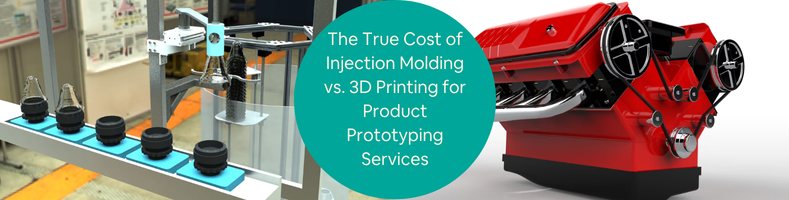
As regards product prototyping, the selection of manufacturing processes lies at the center of the time-quality-cost tradeoff. Two of the most widely used processes with different advantages are injection molding and 3D printing. Injection molding produces a mold where molten material is poured in, and therefore, it is ideally suited for large-scale production as it can be replicated and is affordable.
Whereas front-end tooling is expensive to buy, it is expensive. But 3D printing or additive manufacturing services print objects by object off computer blueprints, and that is more generic and lower initial upfront cost to begin with, and that is more appropriate for small volume manufacturing or complex design. It is useful to have the approximate actual cost of each process to companies so that they can maximize prototyping.
🚀 Table of contents
Injection molding versus 3D printing of product prototypes: What’s most effective?
Product prototyping is a highly important phase of new product development, whereby designers and engineers have an opportunity to prototype, test, and refine their ideas prior to production being in mass quantities. Injection molding and 3D printing are among the most used manufacturing methods applied in prototyping. Both processes have pros and cons, and the right one to be used depends on the complexity of the design, cost, time, and production volume. In this article, we’ll compare injection molding and 3D printing for product prototyping, exploring their key advantages and limitations.
RELATED: How CAD modernizes product concept design at industrial design services companies
Injection molding: An overview
Injection molding is a manufacturing process whereby hot material – plastic in the majority of instances – is inserted into a mold. The mold is of the same shape as the model, and when the material has hardened and set, the part is pushed out. Injection molding services are a widespread practice in the automotive, consumer goods, and medical devices sectors to produce high-quality, long-lasting parts.
Advantages of using injection molding for prototyping:
1. Accuracy and smooth finish parts: Injection molding is also used to create parts with accuracy and a smooth finish. Injection molding is easy to handle without compromising fit and performance.
2. Material versatility: Materials used in injection molding can be anything from plastic, elastomers, or thermosets, with freedom of product forms.
3. Scalability: Once the first prototype has been produced, mass production can be done with injection molding and thus is best adapted for production on a large scale.
4. Strength and durability: The products produced with injection molding are stronger and more durable compared to those produced by 3D printing and thus best adapted for use in actual conditions.
Disadvantages of using injection molding for a prototype
1. Extremely high initial capital: Injection molds are expensive and require a massive initial investment. Injection molding becomes uneconomical to produce prototypes in phase one or to make low runs.
2. Longer lead time: Taking weeks to create an injection mold may not be suitable for the need for immediate prototyping.
3. Limitations of design complexity: Injection molding is suitable for simple flat designs, but it is not easy to design products with internal complexity or complicated details.
3D printing: Overview
Additive printing or three-dimensional printing is the layer-by-layer building of parts directly from a computer-aided design model of 3D through CAD design services. The technology is known to be highly flexible, such that designers can model prototypes of complex geometry at an extremely fast speed that would be impossible or would take an unrealistic amount of time using conventional production techniques.
RELATED: Guide for the new product design process when hiring a design services firm
Benefits of 3D printing for prototyping:
1. Big turnaround time: 3D printing enables prototypes to be printed in days or hours, and hence is apt for rapid iteration and rapid prototyping.
2. Less expensive for low-volume: There are no expensive molds and tooling involved when employing 3D printing, and hence, a cheaper process for low-volume or one-off prototyping.
3. Design flexibility: 3D printing designs are precise and possess much detail, such as inner detail and contours, which are possibly hard to achieve using injection molding.
4. No tooling charge: Since in 3D printing there is no special mould or tooling needed, there is no extra charge involved in manufacturing such a part, thus making it less expensive for a one-off model or small numbers.
Disadvantages of 3D printing as a prototyping technique
1. Weaker strength and wear resistance: Parts produced via 3D printing services will either be weaker, more prone to wear, or have a compromised surface finish in comparison to the injection-molded parts, particularly when produced with certain materials. This is a disadvantage for functional part tests in harsh environments.
2. Material limitations: While 3D printing can handle a ginormous list of materials, this is not always true. The material that has been used may not be as mechanically stable as its utilization via some plastic injection, and may only be applied on a limited basis in specific industries.
3. Surface quality: Prototype parts printed using 3D printing show visible lines of layers that need to be removed using post-processing, such that a level surface is exposed. That is a plus point when producing prototype parts with quality finishes.
What is the best prototyping option?
The choice between injection molding and 3D printing is mostly a function of the specific needs of the project.
For rapid prototyping: If time and cost are concerns, especially with low-volume or complex designs, the initial best choice is 3D printing. There can be quick iteration, and designers can update their prototypes without sacrificing costly molds or huge lead times.
High volume production: When functional prototypes close to the final product’s strength, durability, and material properties are to be made, then injection molding would be best for product engineering services. Though it might be costly to start with, it is more cost-effective in the long term for high-volume production.
For detailed designs: 3D printing is best utilized when geometries in question are complicated, which would be extremely difficult or even not possible to possess in the case of injection molding. It is thus ideal for subtle details or inner geometries.
In prototyping a product, the process that is being used can truly break or make a project’s timeline and budget. Among the most common kinds of prototyping processes that are being used are injection molding and 3D printing, and both are good at and bad at something. Knowing how much each of these processes costs is incredibly crucial in knowing which is best to use that is most suited for your individual requirements.
Second, let’s consider cost differences between injection molding and 3D printing when considering material prototyping service expenses, including material expenses, tooling expenses, labor, rate of production, and other basic factors.
RELATED: What are proven product design principles when working with companies & freelancers?
Material costs
At the core of each item of work of prototyping design services are materials, and they constitute a considerable cost. Injection molding is based on the raw material treatment process, where raw material in plastic pellet form is melted and compressed under pressure into the mold in an attempt to produce a part. Material used for molding can be blended, but typical molding materials are thermoplastics such as ABS, polycarbonate, and polypropylene. All these are normally purchased in bulk and therefore become easy to determine prices and reduce the cost of material per unit while producing en masse.
3D printing uses filaments or resins, which are available in all the material combinations, such as PLA, PETG, nylon, or special resins such as carbon-fiber-reinforced resins. They are usually purchased on spools or vats and, though sometimes cheaper than injection-molded bulk plastics, are not. A range of advanced 3D printing resins, such as those with extremely high heat stability or which deliver specific mechanical properties, enables a cost per unit at times. Besides, material supply to 3D printing increases but remains a monstrous deficit behind capability relative to applications using injection molding, especially industrial-grade polymers relevant in specific environments.
Tooling and setup costs
The second critical region where injection molding and 3D printing differ is tooling. Injection molding requires the building of a mold for each part to be manufactured. The mold is aluminum or steel and varies based on the design complexity. The true cost of the mold itself will be thousands to tens of thousands of dollars, especially if there are a multitude of parts or intricate designs to make.
The cost of the tool in injection molding is front-end-biased to a tremendous extent for product design companies – tremendous upfront capital expenditure, but unit cost drops like a stone as the volume of units produced increases. Basically, the bigger the units you produce, the more you can spread your initial tool investment over the units, and therefore it becomes economically feasible for bulk quantities.
3D printing is a “tool-less” process, though. There’s no need to have a mold setup, and setting it up online is just a matter of accessing the 3D design files and configuring the printer. That’s a heck of a lot less startup expense. There is some cost of capital involved in 3D printing; however, in terms of an industrial-grade or high-end printer, that may be several hundred thousand to a few thousand dollars, depending on what the printer will be doing.
Labor costs
3D printing and injection molding are going to bear differing labor costs considerably, though in the overall sense, 3D printing will incur less human labor in the procedure. Injection molding requires people who have been instructed to operate the equipment, maintain the process, check for quality, and, if possible, strip and coat parts upon completion of molding. Labor cost on such injection molding, then, may be higher, especially for high precision or produced in a nation where manpower is costly.
Conversely, 3D printing, while still controlled, is arguably less labor-intensive and more machine-intensive in printing. Most of the coming generation of 3D printers will have the capability of printing with minimal direct supervision. This reduces the cost of labor in printing, although design intricacy and post-processing may be more time-consuming and involve experienced personnel. Also, the price of labor on printing 3D models, debugging, and post-processing, like sanding, washing, or curing, will add some extra cost to the end-product.
Production time and speed-to-market
Speed will be one of the biggest drivers for deciding between using injection mold tooling and 3D printing for prototyping, or even rapid prototyping services. Injection mold tooling is faster to produce in volume once mold development is set in motion. The actual molding cycle is minutes or seconds per part based on part size and complexity. But initially, the use of the original previously used to take until one can experiment, draw, and build the mold can take weeks from the project. And with any design change, the mold has to be rebuilt, thus it is more costly and time-consuming.
On the other hand, 3D printing is faster to print prototypes, especially one-off or low-series parts. The printer will begin to print out the part once the design file has been readied, and the part is available within hours to days, depending on the material and complexity. It is significantly an attractive solution if iteration needs to be fast and product development is emergent.
But keep in mind that 3D printing will not be so fast for very big and complicated parts, or where huge amounts of prints need to be produced. Large batches take away the speed advantage that injection molding has. Costs decrease.
Post-processing and finishing costs
Post-processing is also the kind where 3D printing and injection molding both have costs. Post-processing in injection molding generally consists of performing any other process, excess removal, and part ejection from molds. These are processes that may incur labor cost and project time but are largely routine and well-documented.
Post-processing in 3D printing may be more time-consuming, especially for parts that are printed using SLA (stereolithography) or other resin-based technologies. It could be part cleaning, support removal, curing the resin, and polishing and sanding of the surface to provide a finished look for consumer product companies. All these consume efforts and time, and post-processing expense will be largely dependent on the finish and part complexity. Post-processing may be extremely time-consuming and a function of total cost in case of high-definition 3D printing, but nothing in case of low-key prints.
Design flexibility and complexity
Design flexibility is an area where 3D printing is head and shoulders above the rest. Since 3D printing builds parts in layers, it will not mind high-complexity geometries, internal geometry, and custom geometries without paying the costs of expensive molds or tool overhauls. One can reverse-engineer and iterate as fast as if one were sketching out parts impossible or downright too expensive to manufacture with injection molding. The price of adding fine detail or re-designing is free in 3D printing, and it is more design-experimentation-culture-friendly.
In contrast, injection molding is not as forgiving of design change or complexity. Design change will typically involve changing the molds, and this costs money and takes time. Small changes in the design can even require new molds or new molds to be made, and injection molding is less amenable to quick iteration or highly complex designs.
Economies of scale
Most importantly, injection molding can be volume-multiplied. After the master mold is created, it is much cheaper to produce each subsequent unit as volume grows. It is costly initially, but for volume production, the unit cost is very low, especially with the help of injection molding services. This is why injection molding is particularly well-suited to massive runs of production where thousands and even millions of units must be produced.
3D printing lacks these economies of scale, however. It costs roughly as much to make additional units as it does to make the first unit, and so unit prices never fall with higher unit quantities. Thus, 3D printing is most suitable for low-run production, rapid prototyping, and where having the ability to customize and be flexible is valued more than cost-per-unit.
RELATED: Designing rototypes: 3D design services for inventors and companies
Environmental impact
While both injection molding and 3D printing do have some environmental impact, the character of their impact is different. Injection molding generates an enormous amount of scrap in the production of the mold, as the excess material not absorbed by the part generally must be discarded. It is a plastic material and energy-based, and very non-biodegradable.
3D printing would be more environmentally friendly in the sense that it generates less scrap. Since 3D printing is an additive, layer-by-layer technology, it uses as much material as the part and therefore does not waste. In addition, with increasingly advanced 3D printing technology, more eco-friendly materials such as biodegradable filaments and recyclable resins are now available in the market. But like in injection molding, 3D printing too consumes energy and burns it, and some of the 3D printers (especially the industrial ones) consume massive amounts of energy.
Maintenance
Maintenance of an injection molding system is an example of keeping up with a whole bunch of small things. The mold wear-and-tear will need to be monitored regularly, and how much fixin’ or mold finaglin’ will be done will be questionable. The injection molding machines themselves will need servicing and eventual replacement or rebuilding from time to time, at least in applications where they’re being worked hard by tool design services.
3D printer maintenance is predominantly model-dependent. Low-end machines are low-maintenance with a higher rate of generic type breakdowns, primarily in manufacturing applications. High-end machines, particularly those utilizing resin processes, involve a high level of labor and effort to clean and service in order to produce high-level prints.
Lastly, injection or 3D printing in product design is an option that relies on a series of variables: volume, design complexity, time to make, and material requirements. Injection molding provides a lower cost per unit at high volume, but 3D printing provides unparalleled flexibility and rapid iteration at low volume or complex designs.
For companies trying to determine how best to handle prototyping services, it will depend on the volume of production, design sophistication, and expense. All have pros and cons, and expenses per stage, from material and tooling to man-hours and post-processing, can make the decision an informed one.
RELATED: How innovative design techniques can supercharge your new product concept
Cad Crowd is here to help
The choice between injection molding and 3D printing largely depends on your project requirements, including production volume, design complexity, and cost. Injection molding is cheaper for high production, while 3D printing is cheaper at low production with little initial investment. Expert advice will allow for a seamless transition through alternatives.
Companies like Cad Crowd are acting as bridges to a global pool of freelance CAD designers and engineers who are waiting to provide specialist services and consultancy to fulfill your prototyping requirements. For more information on how Cad Crowd can help your project and receive a price quote within your budget, call Cad Crowd and talk to experts who are ready to turn your idea into reality. Your price quote is free, so call us today. Request a quote today.