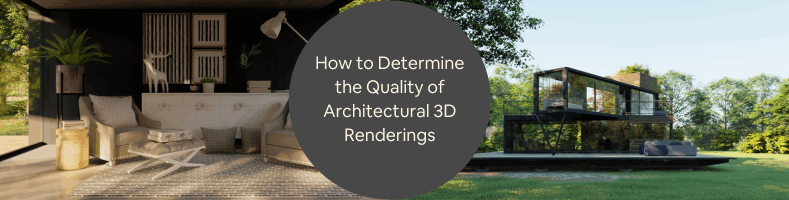
Just because an architectural 3D rendering looks good, it doesn’t necessarily mean it’s “technically” done well. There are a handful of criteria that determine whether the image is of high quality or nothing but a visually pleasing yet nonsensical representation of an architectural piece of work. Chief among which is that the rendering, essentially a computer-generated imagery of a real-world object, has to appear natural.
Sure, visual effects and post-processing touches are welcome, but there’s such a thing as having too many of them in one image, making the supposedly lifelike representation of an architectural project into something somebody just pulled out of the set of a high fantasy movie. An architectural 3D rendering isn’t meant to be fantastical. Keep it realistic and natural, and that’s a lot easier said than done. The good thing is that the visualization technology has matured at just about the same rate it has democratized itself. As 3D and CAD software tools improve, the number of people learning to master the trade also increases.
In the old days, anybody was probably stuck with big (and expensive) architectural visualization studios each time they had to have a 3D rendering made. In this day and age, however, there are thousands of independent render artists offering their services at competitive rates on online platforms, such as the AEC industry-specific Cad Crowd, the leading agency in 3D architectural design services that can help you connect with the freelancers have been pre-screened for skills and experiences, Take time to look at their portfolio and use the following criteria to determine if the freelancer is the right person to handle your next architectural visualization project.
General considerations
Let’s start with the basics of what you can expect from exterior and interior renderings and the general criteria that separate the good from the bad ones. An exterior rendering is how you see an architectural object from the outside. You should notice how an exterior rendering almost always includes a collection of other objects typically observed around a building or a house, such as a tree or two, the streets, cars, another building across the road, and people.
No matter how interesting all those other random additions might be, the main object should remain the focal point of the image; it’s the highlight of the show, so it shouldn’t be relegated to being a supplemental detail. It’s a matter of composition. Also, the background should complement the main object instead of competing with it for attention. And if there are people and natural scenery around it, at least they have to correspond to the weather, the time of day, and the overall architectural style.
In many instances, interior rendering services are more challenging than exterior rendering. Among the main reasons is that almost every object depicted in the image plays a role in introducing the sense of unity and coherence in the interior. Take, for example, a 3D rendering of a typical kitchen; the coffee maker sitting on the countertop is just as important as the fridge next to it. Even the humble backsplash adds to the realism effect as much as the tiny kitchen island.
Because of this, you will have to pay attention to the more technical matters, including proportion and placement. For instance, pieces of furniture and cutlery must be scaled in accordance with their life-size proportions, and no single object floats freely in the air. Patterns on surfaces have to be displayed properly instead of being just another layer of thickness on top of another object, and the overall design itself shouldn’t appear cluttered by unnecessary decor.
That being said, there’s much more to determining the quality of architectural 3D rendering than just the basics of focal point and proportion. There are still several more factors to take into account, as listed below.
RELATED: 5 reasons freelancing studios are the future of 3D visualization services
Photorealism
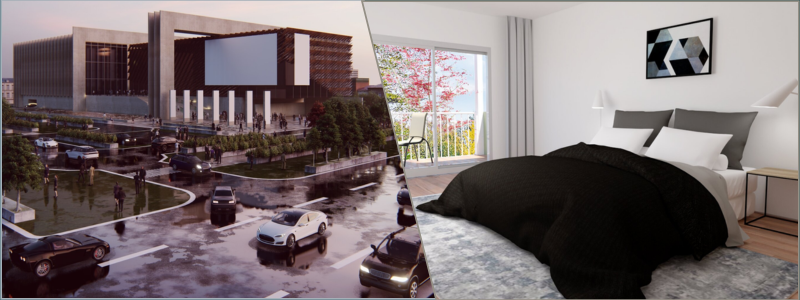
You’ve heard the phrase “render like a photographer” getting thrown around in countless discussions about photorealism since the dawn of architectural visualization services. It doesn’t in any way suggest that anybody has to master photography to be able to render it properly; it’s just that a good understanding of how objects appear in a photograph (or real life, if you like) can go a long way to improving the final product. Architectural rendering demands a little bit of both artistry and technical proficiency to bring about the level of photorealism everybody can appreciate. And true photorealism will take nothing less than near-obsessive attention to detail. For instance:
- Glass elements or objects made of translucent materials like plastic bottles and tinted windows should respond to light in a certain fashion, different from those with transparent and opaque surfaces. Light doesn’t just pass through translucent objects; it gets scattered and, depending on the shape of the object, continues to travel in very specific directions.
- Not everything has to be perfect in every way in a rendering. Some surfaces are allowed to have imperfections, such as scratches and tiny dents. Signs of wear and tear can improve photorealism, especially if the object is normally subject to heavy use, like a kitchen countertop, an office desk, or a pair of shoes. Small imperfections from wear marks or stains are not always bad–if anything, they make an image look even more realistic.
Flawlessly smooth surfaces are the expected norms, but at the same time, they can make objects appear superficial. Slight yet deliberate imperfections, such as stains on the fireplace, dirt on the glass windows, dry leaves on the driveway, or a pile of books on the coffee table, give the rendering a more natural feel. Small, hardly noticeable details like the stitching on the upholstery and decorative door knocker are hints that the render artists strive for more than just accuracy and eye candy, but also lifelike quality in the rendering. With the rendering, they don’t want you to see a mere architectural visualization but also a story contained within the design.
Lighting and shadows
Every render artist can say that lighting often presents a monumental challenge in architectural visualization. Lighting has everything to do with realism and affects the visual appeal or mood of the scene. At the same time, lighting is also an artistic tool; assuming the artist can simulate the natural behavior of lights in the rendering, the result is nothing short of effective imagery that can really evoke emotions in the audience. Clever utilization of lighting design services also helps highlight important little details the audience would otherwise easily miss.
As in nature, light gives you a byproduct called “shadow.” In a photorealistic architectural rendering, you just can’t separate the two elements. If you decide to cast a light–either natural or artificial–on an object, there’s going to be a shadow or reflection depending on the characteristics of the material/surface it hits and the direction of the light in the first place.
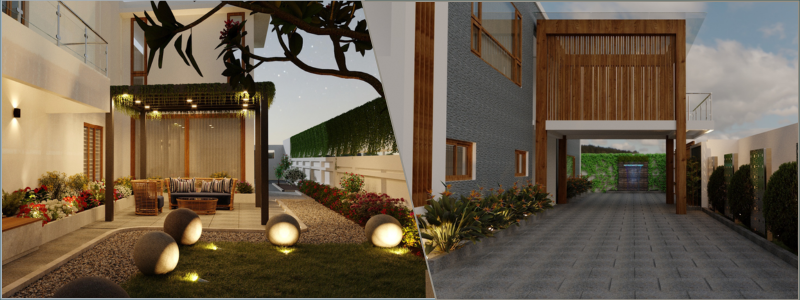
When using natural lighting (the sun during daylight or the moon at night), the visualization has to correspond to the time of day and even the weather. For example, an interior rendering of a living room set on a bright sunny morning must include warm light penetrating the windows into the room. Soft shadows and uplifting brightness (instead of harsh and blinding glare) offer a welcoming air. On a cloudy morning, when the lights are much softer, you should see cooler tones as well. Geographical orientation also matters. Depending on the time of year and position of the sun, the sun-facing walls receive more light than all the others; this has to be represented accurately in an exterior rendering.
The same principle applies to architectural visualization set at nighttime. Artificial lighting might not be a good idea for exterior rendering, but it can work wonders on interior rendering. In fact, an expert 3D render artist can be quite playful with artificial lighting regarding placement, strength, temperature, and direction. For instance, artificial lights can produce warm, yellowish tones or cool white illuminations, which also dictate the intensity of the shadows. Some lighting fixtures are recessed, so they can only cast light to a limited area, whereas ceiling lights or chandeliers can brighten up an entire room from above. Sometimes, there is minimal shadow; this doesn’t immediately create an impression of non-realistic rendering, especially if you see in the image multiple, strategically positioned, diffused light sources.
Modern 3D rendering software tools have a feature known as GI or global illumination, sometimes referred to as indirect illumination. When utilized, the technology fires up a group of algorithms to produce realistic lighting in 3D scenes by taking into account object materials, reflections, refractions, and shadows. In essence, global illumination can simulate how light bounces off a variety of different surfaces and shapes.
Say the room has a shiny wooden floor and dark red walls, with some black-colored accents in the lower section. Without the GI, a bright white ceiling light will illuminate the floor and the walls with equal intensity. The floor might appear shinier, and the walls look brighter, but you still can’t see the accent clearly. Thanks to GI, the algorithm makes sure that the same light hits the floor and then bounces off it due to the reflective characteristic of the shiny surface. The light that bounces off the floor might be absorbed by the walls, making the red color look more radiant and revealing the black accent. Although all of these processes are handled automatically by the software, it takes a skillful render artist to position the lights, adjust the color tone, and apply textures to objects.
RELATED: The role of 3D visualization in winning real estate clients for your firm
Camera angles and composition
It’s easy to assume that camera angles and composition are the realms of photography and videography, not 3D rendering services. But that’s not entirely correct. Keep in mind that 3D renderings portray or visualize an object as realistically as possible, just like a photograph. While there’s no actual camera involved in the workflow, the rendering process uses virtual cameras, not to capture an image but to determine the point of view; the cameras determine from what angle the image will be displayed.
In a 3D-rendered floor plan, the virtual cameras are positioned directly above or near that point for a bird ‘s-eye view. A typical interior rendering would place the camera at eye level or slightly above it to recreate the natural viewing position. It’s welcoming and comfortable. Some exterior renderings use worm’s eye perspective to highlight the grandeur of a building, while others prefer a zoom-out aerial view to include the surrounding area in the frame as well. No specific angle is better than any other, as it all depends on the client’s needs and what features to highlight.
Render artists can also put the virtual camera at any position within the 360-degree horizontal rotation. Camera position affects your perception of scale and spatial relationships. A bird’s eye view helps you understand the overall layout of a room or a house and how it connects/interacts with the surrounding environment. If the rendering is supposed to display a relatively large area in one image, an aerial shot is ideal to capture an expansive view. Close-up shots allow you to focus on a few specific objects and their fine details, while wide-angle lenses enable you to see an entire room in a single image. As mentioned earlier, an eye-level perspective feels more relatable because it tries to mimic the natural viewing position when you’re standing upright.
Composition is all about the arrangement of objects in the frame. Render artists use more or less the same techniques as photographers by using such principles as the rule of thirds, leading lines, symmetry, framing, the golden ratio, and so forth. Most 3D renderings, whether 3D exterior rendering services or interior, use dynamic compositions where multiple objects are included in the frame to build the right context and lead you to feel the intended atmosphere. For instance, placing a fireplace at the center of the rendering can suggest warmth and comfort; a lounge chair in a living room sends a message about coziness, etc.
Together, composition and camera angles are storytelling tools. The arrangement of objects and how they are presented should convey a message that you can effortlessly decipher. A good 3D rendering tells you a story and invites you to the experience instead of just showing you a bunch of objects cramped in an image.
Environment and context
A realistic and natural environment means everything in the surrounding environment should feel integrated and organic in some way, rather than being forced to be in the scene for the sake of inclusion. You’d think that “environment” is only a problem for exterior rendering, but an interior visualization can have elements from nature as well. For example, a visualization of a kitchen where the camera is positioned directly across an open window has to inevitably include a view of the outside area, even if only a small portion of it. This inclusion, if done right, also serves a purpose, mainly adding relatability and depth.
An exterior rendering benefits from supplemental details like shrubs, trees, clouds, streets, or pathways positioned near the main object. Once again, the choice of plants and the weather conditions should be relevant to the time of day, season, and location. If the photorealistic rendering service is meant to showcase a residential house in a suburban area during winter, some trees and a rooftop covered in snow are the natural choice; for a villa in the countryside, the backdrop elements of cloudy skylines above some green mountains in a distant horizon can complement the architectural object nicely, without overshadowing the design.
Props and little things in the background are not actually architectural objects, so they need to be noticeable yet subtle enough that they don’t distract you from the design.
Although interior visualization probably doesn’t have much to showcase in terms of natural elements, the render artists should still be able to create an engaging environment using decorations or other props as long as they complement the design well. For instance, a rendering of a rustic kitchen design with wooden flooring and accents can benefit from the addition of vintage appliances or classic cookware; all the objects included in the scene add to the design, and more importantly, nothing looks out of place.
RELATED: Keys to successful structural design & construction projects with architectural services firms
The usual suspects
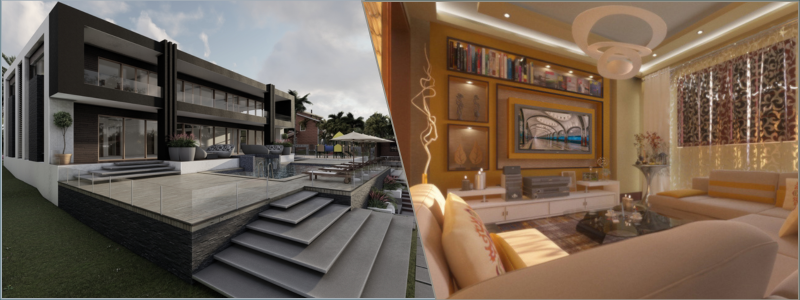
Last but certainly not least, it’s time for the technical criteria of color accuracy, textures, material mapping, and image resolution. In architectural renderings, colors are not merely used for aesthetic preferences but to enhance realism. Different objects can have different colors, and you may come across some design peculiarities such as completely black & white interiors, bedroom walls covered in murals, an all-around green color scheme in the bathroom, a modern kitchen filled with rainbow colors, and so on. Whatever it might be, the important thing is that the color is depicted accurately (and naturally) in the renderings. This means taking into account lighting and shadows as well.
Material mapping and textures are not entirely different, either. When the objective is realism, architectural renderings have to present any object as you would normally perceive it in real life. As far as 3D modeling design services and rendering are concerned, textures create the surfaces of objects, whereas material mapping determines how well the surface details are applied to those objects. In short, they make sure that everything you see in the renderings does look like the actual object in the real world, including any kind of imperfection like smudges, stains, scratches, distortions, wear, etc.
Resolution might not be the main concern, but you still need to be aware of it nonetheless. The thing is that, nowadays, you’ll be hard-pressed to find render artists whose lists of services make no mention of Full HD resolution as the standard option. Many have even embraced 2K and 4K options, delivering an impressive level of detail on big screens and large-scale prints.
Conclusion
At the end of the day, architectural 3D renderings are communication tools to convey a message about the essence of a design using imagery. A good communication tool sends a clear message; every word has to serve a purpose that leads you to a better understanding of the issue at hand. With that in mind, all the objects and little details in an architectural visualization also have to represent certain functions and enhance the imagery instead of being just another distraction and clutter. They help create and maintain balance between technical precision and artistic touches to guide you to a better understanding of the design’s characteristics, spatial relationships, and purpose.
It may all seem pretty simple, but in reality, it takes a true professional to create an architectural visualization that hits every mark and leaves a lasting impression.
RELATED: 6 reasons to hire CAD drafting companies & design services firms
How Cad Crowd can help
However, there’s no denying that the highest quality 3D rendering presents accurate details and many artistic expressions that cost a pretty penny. Even more so when you have it done by a big-name visualization studio. Here at Cad Crowd, you’ll get a reasonable balance between price and quality, and hiring a freelancer might be the next best thing. Don’t be fooled by the old assumption that freelancers aren’t as capable as an architectural firm or a studio. With over 94,000 experts to choose from, freelancers are pre-vetted for the skills and abilities to ensure that clients only work with the most competent render artists for any architectural visualization project. Don’t hesitate to contact us today!