

Welding cell (Car body elements)

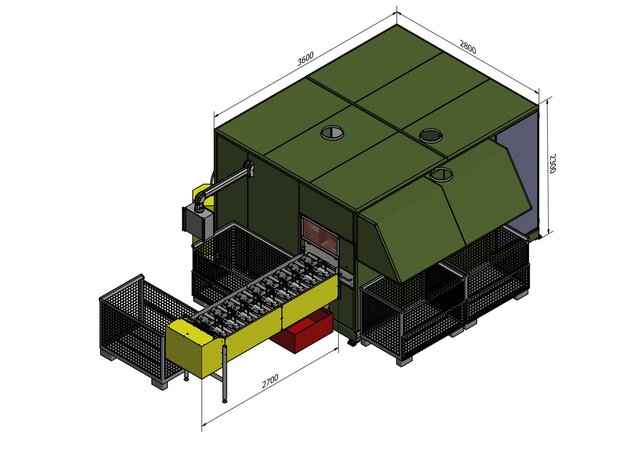
We worked as a partner responsible for the design and construction of the mechanical part and the cell housing.
My role:
Layout development and workspace analysis for three robots
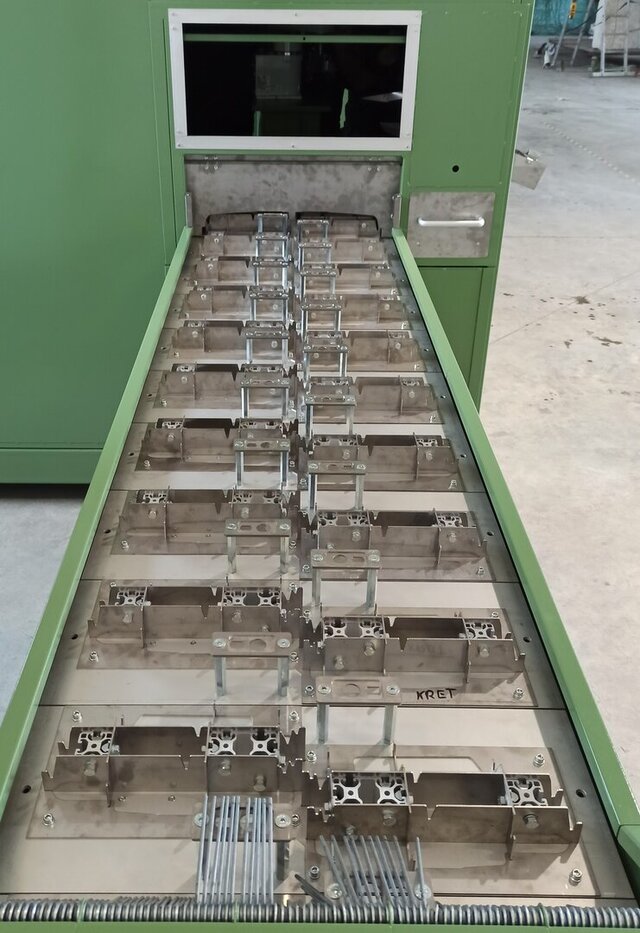
Design of dedicated conveyor with Poka-Yoke nests
Full mechanical design of the cell structure
Preparation of manufacturing drawings including GD&T and welding documentation
BOM creation
FEM analysis of critical components
Application of DFA/DFM principles (cost reduction of nests, ease of assembly)
Coordination of the work of the design and automation teams
Supervision of production, assembly, FAT
Project description
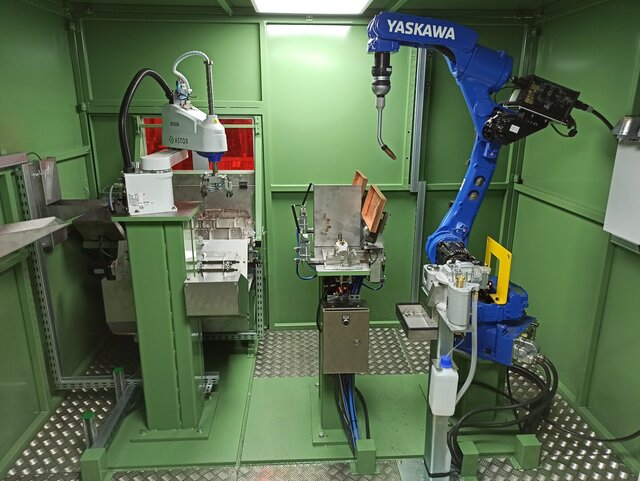
The Welding Cell is a comprehensive solution that ensures the assembly of parts and their connection in the welding process.
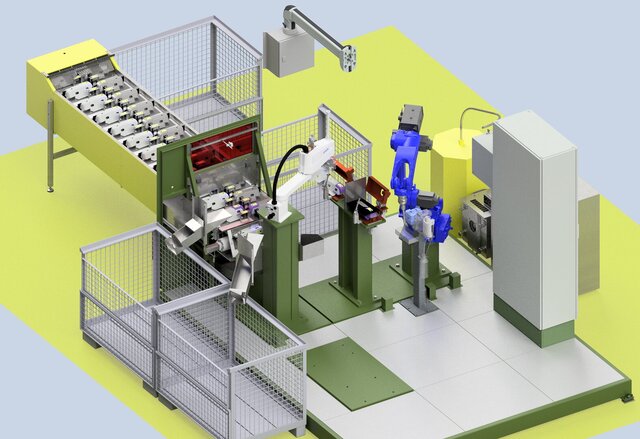
The operator takes out the components from baskets located next to the Cell and places them on a conveyor. Shaped nests ensure proper part placement (they cannot be placed in the wrong nest or in a different orientation). Both left-hand and right-hand parts are simultaneously placed on one conveyor section. Additionally, the parts on the conveyor pass through a shaped gate, which serves as a second level of inspection and a safety feature that stops the machine if other items are left on the conveyor. The final checkpoint before assembly, located inside the Cell, is the presence and orientation check, ensured by a vision system.
Two robots operate inside the housing. The first, a SCARA, picks up both parts from the conveyor and assembles them directly on the welding cells. The welding is performed by the second robot, this time a 6-axis robot. After welding, the SCARA removes the finished parts and places them in the appropriate discharge chutes.
In the Cell, “right” and “left” workpieces are welded alternately. While welding is taking place on one workpiece, the other is emptied and the next workpiece is assembled on it.
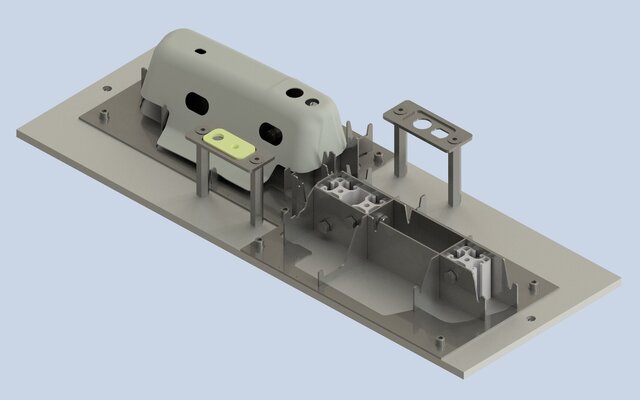
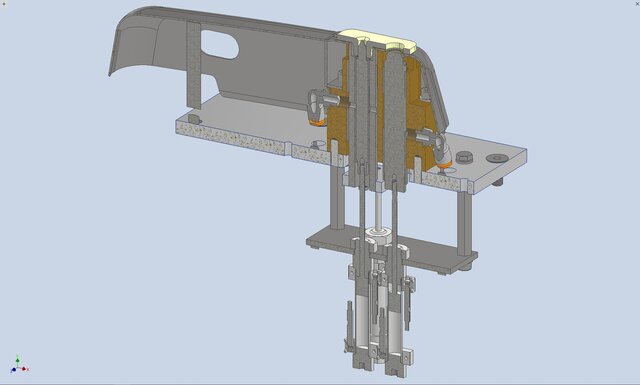
The process involves welding a thick, small component with two holes to a sheet metal stamping. To ensure process continuity, we designed a buffer conveyor. It has 24 pairs of shaped nests to ensure flawless part alignment. Due to the large number of nests, manufacturing them as individual blocks would be very expensive, so I developed a much cheaper version based on five cross-sections.
Currently, the cell is staffed by one welding robot. If the need arises to increase production speed, there is space for a second welding station with a second robot.
Types of effects obtained as a result of work implementation
Work safety:
Clean air – the assembly and welding process takes place in a closed space, the extraction system ensures a slight negative pressure inside.
Eye protection – the cell housing provides full protection against radiation generated during welding.
Design:
The conveyor’s shaped nests ensure proper positioning of the parts on the conveyor, ensuring their smooth pickup by the robot. The conveyor consists of 26 plates, with two nests on each plate. Creating this many nests using subtractive or additive machining would be prohibitively expensive. Therefore, the component shapes were modeled using selected cross-sections. Five cross-sections were required for the parts in this process, plus a contour sheet to facilitate nest identification by the operator. Their total cost for the entire conveyor is comparable to the cost of producing one plate (two pockets) using subtractive methods.
Ergonomics:
The operator places the components on a segmented feed conveyor, which is designed to prevent incorrect positioning of the parts.
The conveyor serves as a buffer of parts for the process, which provides the operator with sufficient time for other process-related activities (replacing the container with the finished product, providing input components at the loading station, etc.), without compromising the efficiency and repeatability of the process.
Economy:
The cell supports 2 types of elements without the need for retooling.
The machine is distinguished by its ease of use – the process does not require the operator to assemble the input parts that are components of the finished product (we exclude incorrect assembly and reduce time).
The finished product is produced in less than 22 seconds (the customer’s requirement was 22 seconds – 160 pieces/hour). After optimizing the welding process (MAG pulse welding), the machine achieved a maximum output of 200 pieces/hour.
In fact, the surplus time we gained after process optimization was used for maintenance breaks (cleaning of welding stations every 4 hours of work)
Quality:
The completeness of the parts placed on by the operator is checked by the vision system.
A welding robot integrated with an advanced power source ensures high quality and repeatability of the welding process.
Published