

Supersonic CFD Analysis – Multi-Species Air/Hydrogen Propulsion

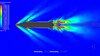
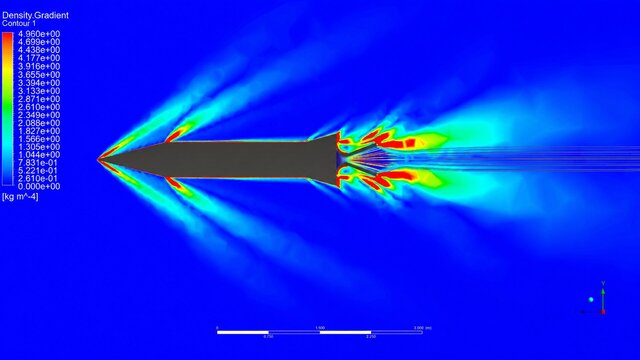
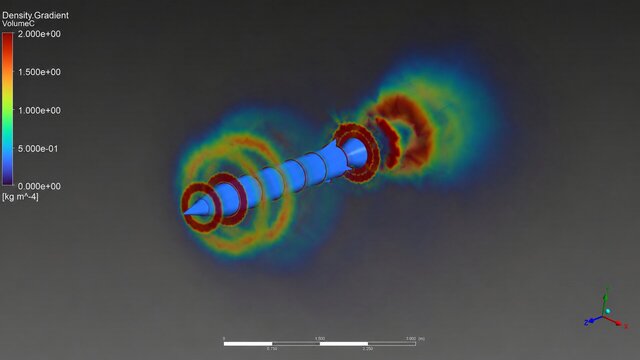
This project presents a steady-state RANS CFD study of a simplified rocket geometry designed from scratch to investigate supersonic aerodynamic behavior, shock-wave formation, and the interaction between the external flow field and a hydrogen propulsion plume.
The simulation was developed using a compressible density-based solver with the k-ω SST turbulence model, selected to improve near-wall flow prediction along the rocket body and rear fin surfaces. Species transport was included to represent the interaction between the external air and the hydrogen propulsion stream.
The rocket incorporates four rear fins with approximately 25° inclination near the propulsion section. The mesh used a predominantly polyhedral volume discretization, triangular surface elements, five inflation layers along the body, and local refinement around the nose, fins, nozzle, plume region, and expected shock locations.
The results include:
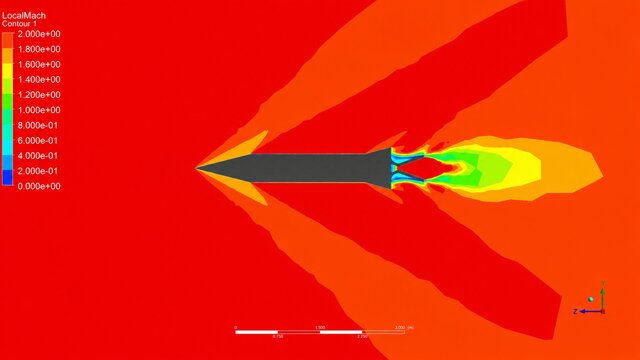
• Local Mach number distribution
• Density-gradient visualization of shock structures
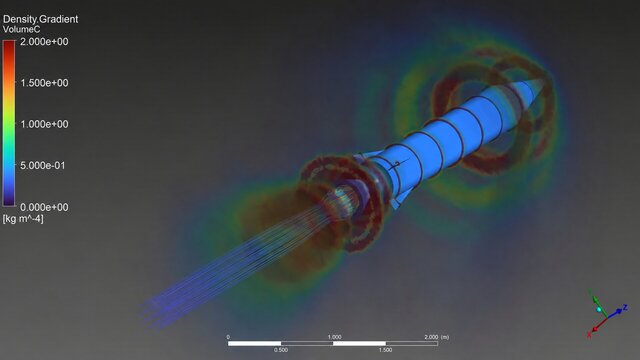
• Three-dimensional shock-wave development around the vehicle
• Hydrogen plume expansion and interaction with the external supersonic flow
• Streamline visualization of the propulsion flow
• Analysis of compression and expansion regions around the vehicle
The objective of the project was not only to obtain the flow field, but also to study the numerical setup required to capture steep compressible-flow gradients while balancing mesh resolution and available computational resources.
This project demonstrates experience in compressible CFD, turbulence modeling, species transport, mesh strategy, shock-wave analysis, post-processing, and engineering interpretation of simulation results.
Full project discussion and additional engineering work available on my LinkedIn profile:
[▒▒▒▒▒▒▒▒▒▒▒▒▒▒▒▒▒▒▒▒▒▒▒▒▒▒▒▒▒▒▒▒▒▒▒▒▒▒▒▒▒▒▒▒▒▒▒▒▒]
Published
in
CAD Design