

staticfigure14

🏎️ Modal, Harmonic, and Transient Analysis on a Race Car Chassis
In this project, I dynamically analyzed a race car chassis to understand its behavior under various vibration modes and dynamic loads. My workflow covered Modal, Harmonic, and Transient Analysis — each revealing how the structure reacts to real-world excitations like bumps and side impacts.
🔹 1️⃣ Modal Analysis
The first step was identifying the natural frequencies and mode shapes — the “fingerprints” of dynamic behavior.
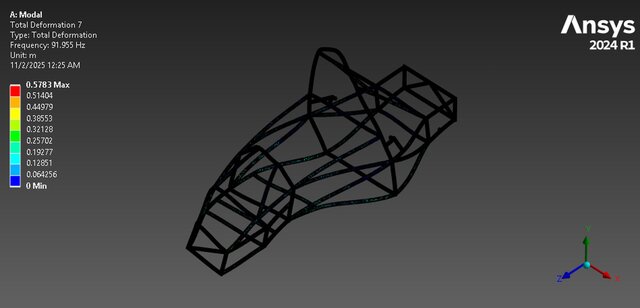
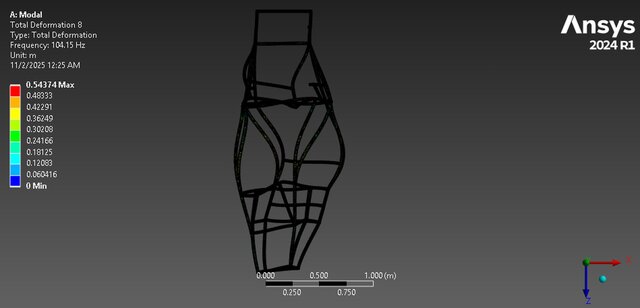
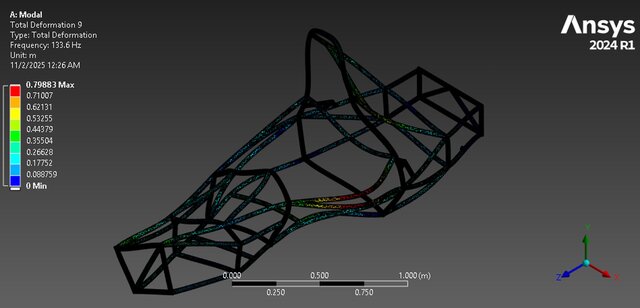
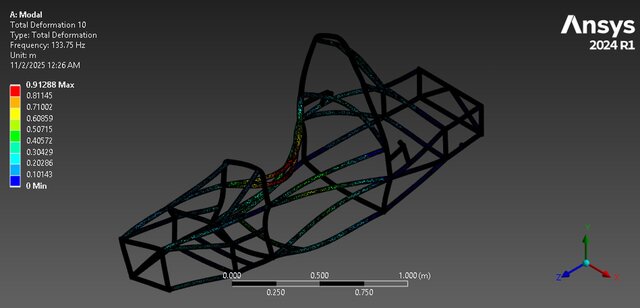
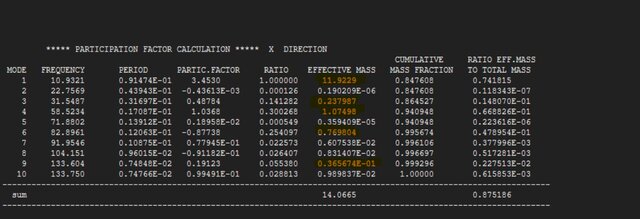
Here’s a summary of the first 10 mode shapes:
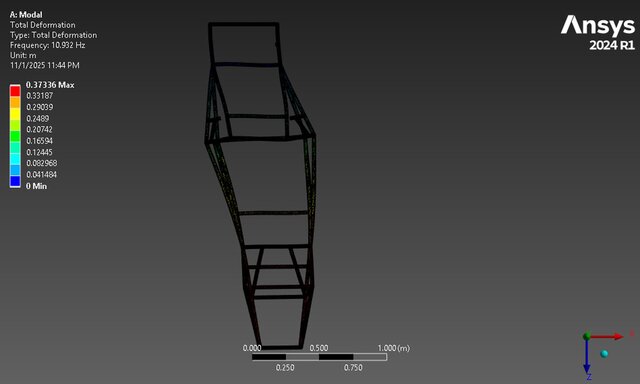
1️⃣ 10.93 Hz – Fundamental mode caused by side shear in X-direction at the chassis front.
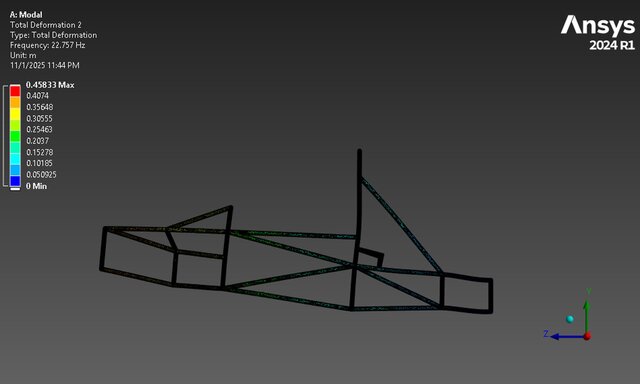
2️⃣ 22.76 Hz – Global vertical motion (Y), like a bump — less critical here.
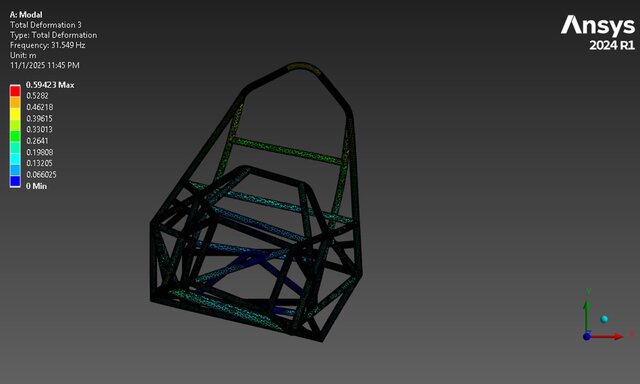
3️⃣ 31.55 Hz – Torsion about Z-axis; affects stiffness but minor in X.
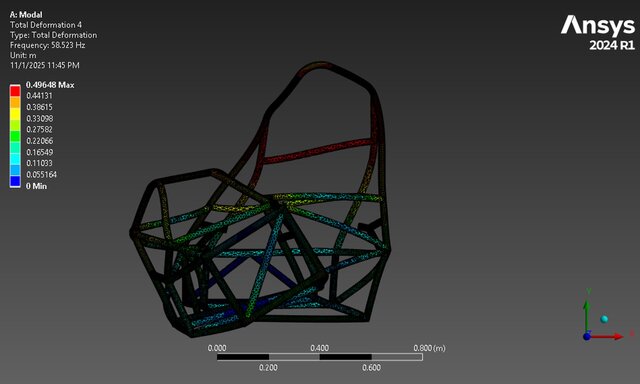
4️⃣ 58.52 Hz – Strong X-displacement at front and mid chassis.
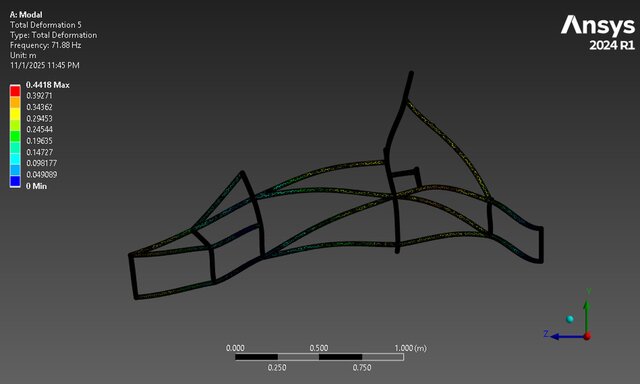
5️⃣ 71.88 Hz – Bending in Y, max at mid-span.
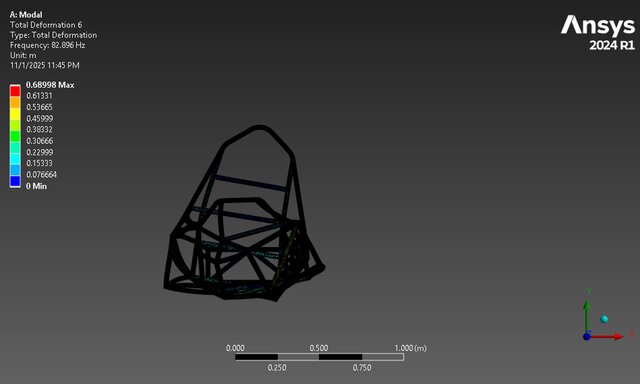
6️⃣ 82.90 Hz – X-direction motion at front & middle.
7️⃣ 91.95 Hz – Similar to 6, but deformation more centralized.
8️⃣ 104.15 Hz – Major torsional mode about Z.
9️⃣ 133.6 Hz – Mixed X-displacement and Y-rotation.
🔟 133.75 Hz – Complex mixed mode with small contributions.
The most dominant were Modes 1, 3, 4, 6, 7 & 9 — especially Mode 1, representing the critical side impact.
🔹 2️⃣ Harmonic Response
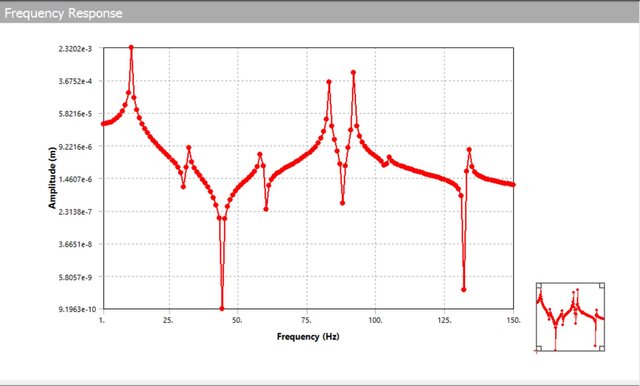
The Harmonic Analysis visualized the Frequency Response Function (FRF). Resonance peaks aligned with modal frequencies, confirming Mode 1 as dominant.
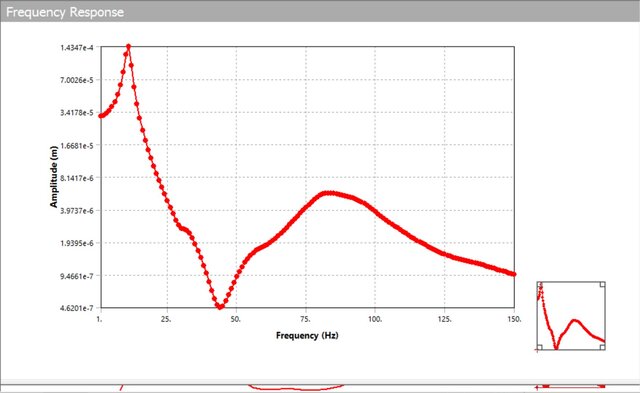
To refine the response, I added modal damping based on Mode 1 frequency. This reduced its resonance and suppressed higher modes.
🔹 3️⃣ Transient Analysis
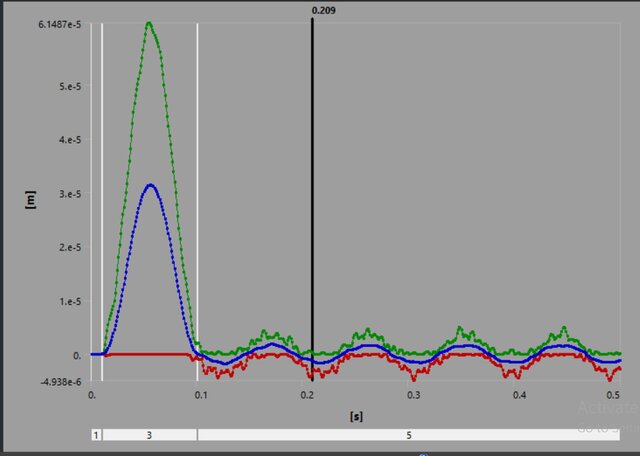
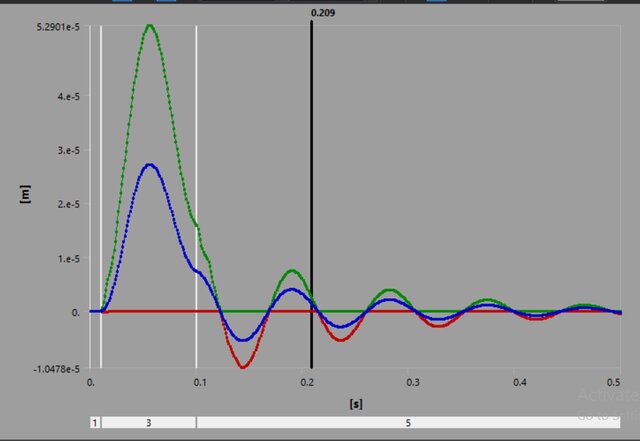
Finally, I simulated a real side impact. Without damping, oscillations persisted unrealistically. With damping, vibrations decayed smoothly.
The time between peaks was 0.092 s (~10.87 Hz), perfectly matching Mode 1 — proving it’s the dominant mode.
Every phase — from meshing to constraints — was tuned for realistic accuracy. Because in dynamics, it’s not just about running simulations, but understanding which mode truly defines your design’s response under impact.