

Multiphase CFD Erosion Analysis of 3D-Printed Polymer Sieve Meshes

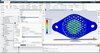
Multiphase CFD Erosion Analysis of 3D-Printed Polymer Sieve Meshes
A final year research project combining CFD simulation, design of experiments, and additive manufacturing to study erosive wear in 3D-printed sieve mesh geometries.
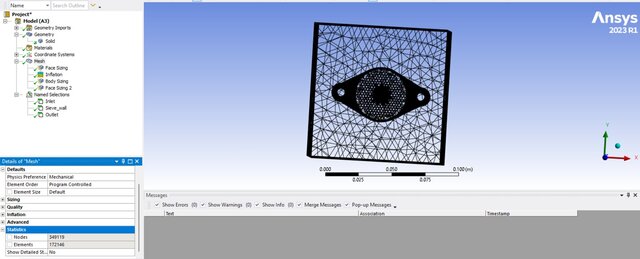
The project began with designing sieve mesh geometries in CAD and manufacturing physical prototypes via 3D printing using PLA and ABS polymers, allowing direct control over mesh parameters like wire diameter, aperture size, and weave pattern variables that are difficult to isolate with conventionally manufactured woven meshes.
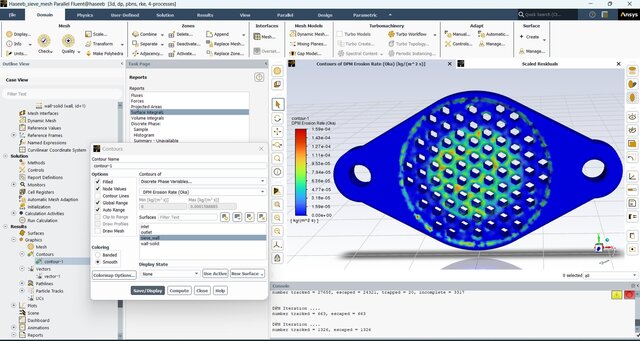
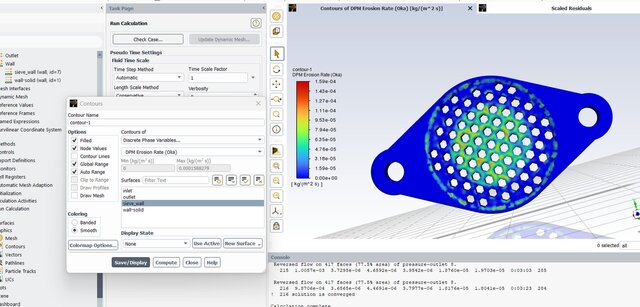
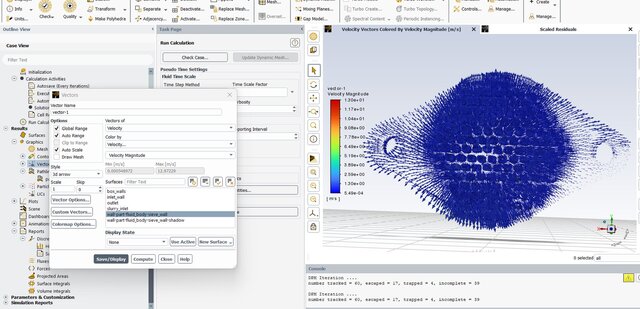
On the simulation side, I used ANSYS Fluent's Discrete Phase Model (DPM) to simulate particle-laden flow through the mesh geometries, applying the Oka erosion model to predict wear rates and erosion hotspots across the mesh surface. Rather than testing configurations arbitrarily, I structured the study using a Taguchi L9 design of experiments, which let me systematically evaluate how multiple geometric parameters influenced erosion behavior with a minimal number of simulation runs identifying the dominant design factors efficiently.
To close the loop between simulation and physical reality, the 3D-printed samples were subjected to erosion testing and then examined using SEM (Scanning Electron Microscopy) and EDX (Energy Dispersive X-ray) analysis, validating the CFD-predicted erosion patterns against actual surface degradation and material composition changes on the manufactured parts.
This project reflects an end-to-end workflow: CAD design, additive manufacturing, CFD/DPM simulation, DOE-driven optimization, and experimental validation the same methodology I apply to porous media, multiphase flow, and mesh/filter design projects for clients today.
Tools used: ANSYS Fluent (DPM, Oka Erosion Model), SolidWorks, FDM 3D Printing (PLA/ABS), Taguchi DOE, SEM/EDX Analysis
Published