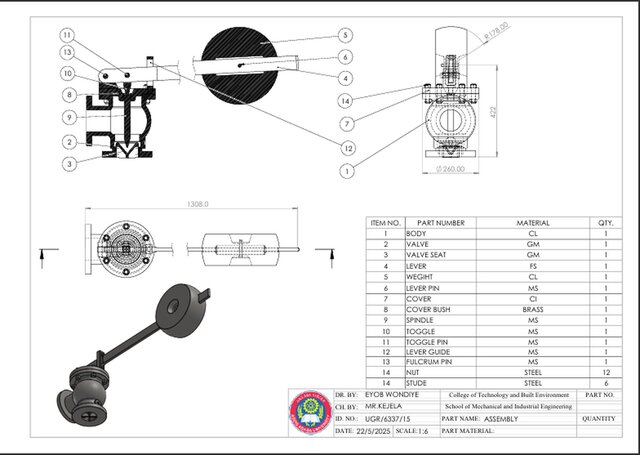

Lever Safety Valve

A Lever Safety Valve is a type of pressure relief valve designed to protect pressure vessels,
boilers, pipelines, and other equipment from excessive pressure buildup. It automatically releases
fluid (gas or liquid) when the pressure exceeds a preset limit, thus preventing potential
equipment damage or safety hazards. The lever amplifies the force exerted by the fluid pressure
to lift the valve disc off its seat when pressure is too high.The project involves creating a 3D
model and 2D engineering drawings of a Lever Safety Valve using SolidWorks, a leading
CAD (Computer-Aided Design) software. The goal is to accurately design the valve assembly,
generate detailed part drawings, and simulate its functionality to ensure proper mechanical
operation.
Area of Application of the Machine
Lever safety valves are widely used in boilers, pressure vessels, and steam systems to prevent
overpressure conditions. They automatically release excess pressure to avoid equipment failure
or explosions, making them crucial in:
• Power plants (steam turbines, boilers)
• Chemical and petrochemical industries (reactors, pipelines)
• HVAC systems (heating and cooling applications)
• Marine and industrial machinery (steam engines, hydraulic systems)
Working Principle
The lever safety valve operates on the principle of pressure relief:
• Under normal conditions, the valve remains closed due to the force of a spring pressing
the valve disc against the seat.
• When system pressure exceeds the preset limit, the force overcomes the spring load,
lifting the valve disc.
• The lever amplifies the lifting force, allowing the valve to open and release excess
pressure.
• Once pressure returns to safe levels, the spring pushes the valve disc back to close the
valve.
Files (3)
License:
CC - Attribution
Learn more
Published
in
CAD Design