

GIM-I: Indoor Heat-Pump Relay Board (7 Relays, 2 AC-DC Supplies, 2 oz Copper)

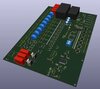
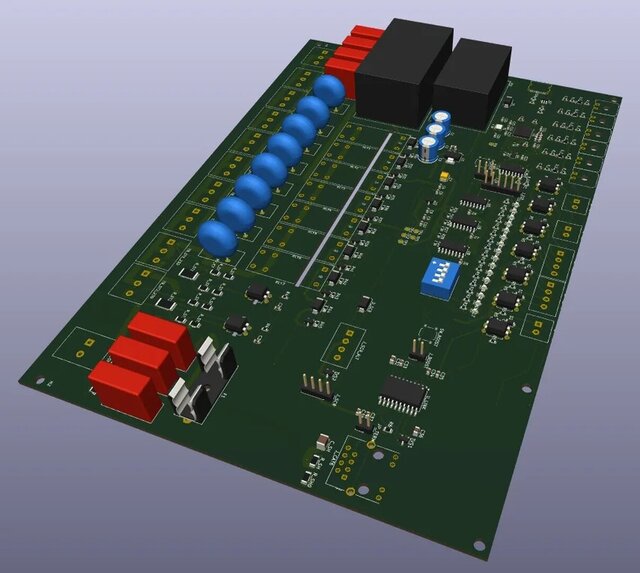
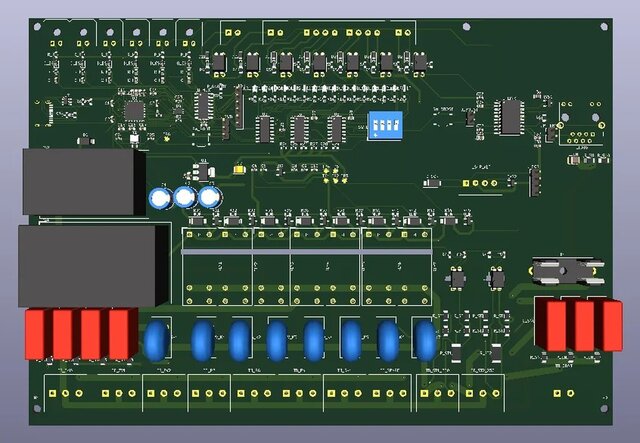
GIM-I is the indoor board of the same two-board heat-pump interface. It is a 220 x 153 mm board with mains terminals along the bottom edge and low-voltage connections along the top, so the two kinds of wiring never cross. It switches mains loads through seven relays, each with its own varistor, and is built on 2 oz copper with the widest tracks reserved for the heavy current paths. The controller is an RP2040, with USB-C for service, an isolated RS-485 link to a shielded RJ45 jack and a screen connector placed near the lid opening.
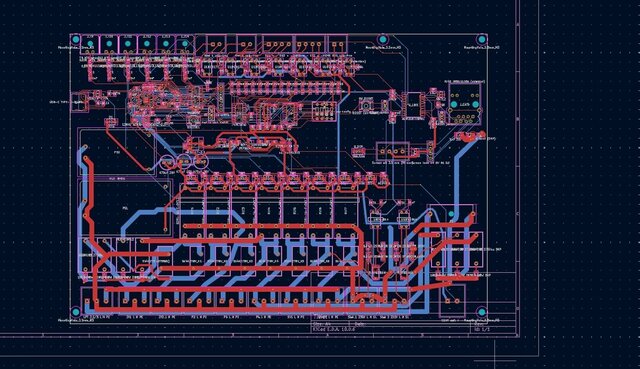
The challenge: carry a 13 A continuous path and relay loads on a 2-layer board while keeping creepage and clearance where specified, keeping mains away from the low-voltage logic, and still fitting two power supplies, a controller and all the connectors in the specified layout.
What the board does:
- Switches seven mains outputs: relays RY1 to RY7 switch the output channels. Each relay has a varistor across it and each output has its own L, N and PE terminal.
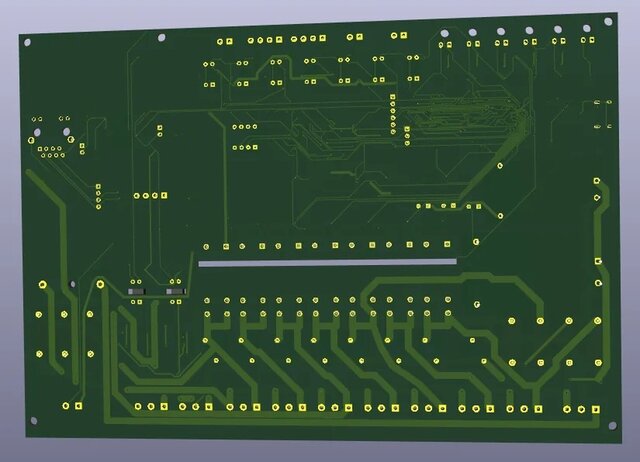
- Carries the current: heavy mains paths use wide tracks on 2 oz copper, with relay contact tracks wider again than the logic routing around them.
- Powers itself: two on-board AC-DC modules turn 230 V into the low-voltage rails, behind a fused and varistor-protected mains input.
- Controls and communicates: an RP2040 with a 12 MHz crystal and a BOOTSEL button runs the board. USB-C is the service port, and an ADM2587E isolated RS-485 transceiver feeds the shielded RJ45 jack so the bus stays separate from the mains side.
- Passes the screen through: a connector near the lid opening passes the display signals to the screen.
- Keeps mains and low voltage apart: isolation slots under isolating parts, no copper pour across the barrier, and mains terminals grouped on one edge.
Board data: 220 x 153 mm, 2 layers, 2 oz copper, 276 components, 825 pads, 341 vias, 7 relay outputs. Routed in KiCad with the design rule check reporting zero violations. Prepared for JLCPCB manufacturing and assembly.
This is PCB engineering work, not formal safety certification. Boards that carry mains need an independent review by a qualified person before they are powered.