

Empty Carton box Detection & Rejection System

Background
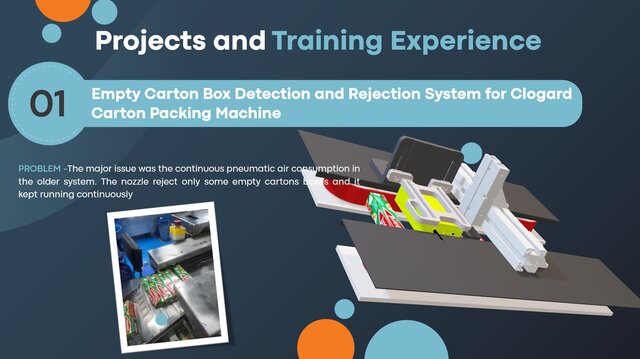
In the Clogard toothpaste carton packing machine at Wimco, empty cartons were previously removed using a pneumatic nozzle that operated continuously. Since the nozzle worked 24 hours a day, it consumed a high amount of compressed air, leading to unnecessary cost and energy waste. To improve efficiency and reduce operating cost, I was assigned to design and implement a new detection and rejection system.
Problem / Issue Identified
The major issue was the continuous pneumatic air consumption in the older system. The nozzle did not discriminate between filled and empty cartons—it kept running continuously, increasing energy usage and maintenance costs.Additionally, there was no intelligent logic to detect and reject empty cartons in synchronization with the packaging process.
Solution / Implementation
To solve this problem, I developed an empty carton detection and rejection system using sensors, PLC logic, and a pneumatic actuator:
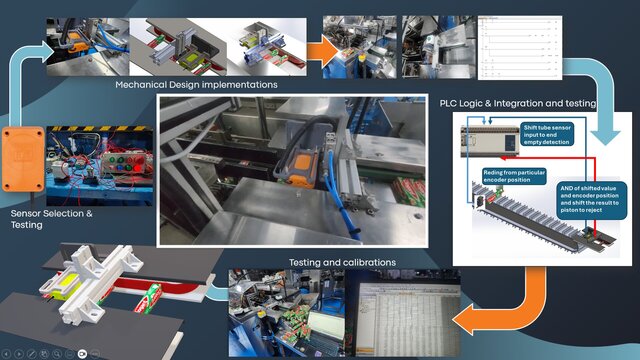
Sensor Selection & Testing
I used a KD5022 capacitive sensor to detect the presence of toothpaste tubes inside the carton.
Initially, I tested the sensor with a simple relay logic circuit. However, this method was not reliable and lacked flexibility.
Mechanical Design
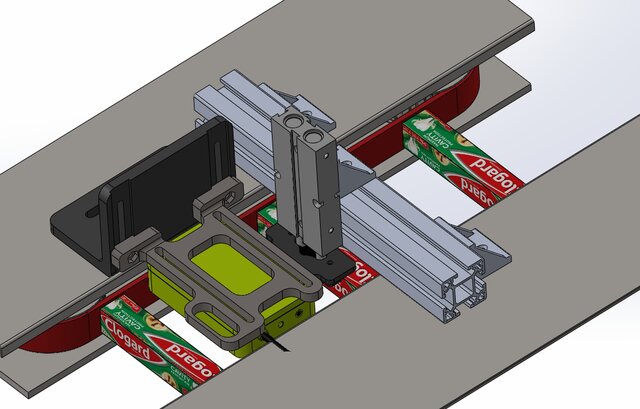
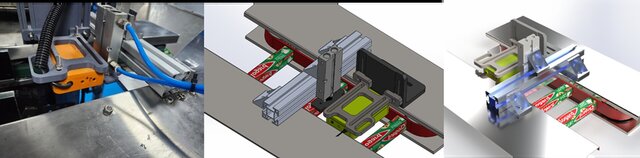
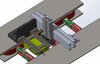
o I designed the rejection mechanism in SolidWorks.
o The mechanism was later fabricated using YA-VA pneumatic parts and integrated into the machine.
Calibration & Testing
o I carefully calibrated the sensor sensitivity and encoder positions to achieve high accuracy.
o Multiple trial runs were conducted to synchronize the rejection system with the conveyor operation
Hardware Tools Used
KD5022 Capacitive Sensor
Mitsubishi FX1N-60MT PLC
Encoder for position tracking
Pneumatic piston (YA-VA parts)
LED indicators for testing
Software Tools Used
GX Developer (for Mitsubishi PLC programming)
SolidWorks (for 3D design of rejection system).
Conclusion / Outcome
The newly developed system successfully detected and rejected empty cartons only when required, instead of running continuously like the old pneumatic nozzle. This solution:
Reduced compressed air consumption, lowering operating costs.
Increased reliability and synchronization with the packing process.
Enhanced my knowledge in PLC programming, shift register logic, encoder integration, and mechanical design.
This project gave me hands-on experience in combining sensors, PLCs, and pneumatics to create an optimized industrial automation solution