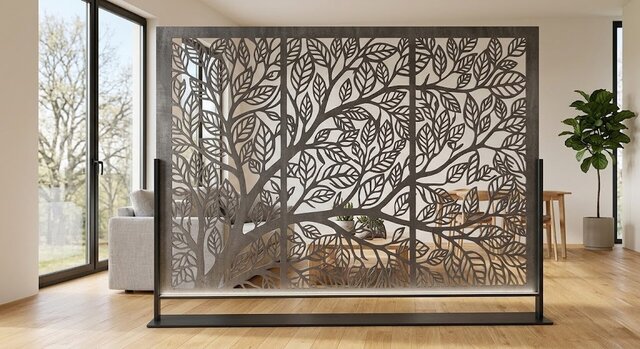

Design & Vector Pattern Development

1. Design & Vector Pattern Development:Graphic Conception: An organic, bio-inspired deciduous leaf and vein pattern was created as a continuous vector network (DXF/DWG format).Structural Bridge Integrity: To ensure the panel maintains rigidity and does not deform or sag across its height, minimum bridge widths of 6–8 mm were preserved between adjacent cutouts. Isolated "floating" islands were avoided by tying all inner leaf segments into the continuous steel web.2. Material Selection & Geometry:Material: 5.0 mm thick structural steel plate (S235JR / AISI 1018 standard cold-rolled sheet).Thickness Rationale: A 5 mm nominal gauge provides self-supporting structural stiffness, eliminating oil-canning (sheet buckling) while remaining suitable for precise thermal/optical cutting.3. CNC Laser Cutting (CAM & Machining):Cutting Technology: High-power fiber laser (4 kW – 6 kW) utilizing high-pressure nitrogen ($N_2$) assist gas to prevent oxidation, scale formation, and dross along the cut edges.Lead-in / Piercing Strategy: Low-frequency pulse piercing with tailored ramping to prevent thermal distortion in fine leaf contours. Corner loops and smooth tangential lead-ins applied to all internal closed contours.4. Surface Finishing & Edge Treatment:Deburring & Edge Radiusing: Automated vibratory or wide-belt de-slagging and edge rounding to remove micro-burrs and prepare the edges for coating adhesion.Finishing Options: Fine directional brushing followed by clear matte protective powder coating (to preserve the raw industrial metallic sheen) or electrostatic architectural polyester powder coating (Qualicoat Class 2) for corrosion resistance.5. Mounting & Integration:Framing / Boundary Perimeter: An unperforated 40 mm outer border around the sheet perimeter incorporates countersunk mounting slots for flush fastening into ceiling tracks and weighted floor brackets or an architectural tubular frame.
Published
in
CAD Design