

Automatic Lid Mechanism - 4 Bar Linkage

A four-bar linkage mechanism that opens a trash can hands-free and seals in odor when closed
Overview
Trash cans sitting in a kitchen cabinet or corner are a constant source of odor, but a lid you have to touch is a lid people leave open. I designed a motorized cover that stays closed when the can isn’t in use and opens automatically when someone approaches. It has been working reliably in my parents’ house.
How It Works
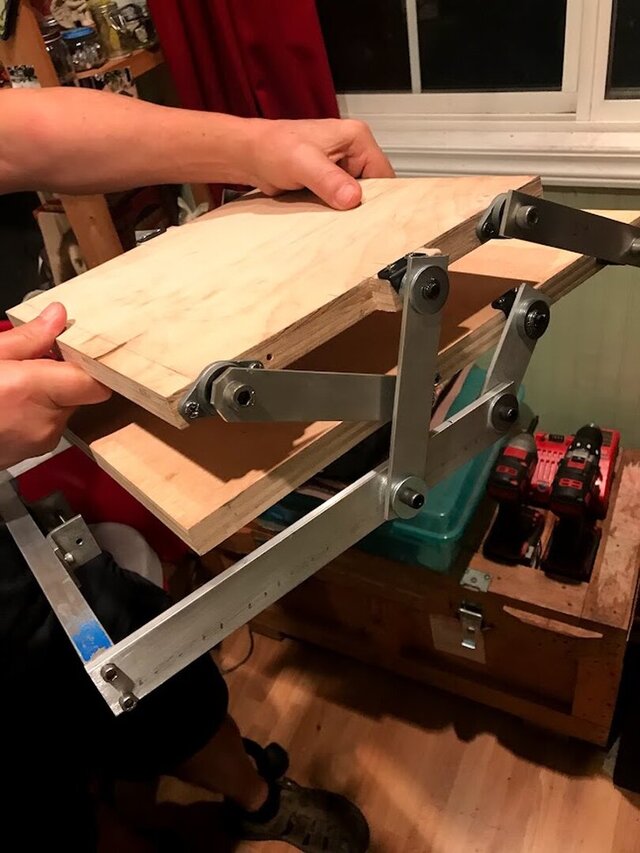
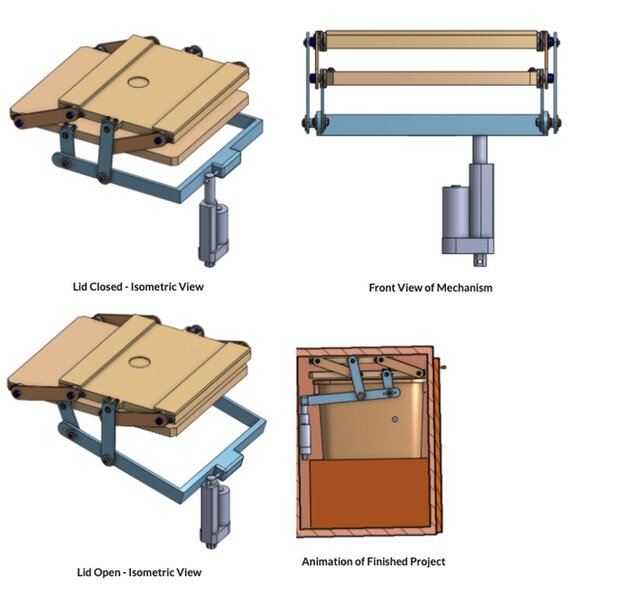
The mechanism is a four-bar linkage driven by a linear actuator. As the actuator extends and retracts, the linkage swings the lid plates between a closed position over the can and an open position that clears the way for the trash. A linkage suits this job because one actuator can produce a controlled, repeatable motion path without a complicated drive system.
An Arduino logic board and two sensors control the actuator, handling when the lid opens and when it closes again.
Design
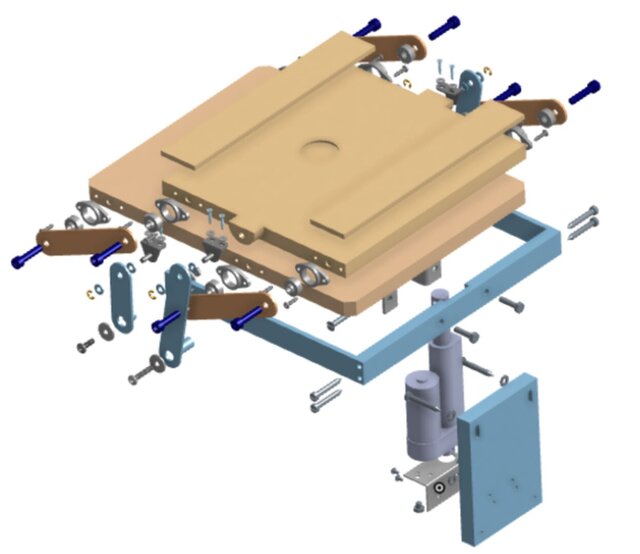
I modeled the full assembly in Onshape. The design includes:
2 lid plates
A fork-shaped piece connecting the plates to the linkage
8 linkage bars
The linear actuator and its mounting bracket
Flanged bearings at the pivot points
Screws, washers, and retaining hardware throughout
I also produced an exploded view of the assembly to plan the build and show how the pieces fit together. The mechanism had to fit within the cabinet alongside the can, so the packaging constraints shaped the linkage geometry as much as the motion did.
Results
The finished mechanism is installed and working, and it has been in regular household use. The project covers a complete build: mechanical design, actuator selection, electronics and control, assembly, and installation in a real environment where it has to work every day.
What This Project Demonstrates
Mechanism design: linkage kinematics, pivot and bearing selection, and packaging inside a tight space
Mechatronics: integrating an actuator, sensors, and a microcontroller into a mechanical system
CAD: a multi-part parametric assembly with exploded views for fabrication
Finishing the job: a prototype that survived real daily use, not just a model on a screen
Published